Global Security, Conflicts and Defence Explained
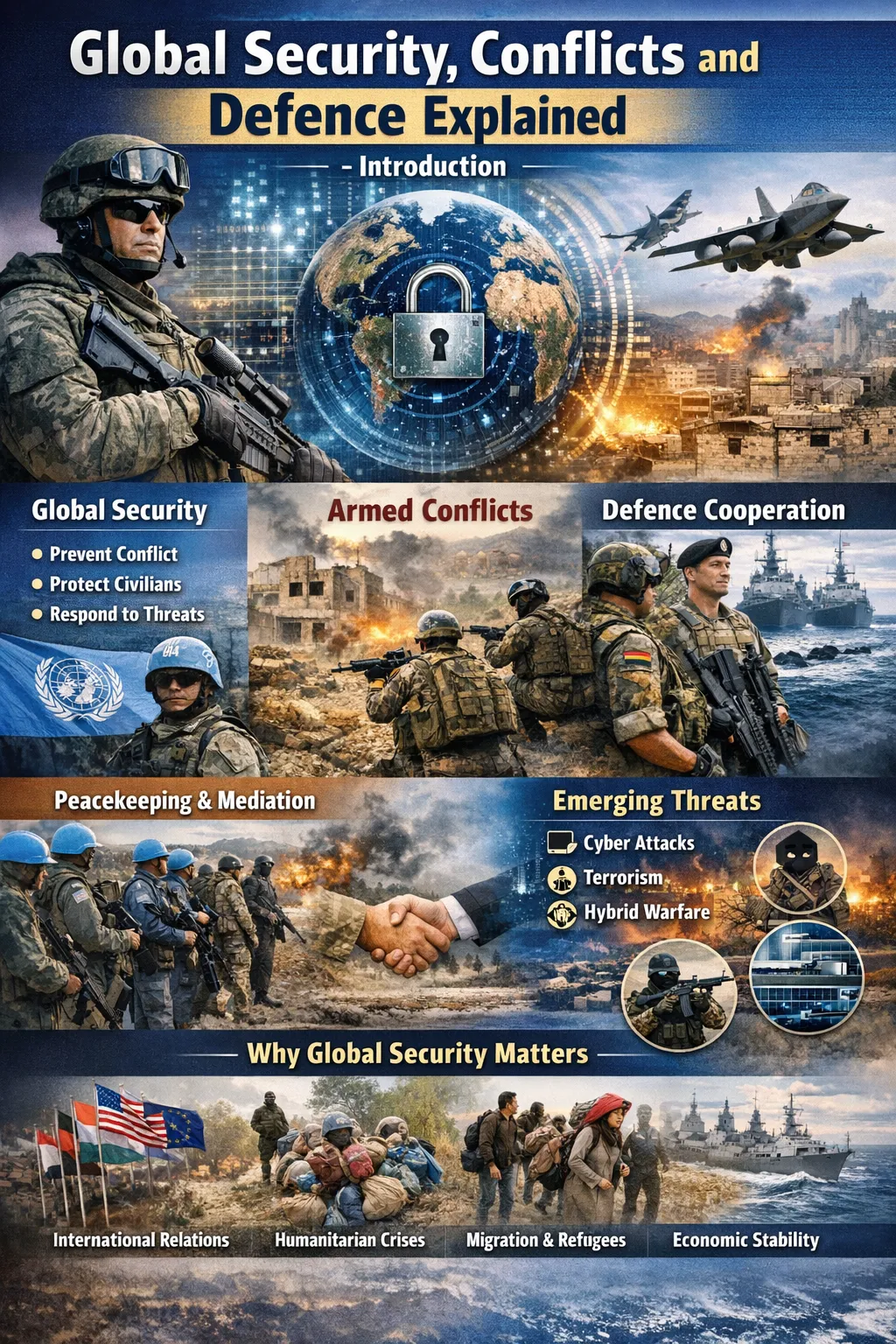
Global security encompasses the threats, conflicts, alliances and defence arrangements that determine whether nations and their citizens are safe from military attack, terrorism, cyberwarfare and other forms of organised violence. The security landscape has changed dramatically in recent years, with the return of large-scale conventional warfare in Europe, the persistence of terrorism and insurgency, the growth of cyber and hybrid threats and the emergence of new domains of competition including space and artificial intelligence.
This guide explains the major global security challenges, how international defence and security cooperation works, the UK’s defence posture and why global security matters for people in the United Kingdom.
What are the major global security threats?
The most significant security challenges facing the international community include the war in Ukraine, which has fundamentally reshaped European security and prompted the largest increase in NATO defence spending since the Cold War; the strategic competition between the United States and China, which affects security dynamics in the Indo-Pacific and the global balance of power; the continuing threat of international terrorism from groups including Islamic State and al-Qaeda, as well as growing far-right extremism; instability and conflict in the Middle East; and the risks of nuclear proliferation, particularly in relation to North Korea and Iran.
Cyber threats have become a major dimension of global security. State-sponsored cyber operations, ransomware attacks on critical infrastructure and information warfare all represent significant and growing risks. The UK’s cybersecurity apparatus and its intelligence partnerships are central to addressing these threats. Climate change is also increasingly recognised as a security multiplier, with rising temperatures, water scarcity and extreme weather expected to exacerbate conflict and drive migration.
How does the UK approach defence and security?
The UK’s approach to national security is set out in the Integrated Review of Security, Defence, Development and Foreign Policy. Key priorities include defence of the homeland, nuclear deterrence through the Trident submarine system, commitment to NATO collective defence and the projection of military power globally. The UK Armed Forces have approximately 140,000-150,000 regular personnel, with a defence budget of approximately £55-60 billion per year set to increase to 2.5 per cent of GDP.
The UK possesses globally significant military capabilities including aircraft carriers, nuclear-powered submarines, fifth-generation combat aircraft (F-35), advanced intelligence systems and a global network of military bases. The intelligence agencies — MI5, MI6 and GCHQ — play central roles in counter-terrorism, counter-espionage and cyber defence. The National Cyber Force conducts offensive cyber operations, and the UK participates in the Five Eyes intelligence alliance with the US, Canada, Australia and New Zealand.
What is the role of arms control and non-proliferation?
Arms control regimes are essential components of global security. The Treaty on the Non-Proliferation of Nuclear Weapons (NPT) is the cornerstone of efforts to prevent nuclear weapons spread. The UK is one of five recognised nuclear weapon states and maintains a minimum credible nuclear deterrent while supporting multilateral disarmament. Other key instruments include the Chemical Weapons Convention, the Biological Weapons Convention, the Arms Trade Treaty and agreements on conventional forces. The erosion of some frameworks — including the collapse of the INF Treaty — has raised concerns about a new arms race.
How do international peacekeeping and humanitarian interventions work?
The United Nations authorises peacekeeping operations to maintain or restore peace in conflict-affected areas. There are currently over a dozen UN peacekeeping missions deployed worldwide, with approximately 90,000 personnel including soldiers, police officers and civilian staff. The UK is a significant financial contributor to UN peacekeeping and provides specialist military and police capabilities. NATO also conducts operations beyond its member states’ borders, including in Afghanistan (until 2021), Kosovo and through maritime security missions.
Humanitarian intervention — the use of military force to protect civilian populations from mass atrocities — is one of the most contested areas of international security. The principle of the Responsibility to Protect (R2P), adopted by the UN General Assembly in 2005, asserts that the international community has a responsibility to act when a state fails to protect its own population from genocide, war crimes, ethnic cleansing and crimes against humanity. However, the application of R2P has been inconsistent, and disagreements among Security Council members about when and how to intervene remain a fundamental challenge for the international order.
How is terrorism addressed globally?
International terrorism remains a significant security threat, despite the territorial defeat of Islamic State’s self-declared caliphate in Iraq and Syria. IS and al-Qaeda continue to operate through affiliated networks in Africa, the Middle East, South and Southeast Asia, inspiring and directing attacks worldwide. The UK’s counter-terrorism strategy, known as CONTEST, has four strands: Pursue (stopping terrorist attacks), Prevent (stopping people from becoming terrorists or supporting terrorism), Protect (strengthening protection against terrorist attacks) and Prepare (mitigating the impact of attacks that cannot be stopped).
International cooperation on counter-terrorism involves intelligence sharing through the Five Eyes alliance and bilateral partnerships, joint operations to disrupt terrorist networks, efforts to counter terrorist financing through the Financial Action Task Force (FATF), and programmes to address the root causes of radicalisation. The UK participates actively in the Global Coalition against Daesh, contributes to international capacity-building programmes and provides training and equipment to partner nations’ security forces. The evolving threat from far-right extremism and the challenge of lone-actor attacks inspired by online radicalisation have broadened the scope of counter-terrorism efforts beyond Islamist terrorism.
What are the emerging security challenges?
Several emerging issues are reshaping the global security landscape. The militarisation of space — with major powers developing anti-satellite weapons, space-based surveillance systems and the capability to disrupt adversaries’ space assets — has created a new domain of strategic competition. The UK Space Command, established in 2021, coordinates the UK’s military space activities, and the government has identified space as a critical national infrastructure that must be protected.
The use of artificial intelligence in military applications — including autonomous weapons systems, AI-powered surveillance, predictive analytics and decision support — raises profound ethical, legal and strategic questions. The UK has stated that it will always maintain meaningful human control over the use of weapons, but international consensus on the regulation of lethal autonomous weapons systems has proven difficult to achieve through the Convention on Certain Conventional Weapons.
Hybrid warfare — the use of a combination of conventional military force, irregular tactics, cyber operations, information warfare, economic coercion and political subversion — has become a defining feature of modern conflict. Russia’s approach to Ukraine, including the annexation of Crimea in 2014, the use of proxies in the Donbas and the full-scale invasion of 2022, exemplifies this blended approach. NATO and its members have invested significantly in developing capabilities to detect, deter and respond to hybrid threats, but the ambiguity inherent in hybrid warfare makes attribution, escalation management and proportionate response particularly challenging.
How does the war in Ukraine affect global security?
Russia’s full-scale invasion of Ukraine in February 2022 was the most significant challenge to European security since the Second World War and has had profound consequences for the global security order. The war has caused devastating humanitarian consequences — tens of thousands of civilian casualties, millions of refugees, widespread destruction of infrastructure and the disruption of global food and energy markets. The conflict has demonstrated both the resilience of Ukrainian resistance and the willingness of Western nations, led by the United States and European allies including the UK, to provide sustained military, financial and humanitarian support.
The UK has been one of the most active international supporters of Ukraine, providing billions of pounds in military equipment (including Storm Shadow cruise missiles, main battle tanks, armoured vehicles and air defence systems), training for Ukrainian forces through Operation Interflex, humanitarian assistance and strong diplomatic support. The UK was among the first countries to impose comprehensive sanctions on Russia and has played a leading role in coordinating the international response through the G7, NATO and bilateral channels.
The war has accelerated NATO’s transformation, prompting Finland and Sweden to join the alliance, driving a dramatic increase in European defence spending and forcing a fundamental reassessment of European security architecture. It has also highlighted the interconnection between military security and economic security, as the weaponisation of energy supplies, the disruption of grain exports and the use of financial sanctions have all demonstrated the economic dimensions of modern conflict.
How does the Middle East affect global security?
The Middle East remains one of the most complex and volatile regions for global security. The Israeli-Palestinian conflict — the world’s longest-running territorial and political dispute — has entered a particularly devastating phase, with the conflict in Gaza following the October 2023 Hamas attacks causing massive civilian casualties, a humanitarian crisis and widespread international concern. The UK government has called for a ceasefire, the release of hostages and a path towards a two-state solution, while facing domestic political pressure from multiple directions.
Iran’s nuclear programme, its support for proxy forces across the region (including Hezbollah in Lebanon, the Houthis in Yemen and militia groups in Iraq and Syria) and its adversarial relationship with Israel and the Gulf states create a persistent risk of regional escalation. The Abraham Accords, which normalised relations between Israel and several Arab states, represented a significant diplomatic achievement but have been complicated by the Gaza conflict. The UK maintains diplomatic engagement across the region and contributes to maritime security operations in the Gulf and the Red Sea, where Houthi attacks on commercial shipping have disrupted one of the world’s most important trade routes.
How does climate change affect international security?
Climate change is increasingly recognised as a threat multiplier that exacerbates existing security risks and creates new sources of instability. Rising temperatures, changing rainfall patterns, more frequent and severe extreme weather events, rising sea levels and competition for diminishing natural resources can contribute to conflict, displacement, state fragility and humanitarian crises. The Sahel region of Africa, the Horn of Africa, South and Southeast Asia and small island developing states are among the most vulnerable to the security impacts of climate change.
The UK Ministry of Defence has identified climate change as a significant factor in defence planning, affecting military operations (through extreme heat, flooding and changing terrain), defence infrastructure (through sea level rise and storm damage to bases), supply chains and the demands placed on armed forces for humanitarian assistance and disaster relief. NATO has adopted a Climate Change and Security Action Plan, and the UN Security Council has debated climate and security on multiple occasions, though efforts to adopt a resolution linking climate change to international peace and security have been vetoed by Russia.
How does the UK address the security implications of migration?
Migration and border security have become increasingly significant dimensions of national and international security. The UK faces challenges from irregular migration (including small boat crossings of the English Channel), people smuggling and trafficking networks, and the broader geopolitical dynamics that drive displacement — including conflict, persecution, climate change, economic instability and governance failure. The National Crime Agency leads operational efforts against organised immigration crime, working with international partners including Europol, Interpol and the border agencies of France and other countries.
The UK’s approach to migration security involves border enforcement (through Border Force and immigration enforcement teams), international cooperation to disrupt smuggling networks, diplomatic engagement to address the root causes of displacement, and development assistance in regions of origin and transit. The government has pursued agreements with countries including France (the Calais Group framework for Channel security), Albania (returns agreement) and Rwanda (the now-discontinued plan for offshore asylum processing). Migration policy sits at the intersection of security, human rights, international law and domestic politics, making it one of the most contested areas of UK foreign and domestic policy.
Why does global security matter?
Global security directly affects the safety, prosperity and freedom of people in the United Kingdom. Conflicts abroad can drive migration, disrupt trade and energy supplies, create terrorist threats and require military intervention. The strength of international alliances, the effectiveness of deterrence and diplomacy, and the ability of international organisations to maintain peace all contribute to a stable environment in which the UK and its citizens can thrive.
Related guides
- Global Politics and Diplomacy Explained
- International Organisations and Global Governance Explained
- Global Economy and International Trade Explained
- Cybersecurity and Digital Security in the UK Explained
- How the UK Government Works
Related coverage:
Read our latest world news
Prepared by: