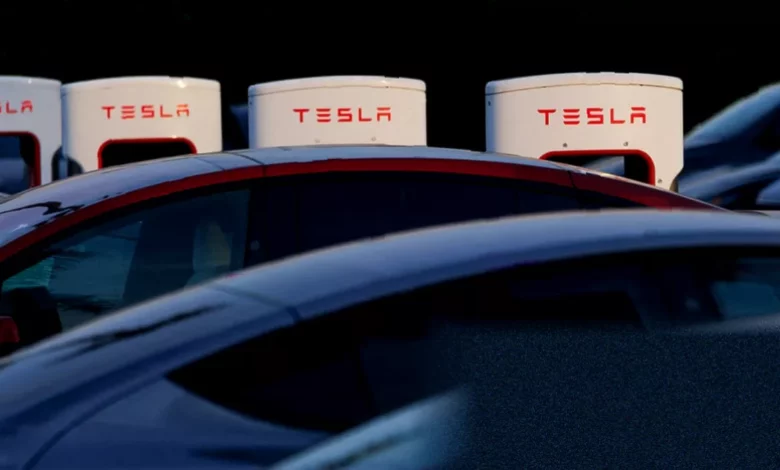
Tesla shattered Wall Street expectations for second-quarter deliveries on Thursday, posting a record 480,126 vehicles handed over to customers in the April-to-June period. The figure — a jump of roughly 25 per cent compared with the same quarter last year — comfortably exceeded the average analyst estimate of 402,776 vehicles compiled by Visible Alpha, and marks a decisive recovery after two consecutive years of annual sales declines.
The company produced 451,758 vehicles during the quarter, meaning deliveries outstripped production by more than 28,000 units. That allowed Tesla to draw down the inventory it had built up during the first three months of the year, a sign that demand is finally catching up with output. The result is the second straight quarter of year-over-year growth in deliveries, effectively ending a prolonged slump that had weighed on the core automotive business.
That rebound is critical for Tesla’s broader ambitions. The company’s roughly $1.6 trillion valuation rests heavily on its bets in autonomous driving and artificial intelligence, and the stronger delivery figures provide the spending cushion needed to fund those expensive projects.
European demand recovery drives strong performance
The standout factor behind the record quarter was a sharp recovery in European demand. Tesla benefited from a combination of government electric-vehicle incentives, an accelerating shift to electric corporate fleets, higher fuel prices and — according to the company — an easing of the consumer backlash over chief executive Elon Musk’s far-right political interventions last year. The rebound in Europe more than compensated for persistent weakness in North America and provided the bulk of the growth in deliveries.
North America remained subdued, although there are signs of stabilisation. The expiration of the federal EV tax credit weighed on sales, and Tesla sold 164,264 vehicles in the United States during the quarter — a 6.3 per cent drop year-over-year. Still, that decline was less severe than the broader downturn in the US EV market, according to Seth Goldstein, senior equity analyst at Morningstar. “I think the huge growth in Europe is the key driver for Tesla right now. US sales still appear to be down, albeit less than the broader US EV decline, while China is seeing small growth,” Goldstein said.
China, Tesla’s second-largest market, delivered modest gains, helped by production of the refreshed Model Y. Intense competition from domestic rivals such as BYD limited the upside, but the company’s locally made vehicles still recorded a year-over-year increase in sales. In the US, Tesla’s share of the EV market fell below 50 per cent for the first time in the second quarter, dropping to 49.7 per cent, even as overall US electric-vehicle sales reached a new high. Smaller rival Rivian also reported strong results, beating estimates for second-quarter deliveries and raising its full-year forecast. Rivian produced 9,612 vehicles and delivered 13,790 in the period.
The strength in Europe was not entirely smooth. Research suggests Musk’s political activity has had a measurable negative effect on Tesla’s sales since mid-2022, particularly in Democratic-leaning areas of the United States, and protests at showrooms have continued both in the US and Europe. But the delivery numbers indicate that the drag may be fading in key European markets.
AI and autonomous driving investments take centre stage
With the auto business showing renewed momentum, Tesla is pressing ahead with a dramatic increase in capital spending. The company expects to invest more than $25 billion in 2026, nearly three times the $8.5 billion it spent last year. The money will be directed towards expanding AI infrastructure, battery production, manufacturing of the purpose-built Cybercab autonomous vehicle, and the Optimus humanoid robot.
Already, Tesla’s AI training centre in Texas has absorbed over $10 billion in investment, and the company is exploring a “Megapod” initiative that would use its Supercharger network for distributed AI computing. Optimus is slated for limited production in 2025, with plans to deploy more than 1,000 units inside Tesla’s own facilities before making external sales in 2026. To accommodate that, the company is repurposing its Fremont factory for Optimus production in the second quarter of next year.
On the autonomous driving front, Tesla has continued to roll out its “full self-driving” (FSD) advanced driver assistance software in Europe. Approvals have been secured in Denmark, Germany, Sweden, the Netherlands, Lithuania, Estonia and Belgium, though the software is so far available only in a handful of countries. The company has shifted to a subscription-only model for European customers, charging €99 a month. Analysts expect broader availability over the coming months, which could further support demand.
Tesla’s robotaxi operations are also expanding. A limited commercial service launched in Austin, Texas, in June, initially using Model Y vehicles, with the Cybercab — a purpose-built autonomous vehicle that has no pedals or steering wheel — expected to be integrated later. Engineering tests of a steering-wheel-free Cybercab have already begun on public roads in Austin, and production is expected to ramp up later this year. Musk has said the company intends to rapidly expand the robotaxi service through 2026.
Tesla is scheduled to release its full second-quarter financial results after the market close on Tuesday, 23 July. Analysts expect earnings per share of around $0.61 to $0.62, down from $0.91 a year earlier but up from the first quarter, with revenue forecast in the range of $20.16 billion to $25.13 billion. The delivery figures have already prompted some analysts, including Dan Ives of Wedbush, to raise their 12-month price target for the stock to $300.