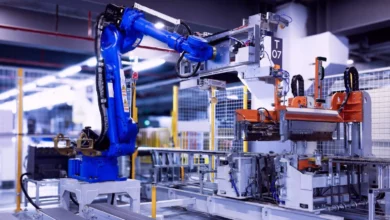
Standard Bots becomes $1bn firm after $200m raise co-led by General Catalyst for AI robots in American factories

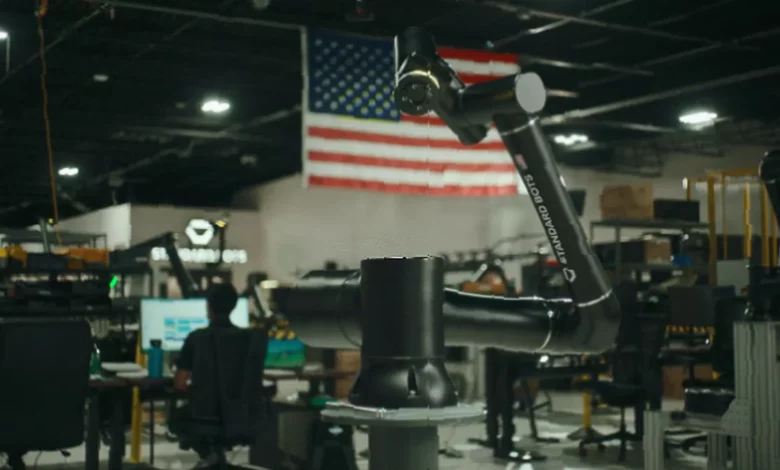
Standard Bots has secured $200 million in a Series C funding round co-led by General Catalyst and RoboStrategy, valuing the New York-based robotics manufacturer at $1 billion as American industry races to close the automation gap with China.
The investment brings the company’s total fundraising to $291 million, following a $63 million Series B round in July 2024 and a $24 million Series A round earlier that year. The fresh capital is earmarked for expanding Standard Bots’ manufacturing facility in Glen Cove, New York, from 16,000 to 70,000 square feet, with the aim of scaling domestic production of AI-native industrial robots.
The urgency behind this growth is underscored by China’s accelerating lead in automation. Industry data cited in a research briefing on the company notes that China installed 295,000 industrial robots in 2024 — nine times more than the United States and more than the rest of the world combined. The US industrial robotics market, valued at $2.17 billion in 2023, is projected to reach $3.21 billion by 2030, but American manufacturers are struggling to keep pace without widespread automation.
Learning by demonstration, not code
Founded in 2011 by Evan Beard and David Golden, Standard Bots was built around a straightforward observation: most industrial robots remain too difficult, expensive and specialised for the average manufacturer. Traditional systems demand skilled programmers, lengthy deployment cycles and significant integration costs, putting them out of reach for many small and medium-sized businesses.
The company’s solution is fundamentally different. Its AI-native robot arms learn through demonstration, not code. An operator physically guides the arm through a task; the company’s Flux AI Skill, built on the NVIDIA Isaac platform, records the routine and enables the robot to replicate it autonomously. No programming is required.
Evan Beard, chief executive and co-founder, describes AI-native robots as “the essential power tool of the 21st century”. He argues that artificial intelligence will allow industrial robots to perform dramatically more tasks independently, and that real-world deployments are critical for gathering the data to improve them. Mr Beard, who holds degrees in computer science and economics from Duke University and previously co-founded A Plus and Gridtech, has been a driving force behind the company’s technological direction. His co-founder, David Golden, previously co-founded Bowery Farming and LeapPay.
Standard Bots claims this approach, combined with a vertically integrated design and manufacturing process, results in costs roughly 30 per cent lower than many legacy providers. The robots are deployed across a range of applications including machining, welding, palletising, grinding, fastening, assembly and inspection. The company designs its own actuators and assembles its products in-house, aiming to manufacture nearly every component domestically by 2027 under what it describes as a “from metal in to robots out” supply chain.
Customers include some of the largest names in American industry: Amazon, Lockheed Martin, NASA, the US Army and Sunoco, alongside hundreds of small and medium-sized manufacturers. The technology even made an appearance in popular culture, featuring in the 2024 A24 film Babygirl.
Competing in a capital-intensive arena
Standard Bots enters a market awash with investor money. Figure AI raised over $1 billion at a $39 billion valuation in 2025, developing humanoid robots for industrial environments. Physical Intelligence secured $400 million at a $2.4 billion valuation to build foundation models for generalised physical intelligence. Covariant, which built AI systems for warehouse manipulation, was acquired by Amazon.
What sets Standard Bots apart is its focus on practical, immediate deployment. Rather than future humanoid prototypes or foundation model research, the company is focused on getting industrial arms onto factory floors today at a price point accessible to smaller manufacturers. Its robots are already in production; many of its well-funded competitors are still scaling toward deployment. RoboStrategy, the publicly traded closed-end fund that co-led this round and whose portfolio includes Figure AI, Apptronik and Dexmate, has evidently placed a significant bet on this pragmatic approach. General Catalyst, the other lead investor, backs the company under its “Global Resilience” thesis, which focuses on modernising critical industrial sectors.
Standard Bots has set a target of delivering 10 per cent of all new US industrial robot deployments within the next year. The company also unveiled a new 30kg payload, 2-metre reach robot at The Automate Show in May 2025 and acquired READY Robotics in November 2024. Mr Beard has become one of the most visible advocates for rebuilding American robotics capability, advising the White House and testifying before the Congressional Joint Economic Committee on frontier technologies and industrial efficiency. He has warned that Chinese manufacturers are selling robots below cost in unfair competition that threatens domestic industry, and has called for a national robotics strategy to counter this.
The harder question is whether a company of around 122 people can scale to that target at a moment when China is installing robots faster than any country in history, and when the domestic suppliers it competes against are backed by decades of manufacturing infrastructure that Standard Bots is still building.