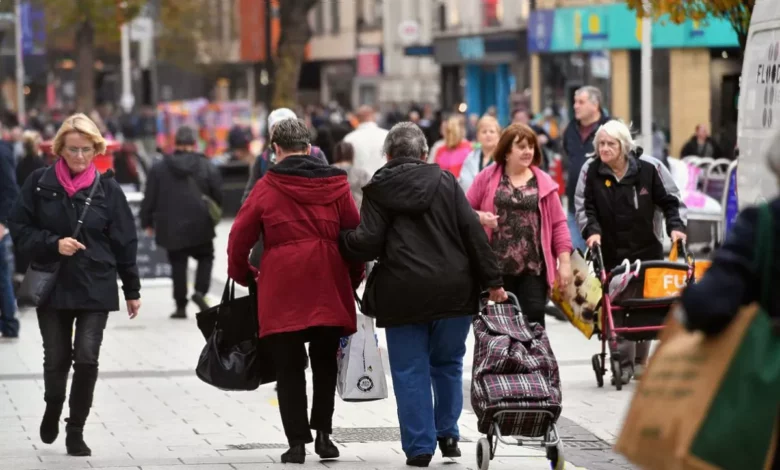
Welsh retail footfall plummeted 13.8% in April compared with the same month last year, marking the worst performance in more than five years, according to figures from the Welsh Retail Consortium. The sharp decline followed a modest year-on-year rise of 1.6% in March and underscores the depth of the challenges facing bricks-and-mortar stores across the nation.
The scale of the drop, however, must be viewed against the unusual timing of Easter, which fell in March this year rather than April. That shift drew a significant volume of shopping activity into March, leaving April with a much tougher year-on-year comparison. Andy Sumpter, retail consultant for Sensormatic Solutions, which conducted the research, noted that while the April figure is “deeply disappointing,” the calendar effect explains part of the severity. “Even when viewed across the two months, the picture remains challenging,” he said.
To smooth out the distortion, the Welsh Retail Consortium combined the March and April figures. That measure shows footfall across Wales fell 5.8% year on year — the weakest result of any of the UK’s devolved nations. Sara Jones, head of the Welsh Retail Consortium, said: “Even when seasonal distortions are smoothed out, the picture remains the same: a subdued and difficult start to the spring trading period.”
Nationally, total UK retail footfall fell 10.7% year on year in April. Wales recorded the second-steepest decline among the four nations, behind Northern Ireland, where footfall dropped 14.3%. England saw an 11.3% fall, while Scotland fared best with a decline of just 5.2%.
Within Wales, shopping centre footfall decreased by 12.1% year on year in April, and retail park footfall was down 12%. Cardiff’s footfall declined 11.1% — a result that places it among the worst-performing core UK cities. Of the 11 cities assessed, only Belfast (down 15.5%) and Liverpool (down 18%) recorded steeper drops. Edinburgh saw the shallowest fall at 3.8%.
Consumer caution and the cost-of-living squeeze
Behind the headline figures lies a clear shift in shopper behaviour driven by persistent financial pressure on households. Jones pointed to “a clear mood of caution among consumers, with fewer trips to retail destinations as households continue to feel the squeeze of higher living costs and weaker confidence.” Consumer confidence in the UK has fallen sharply, reaching minus 25 points in April — the lowest level since October 2023 — partly attributed to the ongoing conflict in the Middle East, which has fuelled fears of renewed inflation.
Nearly half of Welsh households — 40% — report that their financial situation has worsened over the past year, according to broader survey data. UK retail food prices remain roughly 38% higher than pre-Covid levels, and experts have warned that food inflation could exceed 8% by June 2026 if the Middle East conflict persists, potentially adding more than £150 to the average annual grocery bill. Energy price surges have also contributed to the strain.
Sumpter described shoppers becoming “more selective — making fewer trips, but with clearer intent when they do.” He added: “In a month where even a ‘good’ result would likely have remained negative, it’s difficult not to be disappointed.” Yet he noted that those who are still visiting stores often have a clear intention to spend, making each shopper more valuable to retailers.
Retailers call for action on business rates
The figures come in the wake of the Senedd election, which saw Plaid Cymru emerge as the largest party and Rhun ap Iorwerth become First Minister. Jones said attention now turns to “how quickly the new parliament can help turn things around for Wales’ struggling high streets.” At the heart of that challenge, she argued, is the business rates system, which she described as “increasingly out of step with reality.”
“The burden on bricks-and-mortar stores continues to act as a major brake on recovery,” Jones said. “Retailers need the ability to survive, invest, and evolve — not simply absorb rising overheads. Easing the business rates burden would unlock vital capacity for investment in staff, store experience, and local communities, helping to breathe life back into town centres and restore the pull of the Welsh high street.”
From April 2026, a new three-tier system for non-domestic rates multipliers has come into effect in Wales. A lower retail multiplier of 0.350 applies to shops with a rateable value below £51,000, a measure intended to rebalance the system in favour of small to medium-sized retailers and estimated to save eligible shops £20 million. However, an estimated 970 stores across Wales — mainly mid-sized and larger outlets — face higher bills under the new system. Transitional relief is available to phase in increases over two years for businesses affected by the revaluation. The Federation of Small Businesses has been advocating for targeted relief for retail, hospitality and leisure sectors as part of its election manifesto.
Regional pressures and limited bright spots
The challenges are not evenly distributed. Newport has been particularly affected, with high shop vacancy rates and recent closures at Friars Walk shopping centre, including the departure of River Island. The city council is responding by purchasing vacant units and offering business rates relief. In Monmouth, the high street has been severely impacted by flooding from Storm Claudia in November 2025, which forced several businesses to close — among them Wyedean Healthfoods, which announced permanent closure and relocation.
There are, however, isolated positive signs. Cwmbran, in neighbouring Torfaen, has bucked the trend, with the M Centre reporting a year-on-year rise in visitors. Some retailers are hoping that warmer weather and major sporting events such as the World Cup might help reverse the broader decline in the months ahead. But for the moment, as Sumpter put it: “After the country headed to the polls, retailers would do well to remember that shoppers will continue to vote with their feet — and winning their custom will depend on delivering value, relevance and good reasons to return.”