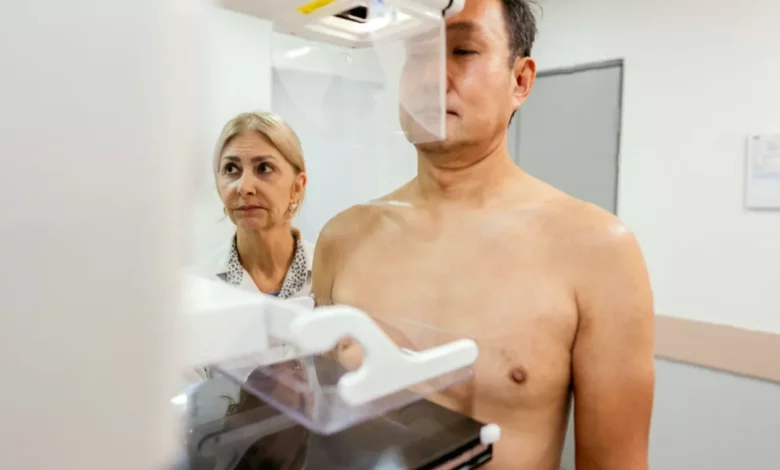
Men are at risk for breast cancer, though often unaware of the fact. Despite the overwhelming majority of cases occurring in women, the disease does not discriminate by gender — and medical professionals warn that a widespread misconception that it is a “women’s condition” is contributing to late diagnoses and poorer outcomes for men.
Tyler Mane speaks out to break the silence
The actor and former professional wrestler Tyler Mane, 59, best known for playing Sabretooth in the X-Men films, announced his diagnosis with a “super rare” form of breast cancer on Monday. In a video shared to his social media accounts, Mane revealed that his first instinct was to keep the news secret. “I mean it’s kind of embarrassing,” he wrote in the accompanying caption. He said his doctors had initially dismissed his symptoms, and it was his wife who encouraged him to get a lump checked. Mane stressed that the disease is “VERY treatable” if caught early and urged people to start talking about it openly, because men are more likely to be diagnosed at advanced stages precisely because “it’s not talked about and not looked for.”
Mane is far from alone. Each year, approximately 400 men are diagnosed with breast cancer in the UK, accounting for less than one percent of all new male cancer cases. Across the Atlantic, the American Cancer Society estimates that about 2,670 men will be diagnosed with invasive breast cancer — the most common type — in the United States in 2026, and approximately 530 men are expected to die from the condition. The average age at diagnosis for men is between 60 and 70, around five to ten years later than for women, though the disease can occur at any age. The average lifetime risk of a man developing breast cancer is about 1 in 755.
The stigma that delays diagnosis
The stigma surrounding male breast cancer has long been identified by researchers as a key driver of delayed diagnosis. Men often report feelings of shame, embarrassment, or emasculation due to the widespread perception of breast cancer as a disease that only affects women. This can make them reluctant to report symptoms or seek medical attention promptly. Some men who do visit their GP say their symptoms were initially dismissed. The result is that men are frequently diagnosed at later stages than women, leading to a higher mortality rate relative to the number of cases.
Health professionals and advocacy groups stress that anyone with breast tissue — regardless of gender — can develop breast cancer. The most common symptom in men is a painless lump in the chest, including up to the collarbone or armpit. Other symptoms can include liquid discharge from the nipple, which may be blood-stained; nipple changes such as tenderness or inversion; sores or a rash on the chest or nipple area; swelling in the chest or underarm lymph nodes; changes in breast size or shape; and reddening, hardening, or dimpling of the nipple or surrounding skin. A benign condition called gynaecomastia, in which men’s breast tissue enlarges, can sometimes be mistaken for cancer. There is no routine screening programme for male breast cancer, so men are urged to be “chest aware” — checking their breasts regularly for any changes, much as they would check their testicles.
The rarity of the disease and the lack of tailored information and support can lead to profound isolation for men diagnosed with breast cancer. In October 2023, the UK’s first dedicated male breast cancer organisation, Moobs, was launched to raise awareness, provide resources, and offer support groups designed to reduce that isolation. Other organisations — including Breast Cancer Now, Macmillan Cancer Support, Cancer Research UK, and the Male Breast Cancer Global Alliance — also provide specialist information, nurse helplines, and online communities. Breast Cancer Now’s “Someone Like Me” service connects men with other male survivors, and the charity runs a Men’s Virtual Meet-Up support group.
Statistics, risk factors, and the obesity link
In the UK, over 90 percent of male breast cancer cases are invasive breast cancer of no special type (NST), also known as invasive ductal carcinoma NST — the same most common type seen in women. While the overall incidence of male breast cancer has remained stable in most age groups over the past two decades, it has increased by around 38 percent in men aged 65 to 69. Around 85 men die from breast cancer in the UK each year, and it is not among the 20 most common causes of cancer death in men.
Doctors point to rising obesity rates as a significant factor behind the increase. In the United States, some 100 million people live with excess fat that puts them at risk for cancer and other chronic conditions. “There’s an annual increase of about 1 percent or less in male breast cancer cases,” Cristina Lopez-Penalver, a breast surgical oncologist at Baptist Health Miami Cancer Institute, said in a statement last year. “The obesity epidemic plays a significant role, as it leads to elevated estrogen levels, which stimulate breast epithelial proliferation and can facilitate malignant transformation — which is the mechanism of action behind breast cancer.” The process occurs because aromatase in adipose tissue converts testosterone into estrogen, raising hormone levels in the body.
Other risk factors for men include age, with risk increasing after 60; a family history of breast cancer — about 20 percent of men with the disease have a close relative who has had it; inherited gene mutations, particularly BRCA2, which also raises lifetime risk of prostate cancer; the rare genetic condition Klinefelter syndrome (XXY chromosomes), which accounts for around seven percent of male breast cancers; high estrogen levels resulting from liver damage such as cirrhosis; previous radiotherapy to the chest, especially at a young age; testicular issues including undescended testicles, adult mumps, or surgical removal; working in hot environments such as steel works, which can damage testicles; a diet high in processed food, high alcohol consumption, and low fruit and vegetable intake; and an association with male infertility, though the reasons are unclear. Use of prohibited drugs such as marijuana has also been linked to higher estrogen levels and increased breast cancer risk.
Treatment and the need for more inclusive research
Treating male breast cancer follows the same principles as treating cases in women. Men can undergo mastectomy — removal of the entire breast and nipple — which is the most common surgical approach, used 86 percent of the time according to a 2021 review. Because men have less breast tissue, breast-conserving surgery is less common. Lymph nodes in the armpit may also be removed. Other treatments include chemotherapy, radiotherapy, hormone therapy, and targeted medicines. Tamoxifen, taken daily for at least five years, is the most common hormone therapy for men with oestrogen-receptor-positive breast cancer; aromatase inhibitors are an alternative. Breast reconstruction is not usually offered to men due to the lack of implants designed to recreate the shape of male breasts.
Because of the rarity of male breast cancer, a great deal of the medical evidence and treatment guidelines are extrapolated from studies conducted on women. There is a growing recognition of the need for sex- and gender-inclusive research to address the specific clinical and psychosocial needs of men, rather than relying on data drawn solely from female patients. Scientists have discovered new genetic variants (SNPs) that increase risk in men, some with a greater effect than in women. Breast Cancer Now funds one of the largest studies into male breast cancer, aiming to identify risk factors, understand causes, and find better treatments. Advocates continue to push for more men to be included in clinical trials.
Several notable public figures have shared their experiences to help break the silence. Actor Richard Roundtree, best known for Shaft, was diagnosed in 1993 and became an advocate. KISS drummer Peter Criss was diagnosed in 2007 and has spoken out. Game show announcer Rod Roddy battled both colon and breast cancer and became a spokesperson for early screening. Senator Edward Brooke, the first African-American elected to the Senate, was diagnosed in 2002 and dedicated time to raising awareness. Others, including Doug Harper, David McCallion, and Harry Gray — whose story was reported in the Daily Mail after he initially attributed chest soreness to running shirts before being diagnosed with stage two breast cancer — have also shared their journeys to dispel misconceptions.