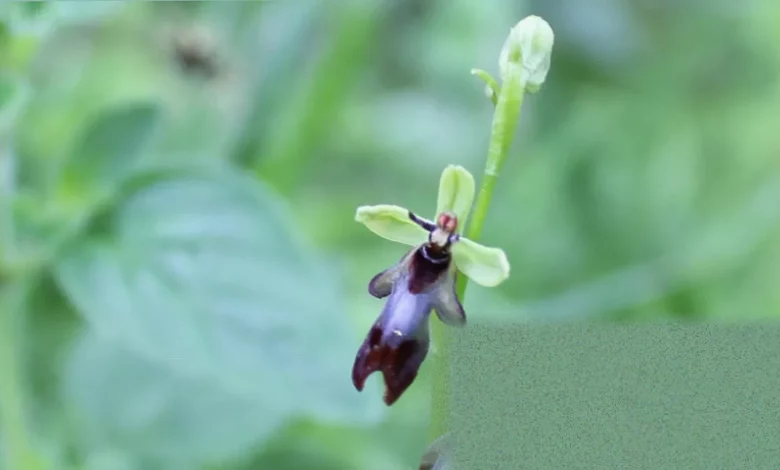
From the lady orchid to the frog, man and spider, British orchids have a long tradition of borrowing appearance from the animal kingdom and human forms. Among them, the fly orchid (Ophrys insectifera) is perhaps the most sophisticated illusionist, a plant whose resemblance to an insect is not merely a trick of human perception but a biological necessity.
A Master of Deception: Appearance and Scent
The fly orchid is a slender perennial that can reach 60 cm in height, bearing narrow, upright leaves and a flower spike of between one and ten blooms. Its sepals are yellow-green, while the tiny petals are reduced and dark brown or black, resembling insect antennae. The defining feature is the labellum — the lip of the flower — which is long, narrow and lobed, varying in colour from maroon to black. Two glossy depressions mimic insect eyes, and an iridescent blue or grey patch at the centre simulates the sheen of folded wings. Up close, the labellum’s edges are curved back in a subtle fold that gives the illusion of volume, an effect the writer of a recent account described as “uncannily insectile”.
This visual mimicry is matched by a chemical one: the orchid emits a scent that copies the sex pheromones of female digger wasps. The dual strategy of visual and olfactory deception is key to luring its specific pollinators. The genus name Ophrys derives from the Greek word for “eyebrow”, while the species name insectifera is Latin for “insect-bearing” — both names directly referencing its insect-like appearance. Rare forms exist, including a yellow-flowered variety (Ophrys insectifera var. luteomarginata) with a yellow-margined lip, and another (var. ochroleuca) with a greenish-yellow lip and white speculum. Hybrids with other Ophrys species have also been recorded, such as Ophrys × pietzschii (with the bee orchid) and Ophrys × hybrida (with the early spider orchid).
The Elusive Pollination: Wasp Seduction and Darwin’s Puzzle
While many Ophrys species rely on bees for pollination, the fly orchid is highly unusual in targeting wasps — specifically male digger wasps (Argogorytes mystaceus and Argogorytes fargeii in the UK). When a male wasp, lured by the visual and olfactory mimicry, attempts to copulate with the labellum — a behaviour known as pseudocopulation — the orchid’s pollen-bearing structures, called pollinia, become attached to the insect’s head or back. The wasp then carries the pollen to the next bloom it attempts to mate with, completing the fertilisation.
This elaborate mechanism, however, has an alarmingly low rate of success. The writer of a recent account noted having never seen a wasp approach the flowers, despite encountering more than 20 plants annually on the South Downs. The same puzzle troubled Charles Darwin, who spent years studying a population of fly orchids in Kent and never witnessed a single pollination event. “It is remarkable … that this Ophrys has not been rendered more attractive to insects,” he wrote. Darwin’s extensive research into orchid pollination, detailed in his book The Various Contrivances by Which Orchids Are Fertilised by Insects, helped shape our understanding of co-evolution and natural selection. It was not until the 1910s that the pseudocopulation mechanism was widely recognised by botanists.
The reliance on wasp pollinators rather than bees is thought to indicate that the fly orchid emerged early in the evolutionary history of the Ophrys genus, before bees took over the role of driving rapid diversification in the group. Recent genetic research has investigated diversity within the Ophrys insectifera group, suggesting recent diversification and potential speciation, though migration and admixture can make genetic differences ambiguous.
The digger wasps themselves depend on specific food sources: as larvae they feed on froghopper nymphs, while as adults they take nectar from Umbellifer flowers. The orchid, in turn, relies on a symbiotic relationship with mycorrhizal fungi in the Tulasnellaceae family for nutrient uptake, making it vulnerable to fungicides and other soil chemicals.
An Ethical Question
Philosophers and naturalists continue to debate the ethics of this sexual deception. Does the flower exploit its pollinator, duping a male wasp into a wasteful expenditure of sexual energy? Or does the wasp, in its brief pseudocopulation, derive some form of pleasure, ensuring a happy ending for both parties? The question remains unresolved.
Beyond the philosophical discussion, the fly orchid faces real-world pressures. Globally, the International Union for Conservation of Nature (IUCN) lists it as “least concern”, but in Great Britain its conservation status is “vulnerable” and “near-threatened”. It is a priority species in Suffolk’s Biodiversity Action Plan. The plant favours damp, alkaline, unimproved soils and is found in beech woodlands, forest edges, scrub, limestone pavement, chalk pits, wet meadows, cliffs and disused railways. It is light-loving but tolerates semi-shade, and in the UK flowers from mid-May to June (earlier in southern France). Its UK strongholds are in southern England, with scattered populations in northern England and North Wales, including the fenlands of Anglesey; it is absent from Scotland and Northern Ireland.
Threats include habitat destruction through drainage of fens, coniferisation of woodland, decline in coppicing, scrub encroachment, and the closing of woodland canopies. Drying of woodland soils also harms the orchid. Climate change poses an additional risk because of its specialised relationship with its digger wasp pollinators; studies project a northward shift in suitable habitat and a moderate range contraction, particularly at the southern and eastern edges of its distribution. All orchids in the UK are protected under the Wildlife and Countryside Act 1981, making it illegal to remove them from the wild. The fly orchid has thus become a symbol of conservation and environmental awareness — a subtle conjuror of alternate realities whose survival depends on the delicate interplay of appearance, scent, and the unwitting cooperation of its insect partners.