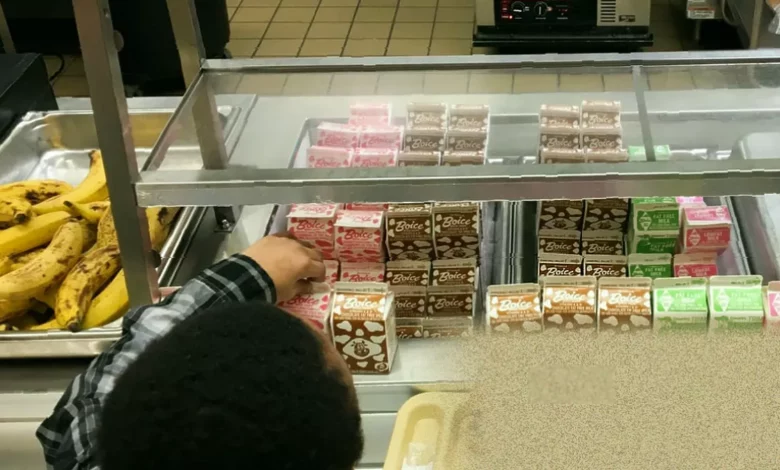
School cafeterias across the United States may soon be forced to drop bananas from their menus, as a proposed revision to the “Buy American” mandate in the Farm Bill threatens to eliminate one of the most popular and practical fruits in the lunch line. The US is the world’s largest importer of bananas, sourcing virtually all of its supply from tropical Central and South American countries such as Guatemala, Ecuador, Costa Rica, Colombia and Honduras. Because bananas cannot be grown commercially in the continental United States, they have long been a staple in school meals – a nutrient-dense food that even the pickiest young eaters will peel themselves. But the latest version of the Farm Bill, passed by the House of Representatives and now awaiting action in the Senate, could make that impossible.
“For little kids, they can peel a banana. They can eat a banana if they have braces. Football teams need bananas for the potassium,” said Donna Martin, a school nutrition consultant from Georgia and former head of the Burke County school nutrition programme. “But now, school districts are saying, ‘I can’t get you bananas because they’re not American.’” Jessica Shelley, director of student dining services for Cincinnati Public Schools, told the Guardian that under the proposed changes she will have to remove bananas from her lunch programme entirely and cut breakfast servings to just twice a week.
The Farm Bill and the ‘Nonavailable’ List
The Farm Bill is a sprawling piece of legislation reauthorised periodically that governs US agriculture and food policy. The “Buy American” provision was added to the National School Lunch Act in 1998, requiring school food administrators to purchase US products “to the maximum extent possible”. For years that language went undefined, but exceptions were carved out for foods that are federally listed as “nonavailable” – items that cannot be grown or produced domestically in sufficient quantities for school meal programmes. That list includes bananas, mandarin oranges, canned pineapple, coconut and bulk spices. Other exceptions exist for foreign-sourced foods that cost less than their domestic equivalents, such as certain fruit juices supplied through the US Department of Agriculture’s (USDA) commodity programme.
In 2024, the Buy American provision was amended to introduce a gradual phase-in of tighter restrictions. Under that schedule, a 10% cap on the value of non-US foods in school meals would be in place through 2026; it would then drop to 8% through mid-2031, and finally to 5% by the 2031-32 school year. Erin Ogden, policy associate for federal child nutrition programmes at the Center for Science in the Public Interest (CSPI), explained that this phased approach was intended “to allow more time to gather current information on what sorts of foods school nutrition directors couldn’t access from American producers”. The data, she said, would ideally “shape USDA strategy with growers/producers on how to eventually meet this demand” domestically.
The version of the Farm Bill passed by the House, however, throws out that schedule. It would abolish the phase-in starting the next full school calendar year after the bill is enacted – potentially as early as the 2026-27 school year – and knock the cap straight down to 5%. Karen Spangler, policy director at the National Farm to School Network, called this “nuts”, pointing out that school food professionals often plan menus and place orders up to a full year in advance. “Introducing a new, different system of what ‘counts’ and an immediately tighter cap, without additional resources, creates an unnecessary burden,” she said.
The way the “nonavailable” list works under the existing rules is already a source of confusion – and the House proposal could make it worse. Currently, schools may still source items from the nonavailable list, but those items count towards the cap. Under the House version, the USDA would be required to create its own list of unavailable products that would not count towards the cap. Spangler fears this would create “a confusing two-tiered system” that risks school food directors unwittingly running “afoul of the rule”. In other words, even though bananas are clearly not grown domestically, under the new system the way they are categorised could determine whether they are still permitted or suddenly count as a violation.
Broader Consequences for School Meals
The potential loss of bananas is just the tip of the iceberg. “We have to serve kids a dark green vegetable, and broccoli is one of the great vegetables we can do,” said Martin. “But you can’t get American frozen broccoli. A lot of the fish we get is not American. Diced peaches are from China.” In many instances, the problem is not that these foods cannot be grown in the US – it is that the domestic versions are prohibitively expensive. Distributors serving schools try to keep their own costs low and supply constant, and foreign-sourced items are often the most affordable option.
These changes to the Buy American mandate threaten to undermine decades of effort to transform school meals from uninspiring staples such as canned green beans, fish fingers and bland mac and cheese into appealing, nutritious offerings. Some school districts have introduced scratch-cooked salmon burgers, overnight oats topped with shredded carrots and coconut, and locally sourced root vegetables roasted with herbs and spices. A tighter cap on imported ingredients could force a retreat from those innovations. The changes also affect the National School Lunch and School Breakfast programmes, which together serve billions of meals each year. For many children, these are the healthiest meals they eat all day.
The administrative burden on school nutrition directors is mounting. They are already responsible for documenting compliance with the Buy American rule, and the proposed changes add another layer of complexity. “There’s already a lack of transparency in the food system,” said Spangler. “It’s tough to ask them to single-handedly turn that around or document each step of it on top of doing their regular jobs.” Beyond the Farm Bill, the Trump administration has created additional hurdles. The 2025-2030 Dietary Guidelines for Americans centre animal protein, which could eventually influence what schools are required to serve at breakfast and lunch – and meat is a major budget item. US Health Secretary Robert F Kennedy Jr has called for schools to serve “real”, not ultra-processed, foods, but many schools lack the full-service kitchens needed for scratch cooking, and USDA grants for equipment are insufficient to meet the need.
In March 2025, the USDA terminated the Local Food for Schools (LFS) programme, which had allocated $660 million to help schools and childcare facilities source fresh produce directly from local farmers. The programme was a lifeline for both schools and small growers. “It’s a palate change, and school nutrition directors are at the mercy of what kids like and don’t like,” Spangler said of the switch from fresh local strawberries to frozen berries. “It’s a big lift to put forward a menu that kids – the most notoriously picky eaters – will be enthusiastic about.” The loss of the LFS programme also created financial strain for farmers who suddenly lost a reliable market.
School nutrition directors face a host of other pressures: rising food, labour and equipment costs, staff shortages, supply chain disruptions, inadequate federal reimbursement rates, and persistent unpaid meal debt. Aligning with new dietary guidelines that require reductions in sodium and added sugars is especially challenging for schools that rely on processed foods. “School nutrition directors completely, 100% support American and local growers – in fact, we invest almost $6m into purchasing local produce and items from Ohio Proud manufacturers,” said Cincinnati’s Shelley, referring to the state programme that promotes locally produced food. “At a time where policy is rightly focused on reducing ultra-processed foods, setting policy that will reduce a school’s ability to procure and serve a variety of fresh fruits and vegetables seems counterintuitive.”
As the Senate prepares to mark up its version of the Farm Bill this month, advocates are urging lawmakers to think carefully about the practical consequences. “There’s definitely an opportunity for them to think meaningfully and critically about what would need to happen to actually reach the goal of, with a few exceptions, sourcing fully domestically,” said Spangler. “We know for a fact that that includes more support for local purchasing and more support for local producers.”