France faces a record-breaking heatwave that has placed more than a third of the country under a red alert, as authorities scramble to protect millions of people from temperatures forecast to exceed 40C and in some areas reach 42C or higher from Monday.
Météo-France, the national weather service, has warned of a heatwave of “exceptional severity and duration”, drawing comparisons to the devastating August 2003 and July 2019 events. It is already one of the most intense June heatwaves on record for the country. The national heat index – an average of daytime and nighttime highs at 30 weather stations nationwide – is expected to hit its highest ever level, the forecasters added. The heat is expected to persist through much of the coming week, with “tropical nights”, where temperatures do not drop below 20C, offering little relief in many areas.
A record 35 of France’s 96 mainland departments were placed on the highest danger-to-life red alert on Sunday, surpassing the previous peak of 20 recorded in July 2019. Another 45 departments were under an orange warning. Combined, level 1 or 2 heat alerts were issued for about 53 million people – 76 per cent of the population.
Event restrictions and public health measures
The heatwave has forced dramatic changes to the annual Fête de la Musique, the nationwide summer solstice celebration in which musicians take over the streets with free performances and revellers party into the night. The government is not considering cancelling the event nationally, but local authorities have been urged to take precautions. Several towns have cancelled pre-7pm performances or moved them indoors.
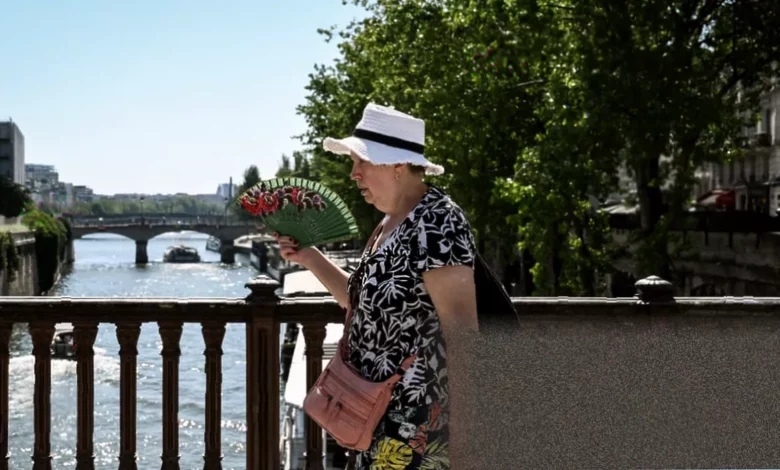
In all areas under red alert, a ban on public alcohol consumption has been implemented, a decision taken at a crisis meeting chaired by Prime Minister Sébastien Lecornu. The aim is to preserve emergency services and allow medics to focus on the most vulnerable. In Paris, which is under a red warning, stronger drinks including high-alcohol beers, fortified wines and spirits have been banned along the banks of the Seine and the Canal St-Martin, to reduce the risk of people falling in. Drinking at licensed bars, cafes and their terraces – where many gigs take place – is permitted.
Nearly 5,000 police have been deployed across the capital for the day and evening, alongside 2,500 emergency and health service workers. Increased police patrols are specifically targeting the Seine and St-Martin areas to prevent drownings, after four teenagers drowned in France on Saturday. Gatherings on the lower banks have been prohibited. Paris city hall has installed more than 1,300 free public water fountains, while more than 1,500 local shops have signed up for a scheme promising to fill personal water bottles without charge. The Eiffel Tower and other Paris venues have set up misting stations to cool crowds. Paris authorities have also ordered parks to remain open around the clock.
France’s culture minister, Catherine Pégard, urged “extreme vigilance” and said it should be up to local authorities to decide whether festivities should be cancelled or go ahead with precautions. Most have opted for the latter. Major cities including Paris, Lyon and Strasbourg are proceeding, but many other local authorities have scaled back or cancelled events.
Broader impacts across France and Europe
The heatwave has forced widespread disruption beyond the festival. The French education minister, Édouard Geffray, announced that 845 schools and collèges would be closed on Monday, mainly in areas under red alert. More than 800 schools across the country had already announced closures, while another 1,800 were rescheduling classes and end-of-year exams. Some middle schools in Paris have adjusted class schedules.
Jean Castex, the head of the SNCF state rail service, confirmed that 71 Intercités routes have been cancelled. He advised “more vulnerable passengers” to avoid taking the train and postpone journeys if possible, warning that air-conditioning systems and other rail infrastructure were being “heavily tested” by the conditions. Thousands of extra staff have been dispatched to deal with potential problems.
Prime Minister Lecornu convened a government heat crisis meeting on Saturday and planned another on Sunday. He ordered ministers to urgently plan for better adapting France to further heatwaves in the future. Enhanced surveillance of water supplies to France’s nuclear reactors has been ordered, and emergency services and military forces have been placed on wildfire alert.
Scientists have said that as the Earth continues to warm, extreme heat events historically confined to high summer will become more frequent, more intense and last longer, as well as occurring earlier and later in the year. This is the second heatwave of 2026 for France, following a hot spell in May that broke records. The 2003 heatwave in France caused nearly 15,000 deaths, primarily among the elderly, prompting a national reckoning and a government heatwave plan. Meteorologists have warned the current event could be of similar duration and severity.
The heatwave is not confined to France. In Italy, authorities expanded heat warnings from seven to eight cities in northern and central parts of the country, out of the 27 cities monitored nationally by the health ministry. In Spain, the national weather agency, Aemet, has issued red warnings for northern regions. Temperatures between 40C and 42C are forecast in major river valleys and inland areas such as Andalucía and Extremadura, rising to nearly 44C by Tuesday. Spain is experiencing its earliest and most intense June heatwave on record; the late May heat event in Spain resulted in 101 deaths.
In the United Kingdom, the Met Office has issued an “extreme heat” warning for much of southern England and parts of Wales, with temperatures potentially exceeding 38C. There is “growing confidence” this week could break the record for the hottest UK June temperature of 35.6C, set in Southampton in 1976. High humidity is expected to make the heat oppressive and impact public health, infrastructure, and utilities. Amber heat-health alerts are in place across England. In Germany, temperatures are soaring into the mid-30s Celsius, with warnings of severe thunderstorms due to the combination of heat and humidity.
Concerns are particularly high for vulnerable populations – the elderly, young children, the sick, isolated individuals, pregnant women, workers exposed to heat, and those in poorly ventilated housing. The government’s crisis meeting on Sunday is expected to review further measures as the heatwave shows no immediate sign of abating.