Uniqlo’s parent company, Fast Retailing, has seen its shares surge 45 per cent this year, hitting a record high in April as roaring overseas growth in the US and Europe propelled the Japanese retail giant to new heights. The company, now the third largest apparel retailer in the world behind Zara’s Inditex and H&M, operates more than 2,500 Uniqlo stores globally and has made its humble brown paper bags a familiar sight from Oxford Street to Fifth Avenue.
Global success and the ‘unibare’ phenomenon
For the fiscal year ending August 2025, Fast Retailing reported a 9.6 per cent increase in revenue to ¥3,400.5 billion (£16.6 billion) and a 13.6 per cent rise in business profit to ¥551.1 billion (£2.69 billion), marking its fourth consecutive year of record earnings. International sales were particularly strong: Uniqlo International revenue grew 11.6 per cent to ¥1.91 trillion (£9.34 billion), with profit up 10.6 per cent. In Europe, turnover surged by 34 per cent to nearly €2.267 billion, and the region now accounts for more than 13 per cent of the retailer’s total sales. Meanwhile, North American revenue jumped 24.5 per cent, driven by new flagship stores the company describes as “media beacons”.
Much of this success can be traced to Uniqlo’s remarkable ability to embed itself in popular culture. You know a brand has conquered the zeitgeist when the vocabulary around it goes mainstream, and that moment arrived when the word “unibare” entered the lexicon, according to The Times. The term expresses the realisation that someone is wearing Uniqlo – rather than anything more expensive. It captures the brand’s knack for providing anonymous, chic “wardrobe building blocks” that look as good alongside designer labels as they do on their own. Uniqlo’s “LifeWear” philosophy, rooted in functional, high-quality basics designed for everyday life, means the clothes are deliberately unflashy. Yet that very understatement has become a badge of quiet sophistication, transcending seasonal trends and appealing across generations. The effect is that wearing Uniqlo no longer signals a budget compromise but a deliberate, intelligent choice – a “meaningful difference” in a crowded fast-fashion market.
This mainstream appeal did not happen overnight. Uniqlo’s early foray into the UK was a costly misstep. The company opened 21 stores within 18 months of its 2001 launch, but struggled to differentiate itself from established high-street rivals such as Marks & Spencer and Gap. British consumers found the products comparable in price and style but lacking strong local brand recognition. The range, optimised for Japanese preferences, did not translate well to British body shapes or fashion expectations. Within three years, 16 of the 21 stores were closed, and the UK operation was restructured at a cost of nearly £100 million by 2005. Today, the lessons of that failure have been well learned. Uniqlo now operates 23 stores in the UK, with recent openings in Liverpool, Glasgow, Edinburgh and Bristol, and a target of eventually having around 200 casual clothing shops across the country. The company’s first global flagship store in Europe opened on London’s Oxford Street in 2007, and the UK is now a key market for European expansion, with ambitions to strengthen its presence in regional areas.
Founder’s inspiration
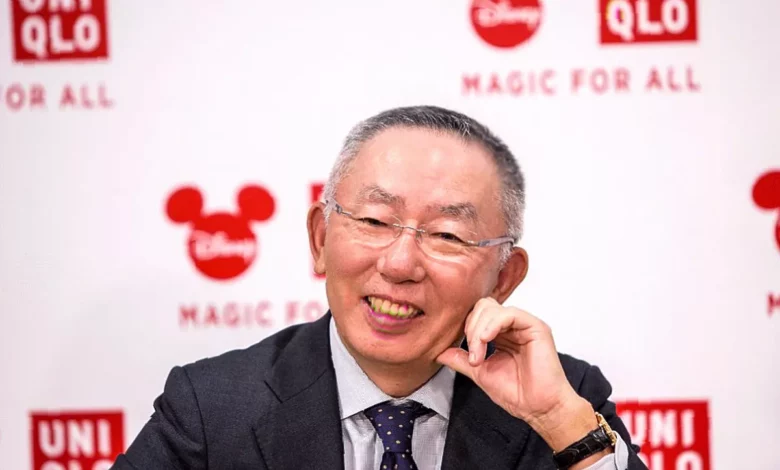
Behind this global success story is Tadashi Yanai, Japan’s richest man, whose personal fortune is estimated at around $69 billion by Forbes. At 77, Yanai still works from a wood-panelled office in Tokyo lined with art books. Among them, he says, his most “sacred text” is a 1987 Next catalogue shot by Vogue and Vanity Fair photographer Koto Bolofo. “This inspired me most, back in the Eighties,” Yanai told an interviewer. “Ordinary people looking cool and casual… I wanted to deliver this kind of clothing for current times. Clothes to make people happy.”
Yanai was born into the rag trade in February 1949 in Ube, a city on the main Japanese island of Honshu, where his parents ran a menswear shop. He studied political economy at Tokyo’s prestigious Waseda University, but the Vietnam War interrupted his studies when a student walk-out allowed him to travel to the US and UK. There, the proliferation of mid-market clothing shops planted a seed. After a brief stint selling men’s clothes for a supermarket chain, he joined his father’s business in 1972. In 1984, he became president of the company, then known as Ogori Shoji, and opened the first “Unique Clothing Warehouse” in Hiroshima – the store that would eventually become Uniqlo. The firm was rebranded as Fast Retailing in 1991.
The big breakthrough came in 1998, as Japan was reeling from its burst economic bubble. Yanai opened Uniqlo’s first Tokyo outlet and sold a lightweight fleece for just £15. “Every fourth Japanese consumer bought one,” according to reports. The product became a symbol of affordable, high-quality design for the masses – a core tenet of Yanai’s philosophy. His autobiography, titled One Win and Nine Losses, reflects his belief that mistakes are learning opportunities. “Change or die. That is the only choice for a business,” he has said. His focus on details and basics is summed up in another mantra: “God is in the details – true excellence is found in the relentless and perfect execution of the basics.”
Business practices and leadership
Yanai runs his company with an iron grip. He has been described by Time as a “dictator” who maintains tight control over decisions, approving samples and colours himself while always keeping the consumer’s needs in mind. That autocratic style extends to a culture that, in Yanai’s words, “can’t help but swim against the tide” in a Japanese business environment famed for grey conformity. He happily flaunts his success despite local taboos against ostentatious wealth, owning two golf courses on the Hawaiian island of Maui alone. Yet when he walks through a Uniqlo store, he exhibits what Bloomberg Businessweek calls “quintessentially Japanese traits”: attention to detail, supply-chain prowess, minimalist aesthetics – and frugality.
The company’s expansion strategy today is more measured than in its earlier, overhasty days. Yanai has written candidly about the mistakes he made, including rushed expansion efforts that necessitated a humiliating retreat. Now, having targeted national capitals, Uniqlo is moving into regional cities. Designer collaborations have boosted the brand: partnerships with minimalist Jil Sander and Dior’s Jonathan Anderson, as well as with JW Anderson, Clare Waight Keller, Christophe Lemaire, Francesco Risso and Cecilie Bahnsen, have elevated Uniqlo’s appeal. The company also works with artists and institutions such as Keith Haring, Andy Warhol, KAWS and even Transport for London, producing collections inspired by the city’s heritage. In 2024, British tennis star Emma Raducanu was signed as a global ambassador to promote LifeWear.
Yanai is also building sponsorship programmes with art galleries globally and sees his business as “a force for good”. Under the RE.UNIQLO initiative, the company repairs, recycles and reuses clothing to extend its lifespan. Fast Retailing has set ambitious sustainability targets for 2030: increasing the proportion of recycled materials to approximately 50 per cent and reducing greenhouse gas emissions by 20 per cent. The company has policies for responsible raw material procurement, has reduced single-use plastics, switched to paper bags and charges for them in Japan to encourage customers to decline them. Social initiatives include supporting refugees through partnerships with the UNHCR, a “PEACE FOR ALL” programme and disaster relief donations, including $12.2 million (1 billion yen) for victims of the 2011 tsunami. The company also focuses on hiring disabled workers and promoting culture, art and sport.
With two sons, Kazumi and Koji, now working in the business, questions about succession are frequent, but Yanai gives nothing away. (His son Koji launched the Tokyo Toilet Project, which inspired the film Perfect Days.) Of his own future, Yanai has said: “When I get older my dream is to take a walk every day on the streets of London” – a continuing source of inspiration, he told The Telegraph in 2015. There is no sign of that happening any time soon.