US and Iran agreed to a 60-day roadmap towards a final deal after the first day of high-level talks in Switzerland, according to a joint statement from the mediators, Qatar and Pakistan.
The agreement, brokered by the two Gulf states, sets out a timeline for reaching a comprehensive settlement on Iran’s nuclear programme and the lifting of sanctions. Technical discussions between lower-ranking officials will continue for the rest of the week in the Swiss resort of Bürgenstock, building on the memorandum of understanding (MOU) signed by Washington and Tehran last week.
Roadmap to a final deal
The joint statement by Qatar and Pakistan said the two sides had agreed to a “roadmap” that envisages a final accord within 60 days. It follows the MOU signed on 17 June which established the broad framework for negotiations. That memorandum calls for a ceasefire on all fronts, the future of Iran’s uranium enrichment programme and the lifting of economic sanctions.
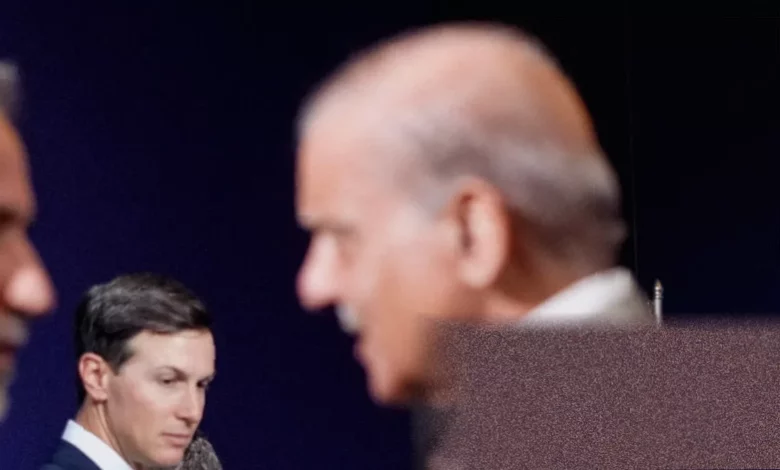
Iranian foreign minister Abbas Araghchi described the first day of talks as “progress”, while US vice-president JD Vance, who led the American delegation, said he hoped the two sides could “turn over a new leaf”. Vance was joined by US special envoy Steve Witkoff and President Donald Trump’s son-in-law, Jared Kushner. The Iranian side was led by parliament speaker Mohammad Bagher Ghalibaf, alongside Araghchi.
Lebanon de-confliction mechanism
The most immediate test of the understandings reached will be the situation in Lebanon, where fighting between Israel and Iran-backed Hezbollah continues. The joint statement said the US and Iran agreed to set up a “de-confliction cell” with the Lebanese government to ensure “the adherence of the termination of military operations in Lebanon”. This mechanism is designed to monitor and enforce a halt to hostilities, with the Lebanese government acting as a partner on the ground.
Araghchi described the elimination of the conflict in Lebanon as “the first real test” of the agreement. Iran views the de-confliction cell as a critical guarantor of the ceasefire called for in the MOU. However, the arrangement was put under immediate strain over the weekend when Israel killed more than 30 people in attacks on central and southern Lebanon on Saturday. Iran said it had reinstated a blockade in the Strait of Hormuz in protest, a claim denied by the US military.
President Trump responded forcefully to the blockade threat, writing on social media: “You close it and you won’t have a country. You won’t even make it back to your fucking country.” He also warned Iran against supporting its proxies in Lebanon, saying: “Iran must immediately stop their highly paid proxies in Lebanon from causing trouble … If they don’t, we’ll hit Iran very hard again.” The US president later threatened to impose US tolls in the Strait of Hormuz if a final deal was not reached.
The exchanges caused a temporary pause in the talks. Iranian state media reported that the Iranian delegation had left the negotiating site after the “publication of an insulting message by the US President” and met with Qatari mediators. Iran’s semi-official Tasnim news agency said the Iranian delegation refused to return to the room but continued to exchange messages via the Pakistani and Qatari mediators. A senior US diplomat later told reporters that the Iranians remained on site and negotiations were still on, according to the Associated Press.
Israeli prime minister Benjamin Netanyahu has stated he would not allow Iran to acquire nuclear weapons and vowed to keep Israeli forces in southern Lebanon until threats to Israel were eliminated, adding another layer of complexity to the Lebanon de-confliction efforts.
Economic sanctions and frozen assets
In a development critical to unlocking broader progress, the US Treasury was preparing to issue a 60-day waiver lifting sanctions on Iran’s oil, petrochemicals and derivatives. Iran’s central bank would then be able to sell oil — principally to China — and receive payments without the threat of US penalties. The economic measures are expected to help relieve pressure on Iran’s exchange markets and gradually slow runaway inflation, the country’s most pressing domestic concern.
Alongside the sanctions waiver, Qatar and Iran signed a memorandum about the release of Iranian assets frozen in Qatari bank accounts due to US secondary sanctions. Iran’s president, Masoud Pezeshkian, confirmed that $6bn in frozen assets held in Qatar would be returned to Tehran as part of the preliminary deal. Iran is seeking access to at least $24bn in blocked funds out of an estimated $100bn frozen worldwide. It was not clear whether the US had placed any restrictions on the use of those assets, such as requiring the money be spent only on humanitarian goods.
The nuclear element of the talks — which remains the most contentious — was initially held back by Iran pending the lifting of the oil blockade and the return of overseas assets. With the bulk of its preconditions now met, the joint statement indicated that Iran would permit some talks on the future of its domestic uranium enrichment and the downblending of its large stockpile of highly enriched uranium — believed to be enriched to up to 60% purity. President Pezeshkian reiterated that Iran would not relinquish its right to enrich uranium but denied any intention of developing nuclear weapons. The MOU calls for Iran to, at a minimum, dilute its stockpile of highly enriched uranium, but many issues — including Tehran’s right to enrich in the future — remain unresolved.
Vance said he anticipated staying in Switzerland only a “day or two”, while the US negotiating team will use the full 60 days to try to reach an agreement that locks Iran into binding commitments on its nuclear programme. Araghchi, reflecting on the first day of talks, acknowledged that the most difficult issue remained the future of the Lebanon crisis, describing it as the defining test of whether the roadmap can hold.