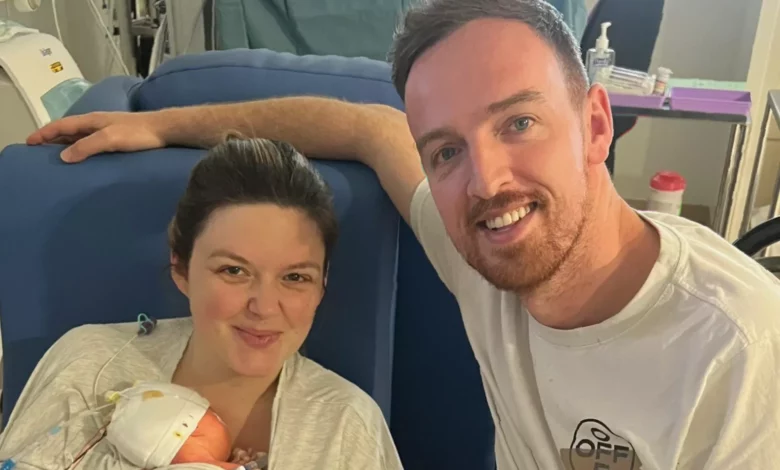
Thousands of women are campaigning for better diagnosis of a dangerous pregnancy condition after a young mother lost more than five litres of blood and required an emergency hysterectomy when her placenta accreta spectrum (PAS) went undetected.
Chloe Robinson, then 32, had an emergency caesarean section at Burnley Hospital in July 2024 to deliver her daughter, Poppy. She recalls medical staff descending into “emergency and panic” as she haemorrhaged. A hysterectomy was performed to stop the bleeding. Both mother and baby survived, but Ms Robinson said the ordeal caused “shock after shock” and that an earlier diagnosis would have allowed her to prepare for the trauma.
A life-threatening condition
PAS occurs when the placenta grows too deeply into the wall of the womb and does not separate easily after childbirth. The condition spans a spectrum: placenta accreta, where the placenta attaches too firmly to the uterine lining; placenta increta, where it invades the muscular wall; and placenta percreta, where it penetrates through the wall and may affect nearby organs. When doctors attempt to remove the placenta after birth, a woman can haemorrhage within minutes.
The condition now affects approximately one in every 272 births, a marked increase from the 1970s that experts attribute largely to the rising number of caesarean deliveries. According to campaign group Action for Accreta, 61 per cent of women go undiagnosed before delivery, and 64 per cent require emergency surgery.
The exact cause of PAS is unknown, but the NHS lists several risk factors: previous caesarean sections, IVF, placenta praevia (a low-lying placenta covering the cervix), maternal age of 35 or above, and abnormalities of the womb. The most significant risk factor is a history of caesarean delivery, with the risk rising sharply for each subsequent caesarean. For women with placenta praevia and previous caesareans, the risk of PAS can range from 3 per cent for one previous caesarean to 67 per cent for five or more.
Ms Robinson had a previous caesarean and was diagnosed with placenta praevia early in her pregnancy, putting her at increased risk. Yet her condition was not spotted on an ultrasound. She said she experienced intermittent bleeding throughout her pregnancy but was told it was due to the low-lying placenta. “It was all dismissed,” she claims.
Challenges in diagnosis and the need for improved training
PAS is usually diagnosed during routine ultrasound scans, but Action for Accreta warns that the condition can be difficult to detect reliably on ultrasound. In many cases, even advanced imaging such as MRI cannot confidently confirm or rule it out. Ultrasound has low sensitivity and accuracy, especially early in pregnancy — placental lacunae, a key sign, are present in only 46 per cent of early cases. The accuracy of the scan depends heavily on the experience of the sonographer and the quality of the equipment, and non-specific blood flow signals can lead to false positives. Critically, the absence of ultrasound findings does not exclude PAS, meaning clinical risk factors remain important predictors.
Survivors and campaigners are now calling for greater surveillance and training in PAS across maternity services, particularly for sonographers, to improve detection. They are also demanding changes to medical guidelines so women are diagnosed antenatally and can be better prepared for potential blood loss during delivery.
Following Ms Robinson’s traumatic birth, an internal investigation by East Lancashire Hospitals NHS Trust concluded it would update its guidance to refer at-risk women to a foetal medicine specialist to be “actively screened” for PAS. The trust apologised to Ms Robinson for not diagnosing the condition before birth and acknowledged that an earlier diagnosis would have “psychologically prepared” her for a hysterectomy.
Pete Murphy, chief nurse and executive lead for maternity services at the trust, said PAS “requires specialist assessment and careful antenatal diagnosis” and confirmed the trust has worked to strengthen the early identification, referral and management of women at risk. “We continue to work closely with colleagues across maternity, fetal medicine, obstetrics, anaesthetics, surgery and imaging to improve the coordination and delivery of care for women where the condition is suspected or confirmed,” he added.
Calls for change and expert views
Dr Chineze Otigbah, an obstetrician and fetal medicine expert at Queen’s Hospital, Romford, told The Independent: “It’s not the condition that kills, it’s what happens when you try and mess around with it.” She said screening women early in pregnancy and flagging those at higher risk, such as those who have had a caesarean, could prevent the need for emergency hysterectomies and “massive blood loss”.
Treatment for PAS usually involves a planned caesarean hysterectomy, where the uterus is removed after the baby is delivered, often with the placenta left in situ to minimise bleeding. Outcomes are optimised when delivery occurs at a specialist centre before labour or bleeding begins, usually between 34 and 37 weeks. A multidisciplinary team — including maternal-fetal medicine specialists, obstetric anaesthesiologists, gynaecologic oncologists, acute care surgeons, neonatologists, critical care specialists and blood bank personnel — is considered essential. Up to 95 per cent of women with PAS require blood transfusions, with a third needing ten or more units within 24 hours. Bladder injury occurs in four out of ten cases, and ureters can also be at risk.
In a separate case, mother-of-four Kimberley Littler, 40, from Glasgow, told how she was already in a high-risk category after three previous caesareans but was only diagnosed after she asked the sonographer if she had PAS. That question triggered an urgent transfer, an eight-hour operation, a hysterectomy and neonatal admission. “It’s very scary, just how one little decision or me deciding to speak up could have really saved my life,” she said. “I could have been dead, don’t know if Eli would have survived, my three girls could have been motherless if it wasn’t spotted.” She stressed that medical staff, including sonographers, need better training to avoid “unnecessary death and unnecessary trauma”.
Katie Buckingham, 34, from Surrey, said she was “mentally broken” when she gave birth to her daughter Tilly in February 2025. She had been suspected of having PAS throughout her pregnancy, but when she delivered in a planned caesarean under general anaesthetic, she was told it was not PAS because her placenta was “whole”. A week after the birth she suffered a secondary haemorrhage, a uterine infection and developed sepsis, requiring surgery to remove tissue and blood clots. The products removed were never sent to histology. She continued to be unwell, and six weeks postpartum a retained placenta was found, requiring yet another serious surgery. “If tissue had been sent for testing, it may have spared me the prolonged trauma of repeated A&E visits, further surgery, and weeks of uncertainty,” she said. “What I needed was not just treatment each time I collapsed into a crisis. I needed joined-up care, specialist understanding, and somewhere to feel safe.” Her placenta was never tested for the condition — the only way a diagnosis can be confirmed — but a specialist consultant later confirmed it was likely PAS after all.
Dr Alison Wright, president of the Royal College of Obstetricians and Gynaecologists (RCOG), said guidance on PAS will soon be updated. “Our understanding of this condition has grown significantly in recent years, and the upcoming RCOG clinical guideline on PAS and placenta praevia, expected to publish in June, reflects the most up-to-date evidence and provides advice on the management and care of women with these conditions. This guidance aims to support teams to deliver the highest standard of care to every woman affected.”
Donald Peebles, national clinical director for maternity at NHS England, said: “Placenta accreta spectrum is rare, but when it does happen, it can lead to very heavy bleeding, which is why identifying women at higher risk early in pregnancy is so important. Maternity teams are supported by clear clinical guidance to spot the warning signs and, where needed, refer women to specialist NHS centres with experienced multidisciplinary teams and access to critical care. Our focus is on making sure every woman receives safe, expert and compassionate care throughout their pregnancy and labour.”