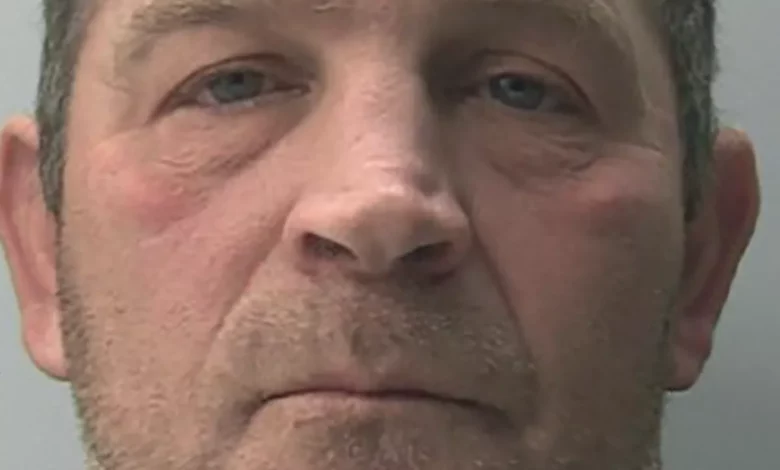
A man has been jailed for 21 years for the 2003 rape of a woman in Salford – the same attack for which Andrew Malkinson was wrongly imprisoned for 17 years. Paul Quinn, 52, was sentenced at Manchester Crown Court on Friday to a total of 24 years, comprising 21 years in custody and a further three years on licence, after being found guilty of two counts of rape, one count of choking with intent, and one count of grievous bodily harm.
Sentencing Quinn, Mr Justice Bright described the victim as a “hero” and said it was “excruciating” for her to return to court a second time. “She, not you Paul Quinn, is the person from this case who I will remember for the rest of my days,” the judge said. The court heard that Quinn showed no reaction as the sentence was delivered. He will be eligible for parole after 14 years – a term shorter than the 17 years served by the innocent man he allowed to remain behind bars.
Wrongful conviction that saw an innocent man jailed for 17 years
Andrew Malkinson was convicted in 2004 of the rape of a 33-year-old woman, based primarily on identification evidence from three witnesses. There was no DNA or other forensic evidence linking him to the crime at the time. The victim had described her attacker as shorter than Malkinson, with a hairless chest and no tattoos, and said he would have a deep scratch on his face. Malkinson, by contrast, had chest hair and prominent tattoos, and bore no such scratch. The victim later expressed doubts about her identification, but was reportedly reassured by detectives that these were “trial nerves”.
Malkinson was released from prison in December 2020, and his conviction was quashed by the Court of Appeal in July 2023. His case was referred to the Court of Appeal by the Criminal Cases Review Commission (CCRC) in January 2023, after the emergence of new DNA evidence. However, the CCRC had previously rejected his applications multiple times, meaning Malkinson served an additional ten years in prison before his exoneration. The chair and chief executive of the CCRC have both resigned in the wake of the case.
The DNA evidence that finally proved the truth
Advances in DNA technology were central to identifying Quinn as the real perpetrator. DNA found on the victim’s clothing had been logged as “Unknown Male 1” for years, but could not be matched because Quinn’s DNA was not on the national database at the time of the original investigation. His profile was only added in 2012, as part of a nationwide operation to collect DNA from all convicted sex offenders – Quinn had a previous conviction from 1993 for raping a 12-year-old girl. Even then, it took further developments in forensic science and a re-examination of stored samples before the link to Quinn was finally made in 2022.
Quinn, a convicted sex offender, had evaded justice for more than two decades despite living near the scene of the attack. The judge noted that Quinn had searched online for information about Malkinson’s campaign to prove his innocence in 2019 – before it became widely known – and later searched “how long is DNA kept in database” after reports emerged of new DNA evidence. Prosecutors argued that Quinn was “only too willing to sit back and take advantage of his misfortune”. Quinn claimed the searches were a “complete coincidence”, but police pointed out that at the time only Malkinson and his legal team knew his conviction was wrongful.
Mr Justice Bright said it was “utterly clear” that Quinn knew throughout that another man had been arrested, charged, convicted and imprisoned for his crime, and that he knew the conviction was wrongful. “Neither of these things appears to have troubled you at any point during the 20-plus years that have passed,” the judge added.
The victim’s ordeal and enduring trauma
The woman, a young mother, was snatched from the street as she walked home in Little Hulton, Salford, in the early hours of 19 July 2003. She was followed, dragged down an embankment, beaten, bitten, choked unconscious and raped twice. She suffered a fractured cheekbone and believed she was going to die during the attack. The judge said she was lucky not to have incurred significant brain damage due to oxygen deprivation.
In court, the woman wept as her impact statement was read. “After 20 years, I now have justice but that does not change the fact that two lives have been impacted in such a way,” it said. “As for me, the impact of what happened that day has stayed with me and will remain with me for life. Every day, I look at my face and see the disfigurement, the scarring. It is a permanent reminder of that night and what I experienced. I have to live with that. For him it was one night of his life, for me it was one night that changed my life.”
She described living with “permanent anxiety” and “constant fear”. Mr Justice Bright praised her as “truly a hero”.
Broader failings and ongoing consequences
The case has been described as one of the worst miscarriages of justice in British criminal history. A public inquiry is under way into the failings that could have exonerated Malkinson a decade earlier. Five former Greater Manchester Police officers and one currently serving officer are under investigation by the Independent Office for Police Conduct (IOPC). Greater Manchester Police has apologised to both the victim and Andrew Malkinson for the “grave miscarriage of justice” and for failing to bring the true attacker to justice sooner.
Malkinson, who said he was “left to rot” in prison, has described himself as “insulted and appalled” that Quinn received a sentence he considers “softer” than his own. He hopes Quinn will not be granted parole and will serve longer than the 17 years he served. He is seeking recompense from British authorities, criticising the Miscarriage of Justice Compensation Scheme as “derisory” and “not fit for purpose”, and has been involved in forcing a change in the law regarding interim compensation payments and legal aid eligibility for suing the police.
Quinn is also being investigated as a potential suspect in other serious sexual assaults, including three unsolved rapes.