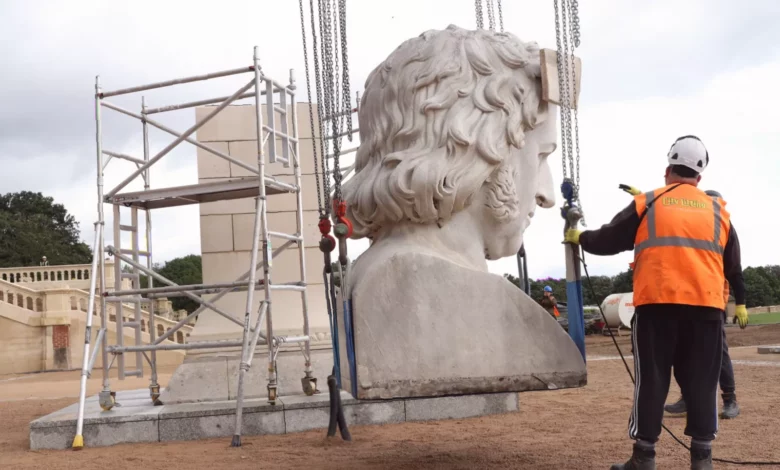
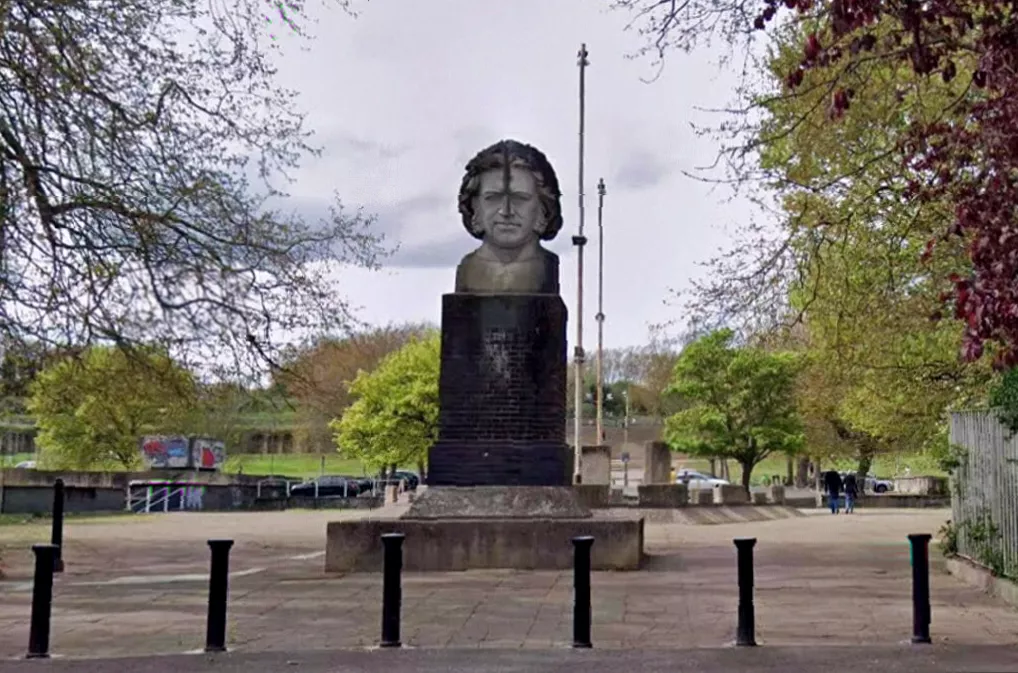
Sir Joseph Paxton is back where he belongs. The monumental bust of the Victorian mastermind behind the Crystal Palace and its surrounding parkland has been reinstalled on the Italian Terraces, gazing out over the landscape he shaped more than 170 years ago. The grey stone sculpture, which had spent years perched on a nondescript brick plinth near the sports ground, now sits on a newly constructed plinth high on the terraces, restored to its original vantage point.
The bust was carved from Italian Carrara marble by the sculptor William Frederick Woodington in 1869 and first unveiled on the upper terraces in June 1873 to mark the 20th anniversary of the Crystal Palace. It originally faced the great glass building itself. But after the Crystal Palace was destroyed by fire on 30 November 1936, the bust was moved several times – first to a spot beside the Penge entrance to the park, then to a location near the sports ground car park, and in 1981 was re-erected facing the Crystal Palace National Sports Centre. The latest relocation, part of an extensive conservation programme carried out last year that included careful restoration and steam cleaning of the sculpture, has returned it to the historic Italian Terraces for the first time in decades. The bust is Grade II listed by Historic England.
Stuart McLeod, Director of England – London & South at The National Lottery Heritage Fund, said: “It’s wonderful to see Sir Joseph Paxton returned to his original vantage point overlooking the park he so brilliantly designed. Thanks to National Lottery players, this significant investment in Crystal Palace Park is helping to restore its historic features, celebrate its remarkable heritage and ensure it can be enjoyed by communities now and for generations to come.”
The Italian Terraces: a Victorian showpiece restored
The Italian Terraces are among the most significant surviving historic features of Crystal Palace Park, and their restoration lies at the heart of the current regeneration project. Designed by Sir Joseph Paxton himself, they were originally laid out in a grand, formal style that reflected Victorian sophistication, complete with statues and fountains. The terraces occupy the site where the Crystal Palace once stood – the vast iron-and-glass structure that Paxton originally built for the Great Exhibition of 1851 in Hyde Park, before it was dismantled and rebuilt in enlarged form on Sydenham Hill between 1852 and 1855. Paxton described the location as “the most beautiful spot in the world” for his creation. The park itself is Grade II* listed on the Register of Historic Parks and Gardens.
After the Crystal Palace burned down in 1936, the terraces fell into disrepair. The current conservation works – which are Grade II listed in their own right – include repairs to walls, balustrades and steps, as well as the introduction of step-free access and improvements to drainage. The terraces remain closed to the public until this phase of the project is completed later this summer. The works are being delivered by the contractor Maylim, with designs prepared by a team of specialist heritage and landscape consultants led by HTA Design LLP.
The restoration of the bust and the terraces is part of a wider, multi-million-pound regeneration plan for Crystal Palace Park, co-delivered by Bromley Council and the Crystal Palace Park Trust. The trust, established in 2016, became the park’s custodian in 2023. The project has received a £5 million grant from The National Lottery Heritage Fund, alongside support from the Garfield Weston Foundation, the Wolfson Foundation, the London Marathon Foundation, and the Pilgrim Trust. Historic England has provided specialist advice and invested over £1 million in the park’s regeneration. The overall plan aims to restore historic features, enhance biodiversity, and create new amenities including a visitor centre and a dinosaur-themed playground. The park’s iconic dinosaur sculptures – the world’s first scientific attempt to visualise extinct dinosaurs, created by Benjamin Waterhouse Hawkins – are also undergoing restoration. Meanwhile, the Grade II* listed Crystal Palace Subway, one of the last remaining features of the original building, completed a major restoration in September 2024.
Sir Joseph Paxton – the gardener, architect, engineer and Liberal MP who began his career at Chatsworth working for the Duke of Devonshire, designed innovative glasshouses, cultivated the Cavendish banana and speculated successfully in railways – is once again looking out over the pleasure grounds he laid out. The return of his bust comes just in time for the reopening weekend of the nearby Crystal Palace Museum, which has been closed for a year after a fire in January 2025. The museum, founded in 1990, will reopen under the custodianship of the Crystal Palace Park Trust on Saturday 6 and Sunday 7 June 2026, telling the story of both the Hyde Park and Sydenham Crystal Palaces.