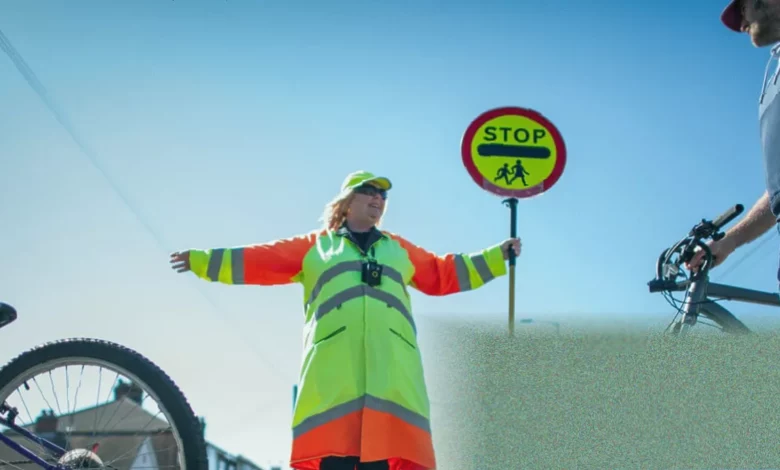
Lollipop people are facing escalating abuse and intimidation on British roads, with school crossing patrols routinely forced to jump out of the path of speeding cars, endure swearing and obscene gestures, and treat a daily torrent of hostility as normal. In Ipswich, Lynne Gorrara, a 61-year-old crossing patrol of a decade, describes the reality of a job where drivers hurtle towards her at 50mph, sometimes waving as they pass. “It’s really scary, because you’re constantly watching the children – that’s my priority,” she says. “When you know they’re not going to stop, you’ve got to make sure you’ve got everybody else out of the way, too.”
The problem, local authorities and experts say, is driven by a combustible mix of rising traffic volumes, deepening societal anger, and a fundamental misunderstanding of what lollipop people are legally allowed to do. Michelle Whinney, 57, who has patrolled Suffolk’s roads for 12 years, says things have got markedly worse “in the last four to five years”. She regularly sees drivers punching steering wheels and sticking up fingers, and has had to dodge oncoming cars. “They can be quite rude at times and there’s no need at all. We only stop you for a second,” she says. Whinney points to a “rising tide of anger in society” and to the sheer number of vehicles on the road: there were 42 million vehicles on Britain’s roads in 2025, an increase of more than five million in a decade.
The abuse is not an isolated phenomenon. The most recent Home Office data for 2024 shows more than 3.5 million motoring offences were recorded by police in England and Wales – the highest figure since records began. Freedom of information requests analysed by the Telegraph in 2024 found that the number of crimes logged by police in the UK mentioning “road rage” or “aggressive driving” had risen by 34 per cent in three years. In 2023, road rage was linked to 143 deaths and 4,084 injuries on British roads. Younger drivers, particularly those aged 17–34, are the most prone to aggressive behaviour, with 63 per cent admitting to using their horn in anger. No single factor accounts for the surge: research identifies contributors ranging from lack of sleep (33 per cent) and work pressure (29 per cent) to financial stress (27 per cent) and family or relationship issues (24 per cent). The car, experts argue, becomes an outlet for pent-up frustration from other parts of life.
A significant and often overlooked driver of the aggression directed specifically at lollipop people is a widespread ignorance of their legal authority. Suffolk county council has launched a campaign called Lollipops Aren’t Just for Children to educate motorists that crossing patrols can legally stop traffic for any pedestrian, not only children. Mike Brooks, the council’s safer active travel manager, says the lack of understanding is frequently the spark for abuse. “It usually takes the form of a driver saying: ‘You shouldn’t be stopping me, because there are no children here – there’s only adults,'” he explains. Under the Transport Act 2000, lollipop people in uniform using their stop sign have the power to halt traffic for anyone. Failing to stop is an offence under the Road Traffic Act 1984 and can lead to fines and penalty points – but many motorists remain unaware.
The psychoanalyst Josh Cohen, author of All the Rage: Why Anger Drives the World, says road rage incidents represent “mini, momentary power struggles” in which drivers use the road to exert control. Social media, he argues, amplifies this by “feeding us a constant stream of provocations” and creating scapegoats. “It’s quite easy to imagine a scenario where lollipop people become public enemies on social media by impeding the flow of traffic.” The pressure is particularly acute at certain times of year. Gorrara and her colleagues dread the Christmas season, when traffic volumes swell and patience evaporates. On sunny days, she notes, drivers are often in a chipper mood – but the underlying risk never disappears.
Cameras as a Deterrent
To combat the epidemic of abuse, Suffolk county council has equipped its lollipop people with body-worn cameras. The footage captures dangerous driving and provides evidence that has already led to police action, from stern warnings to fines. Brooks says several other councils are looking to Suffolk for inspiration, including some in London where low-traffic neighbourhoods have provoked fierce rows between motorists and local authorities. The cameras are also being trialled in Greater Manchester, as well as in Clacton and Basildon in Essex. “Nobody should go to work and receive abuse,” Brooks says. “Unfortunately, our patrols have got into the frame of mind that it is normal, and that’s wrong.” Andy Patmore, the crossing patrol manager who works alongside Gorrara and Whinney, recalls a single 30- to 40-minute shift during which seven cars tried to drive through them. He draws a comparison with other frontline workers: parking wardens, he says, endure physical violence, verbal threats and sexual assault. “Please don’t,” he pleads with drivers. “We’re human beings as well. You’re not going to shout at a traffic light, but you can shout at one of us. It hurts our feelings and gets us down.”
History and Decline
Lollipop people have been a fixture on British roads for almost 90 years. The country’s first was Mary Hunt, a school caretaker appointed in Bath in 1937. Her grandson, Colin Hunt, says she was “not much more than 5ft tall” and that the original sign was so large she would “go sailing off down the road” when caught by a gust of wind. The Bath Chronicle announced her appointment that September with a warning that drivers who “flash by” would have their numbers taken and be summoned. Abuse occurred even then – Hunt recalls “speeding vehicles that just wouldn’t stop”. After the second world war, councils in east London followed Bath’s lead, appointing “able-bodied pensioners”, and the idea spread nationwide. But at the turn of the millennium, the landscape changed dramatically. The Transport Act 2000 removed the legal obligation on councils to employ lollipop people. Subsequent austerity policies accelerated the decline. The Mirror reported last year that councils now employ half as many lollipop people as in 2014, and many are axing them entirely. Durham county council, controlled by Reform UK since May 2025, has proposed a hiring freeze on crossing patrols as part of an Elon-Musk-inspired “Department of Government Efficiency” audit to eliminate “wasteful spending”. Across England, Wales and Scotland, the number of operatives fell from more than 7,000 in 2009/10 to around 5,000 in 2017/18.
As patrols have dwindled, the risks to children on the roads have increased. Department for Transport figures show that the number of under-16s killed or seriously injured in England rose by 17 per cent – from an average of 1,884 between 2017 and 2019 to an average of 2,204 between 2022 and 2024. In 2023 alone, more than 3,350 children aged seven or under were killed or injured on UK roads, an average of nine per day. Colin Hunt describes it as an “absolute tragedy” that lollipop people have had to resort to wearing cameras. “Children are important and lollipop people take their lives into their hands to make sure they’re kept safe,” he says.
Yet for the men and women who still do the job, the rewards remain profound. Gorrara, who lost her husband recently, says the work gives her a reason to get up in the morning and a purpose in serving her community. “It’s not for the money or the uniform,” she says, but for the joy of watching schoolchildren grow up. Abby Hart, a parent whose children attend a nearby primary school in Ipswich, calls Gorrara and Whinney “phenomenal” and says she has witnessed “close encounters” where cars refused to stop. “No one’s in that much of a rush, surely?” she says. Patmore sees the positive side too: lollipop people, he says, bring joy to pedestrians, especially when they treat their crossing as “an extension of their personality”. As Gorrara lowers her stop sign at the end of her shift, she is already looking forward to the next day. “I just love it,” she says. “We’re not out to get anyone. We just want you to slow down.”