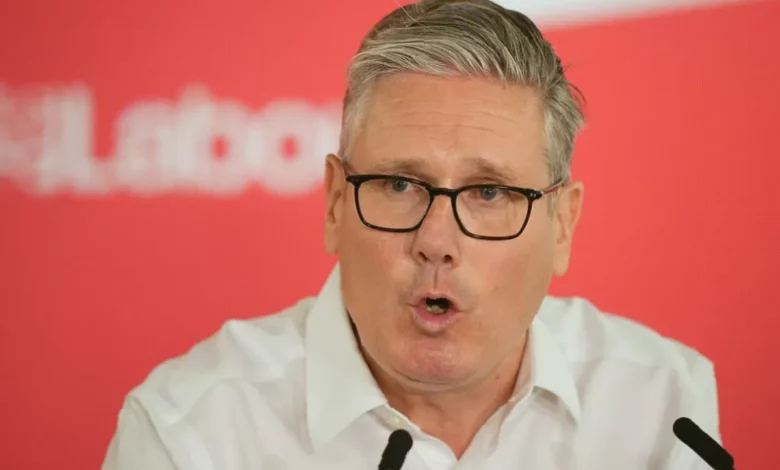
Google Search now requires users to give their explicit consent before the service will function, a change that has immediate implications for anyone trying to access information about breaking political stories — including the mounting pressure on Keir Starmer’s leadership of the Labour Party.
The mechanism is straightforward: a notification informs visitors that to use the search feature, their consent is needed to load Google Custom Search, which may employ cookies or similar technologies. Users are prompted to click “Allow and Continue” to enable the search function, with a link to the site’s privacy policy for further detail. Without that consent, the search box remains inactive, effectively locking users out of one of the most common ways they find news, analysis and official statements.
The roll-out of this consent gate comes at a moment when public interest in political leadership is particularly high. Keir Starmer, the Labour leader and Prime Minister, is under sustained pressure to resign after a string of electoral defeats. Over 80 Labour MPs have publicly called for his departure or demanded a timetable for his exit. Starmer has acknowledged responsibility for the results but insists he will not step down, arguing that stability is essential and pointing to the chaos of previous Conservative governments that cycled through leaders in rapid succession. Anyone searching for his latest statement, his polling figures or the precise rules for triggering a Labour leadership contest must first grant Google’s consent.
How the consent requirement works
Consent is not optional if a user wants to search. The notice is clear: “To use the search feature, we need your consent to load Google Custom Search.” It is a binary choice — allow and proceed, or reject and lose access. The technology behind it, Google Custom Search, can use cookies to personalise results or track usage, which is why consent is being requested under data protection rules. The site’s privacy policy contains the full details of what data may be collected and how it is processed, but the key point for any reader is that with a single click the search bar is either enabled or blocked.
For those following the Starmer story, that click unlocks a stream of information: the latest public opinion polls showing that as of April 2026 only 24% of the public view Starmer favourably against 69% unfavourably, a net rating of -45. Even among Labour voters opinion is divided, with 46% favourable and 48% unfavourable. The Labour Party itself has a net favourability rating of -30. The rise of Reform UK under Nigel Farage has compounded internal fears, with some polls even placing Reform ahead of Labour in national voting intention. All of this data is a search away — but only after consent is given.
What the search function reveals about the leadership challenge
Once consent is provided, the search function becomes a gateway to understanding the mechanics of a potential leadership change. Under Labour Party rules, a formal challenge requires written support from 20% of Labour MPs — currently 81 people. That threshold triggers a leadership contest. If the leader resigns, a contest is automatic, and the incumbent is placed on the ballot without needing nominations. The National Executive Committee sets the timeline. Unlike the Conservative Party, Labour MPs cannot hold a formal vote of no confidence; the only route is through the nomination process.
A search on potential successors returns a field of familiar names. Wes Streeting, the Health and Social Care Secretary at 43, is seen as a centrist well-prepared for a contest, though his Blairite associations are noted. Andy Burnham, the Mayor of Greater Manchester at 56, is the most popular Labour figure with the public, enjoying a positive net favourability rating, but he is not an MP — and by convention the Prime Minister must sit in the Commons. His supporters are pushing for a delayed contest to allow him to return to Parliament. Angela Rayner, 46, the former Deputy Prime Minister, is popular with the grassroots and has been preparing a bid, offering positions to allies in a potential cabinet, though her tax affairs face scrutiny. Ed Miliband, 56, the Energy Security Secretary, is on the shortlist but lacks the public backing of other contenders. Shabana Mahmood, 45, the Home Secretary, is favoured by the right of the party for her tough stance on border control. Other names mentioned include Bridget Phillipson, Yvette Cooper and Al Carns.
Privacy and the cost of access
The consent gate is a privacy measure, but it also imposes a transaction: users trade a level of data access for the convenience of search. The use of cookies or similar technologies by Google Custom Search means that searches — including those for “Keir Starmer resignation” or “Labour leadership rules” — may be tracked and used for advertising or analytics purposes. The privacy policy is the place where a user can understand exactly what they are agreeing to, but the notice itself does not detail the specific cookies or the retention period.
This dynamic is particularly relevant in a political climate where internal party dynamics are fractious. The Labour Party has a history of leadership challenges, and its rules were tightened in 2021 when the nomination threshold was raised from 10% to 20% of MPs. The current situation is marked by a perceived lack of a clear frontrunner and fears of internal infighting. The rise of Reform UK, economic discontent and voter exhaustion with the two-party system all add layers of complexity — layers that a user can only begin to unpick after clicking “Allow and Continue.”