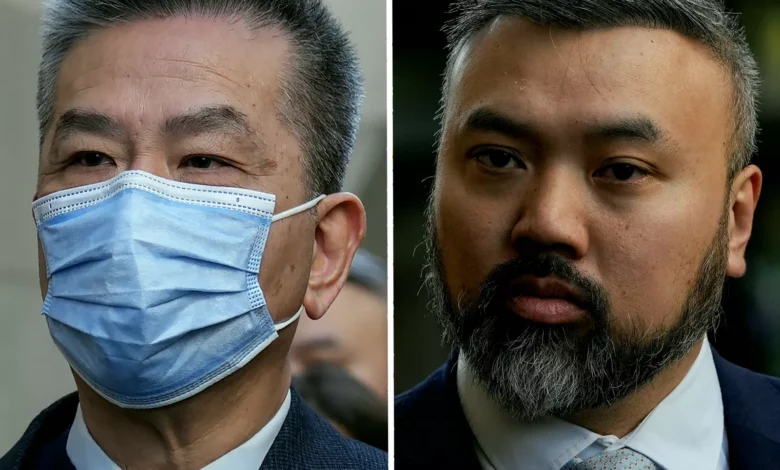
Two men have been jailed for running a “shadow policing” operation that spied on Hong Kong pro-democracy activists in the UK, in one of the first prosecutions under the National Security Act 2023. Peter Wai, 41, a former immigration official and ex-Metropolitan Police officer, and Bill Yuen, 66, a retired Hong Kong police superintendent, were convicted of assisting a foreign intelligence service after a two-month trial at the Old Bailey.
Wai, from Staines-upon-Thames, Surrey, was sentenced to 10 years in prison; Yuen, from Hackney, east London, received eight years. Mrs Justice Cheema-Grubb said their actions were “deliberate, concerted, and serious” and caused “real and significant” harm, leaving those targeted in fear and distress. She described Wai’s attitude as “arrogant” and said he had a “sense of entitlement” to do as he pleased. The judge added that modern foreign intelligence activity is not limited to traditional espionage but includes surveillance, information gathering, intimidation and the targeting of dissidents.
Shadow policing methods and targets
The pair were found to have conducted a sustained campaign of intelligence gathering against Hong Kong protesters who had sought sanctuary in the UK. Wai, who worked for the UK Border Force at Heathrow Airport and as a special constable with the City of London Police, misused the Home Office computer system to check people of interest to Hong Kong authorities. He accessed the database while on sick leave and days off, the court heard. He also ran a private security firm called D5 Security Consultancy Limited. During his arrest, officers found his legitimate warrant card as a special constable and a fake card identifying him as a police superintendent.
Yuen, the handler, was office manager at the Hong Kong Economic and Trade Office (HKETO) in London, described as an extension of the Hong Kong government in the UK. Investigators linked Yuen directly back to the Chinese government’s Security Bureau through his contact with another former police chief. Financial records showed Wai received a payment from the London HKETO after one operation. Hong Kong’s government has said it was not a party to the case but opposed “unfounded allegations” against it or the trade office.
The targets included Hong Kong dissidents, with “special attention” paid to British politicians, including senior Tory MP Sir Iain Duncan Smith, a vocal critic of China. Yuen was reportedly sent a list of names that included Sir Iain, suggesting he was tasked with intelligence gathering related to protest organisations in the UK. Wai referred to Hong Kongers as “cockroaches” as he gathered information on what cars they were driving, where they lived and their social media accounts. Prominent campaigner Nathan Law, who has a one million Hong Kong dollar bounty on his head (about £95,680), was photographed leaving the Oxford Union during one surveillance operation. Law later said he was not surprised by the spy ring’s activities, as he was already aware he was a target.
The operation also involved acts of deception. The arrests of Wai and Yuen stemmed from a failed attempt to apprehend Monica Kwong, a personal assistant accused of defrauding her former employer of £16 million, allegations she denied. Kwong had left Hong Kong with her young son in December 2023 amid the fraud accusations. The defendants located her flat in Pontefract, West Yorkshire, and put together a team to access her home. Matthew Trickett, 37, an immigration enforcement officer and ex-Royal Marine, tried to trick his way in by pretending there was a flood. British security services, who had bugged the flat, were waiting inside when the team eventually broke in. On May 1 2024, 11 people were detained under the National Security Act. Trickett was charged alongside Wai and Yuen, but a week after being bailed he was found dead in woodland near Maidenhead, Berkshire. His death was not treated as suspicious, and the case against him was discontinued.
Impact on victims
The case has amplified concerns about transnational repression faced by the Hong Kong diaspora in the UK. An NGO that assists asylum seekers reported that Hongkongers’ addresses in Britain had been exposed online, with anti-immigration protesters urged to “visit” them. The same NGO’s helpline received suspicious calls from Hong Kong later found to be associated with the Hong Kong police. There have also been threats made by Hong Kong national security police to family members of UK-based democracy advocates. The dragging of a Hong Kong pro-democracy protester into the Chinese consulate in Manchester in 2022 was cited as an example of China’s willingness to extend repression onto UK soil.
Helen Flanagan, commander for Counter Terrorism Policing London, said the activity of Wai and Yuen was “truly chilling”. She added: “They were spying and targeting individuals in the UK who were pro-democracy campaigners and were simply protesting against the Hong Kong and Chinese government and authorities and seeking sanctuary in the UK.” Security Minister Dan Jarvis said Britain would continue to hold China accountable. China’s embassy in London described the case as a “political farce” and an abuse of the legal process, and has lodged serious protests with the UK. Hong Kong Watch has called for a review of the consular privileges granted to the HKETO in London and an assessment of its continued operation in light of national security interests.
For those targeted, the harm has been lasting. The Hong Kong diaspora in the UK has become increasingly fearful, with many avoiding political engagement and self-censoring. The judge noted that the defendants’ actions left individuals in “fear and distress” – a reality that now shapes daily life for activists who believed they had found safety in Britain.