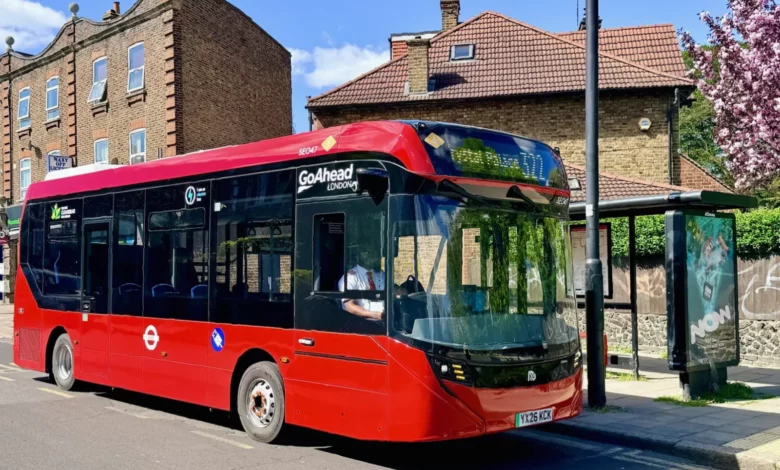
Thirteen new electric buses have entered service on London’s Route 322, linking Crystal Palace with Clapham Common. The Alexander Dennis Enviro100EVs, operated by Go-Ahead London for Transport for London, began running on 25 April from the operator’s Sydenham Garage, with departures every 15 minutes on weekdays and Saturdays, and every 20 minutes on Sunday mornings.
New Electric Buses on Route 322
Route 322 was first introduced on 24 October 1992, originally running between Crystal Palace and Vauxhall Station. It has changed hands several times over the decades, with the most recent operator before Go‑Ahead London being Transport UK London Bus, which ran the route using Switch MetroCity EVs and Enviro200s. Under the new contract, the frequency has been adjusted from a previous 12‑minute interval on weekdays and Saturdays, and from 30 minutes on Sunday mornings. The route covers approximately six miles and takes between 35 and 60 minutes for a full journey.
These are the first electric vehicles to launch from Go‑Ahead London’s Sydenham Garage, which opened in September 2025. The depot is now the operator’s 14th to run battery‑electric buses, joining a network that includes Northumberland Park, described as one of Europe’s largest electric bus depots.
The Enviro100EV – Designed for Urban Streets
Alexander Dennis markets the Enviro100EV as a “big small bus”, combining compact dimensions with the feel of a full‑sized city bus. At 8.5 metres long, 2.35 metres wide and with a 4.5‑metre wheelbase, the vehicle has a tight turning radius of 8.6 metres, making it highly manoeuvrable on narrower, congested streets. In its Transport for London configuration, it carries up to 45 passengers – 21 seated and 24 standing.
The bus is powered by a 354 kWh Impact NMC lithium‑ion battery system. Alexander Dennis claims a theoretical range of 573 kilometres (356 miles) on the UK Bus Cycle at the start of its life, and says the range is designed to last a full day of intensive urban operation on a single charge. The battery packs are covered by a 15‑year warranty, which the manufacturer states is intended to cover two consecutive seven‑year operating contracts without needing replacement. The driveline achieves a claimed grid‑to‑wheel efficiency of 97% and an energy consumption of 0.54 kWh/km under the UK Bus Cycle.
Charging is via a CCS2 DC plug with a nominal power of up to 150 kW, or an optional roof‑mounted pantograph system rated at up to 177 kW. Alexander Dennis provides AD24 whole‑vehicle aftermarket support. The buses meet Transport for London’s Bus Safety Standard and, like all electric buses, are significantly quieter than diesel equivalents; TfL is trialling artificial sounds at low speeds to alert pedestrians and cyclists, particularly those with visual impairments.
Although the upfront purchase price of an electric bus is substantially higher than a diesel – estimated at £400,000 compared with £150,000 – operators benefit from a lower total cost of ownership. Electricity is roughly 60% cheaper per mile than diesel, and maintenance costs are estimated to be 30‑40% lower due to fewer moving parts. Some passengers report a smoother, quieter ride, but there have also been complaints about harsh braking on electric buses, which can be uncomfortable for those with prams or mobility issues. Electrifying bus depots also presents challenges, requiring significant grid capacity upgrades and long lead times for high‑voltage power supply.
Go‑Ahead London’s Expanding Zero‑Emission Fleet
The 13 buses on Route 322 are part of a broader plan to introduce 60 Enviro100EVs across Go‑Ahead London’s network. The operator now runs more than 1,000 zero‑emission buses – the largest such fleet in the United Kingdom – out of a total of approximately 2,500 vehicles. The Go‑Ahead Group has committed to achieving a fully zero‑emission fleet by 2035.
Transport for London, which oversees the capital’s bus network, already operates around 2,500 zero‑emission buses, representing 28% of its total fleet – the largest zero‑emission bus fleet in Western Europe. TfL’s target is to reach 100% zero‑emission by 2030, although this is contingent on additional government funding and could extend to 2034. The transition is a key part of London’s strategy to improve air quality; TfL estimates that hitting the target would save 4.8 million tonnes of carbon by 2034.
Operator’s View
Andy Edwards, Managing Director of Go‑Ahead London, said the new buses “will improve journeys on one of south London’s busiest corridors and contribute to the wider move towards a fully zero‑emission bus fleet in the capital.” The Enviro100EV’s 15‑year battery warranty is designed to cover two consecutive seven‑year operating contracts without replacement, according to Alexander Dennis.