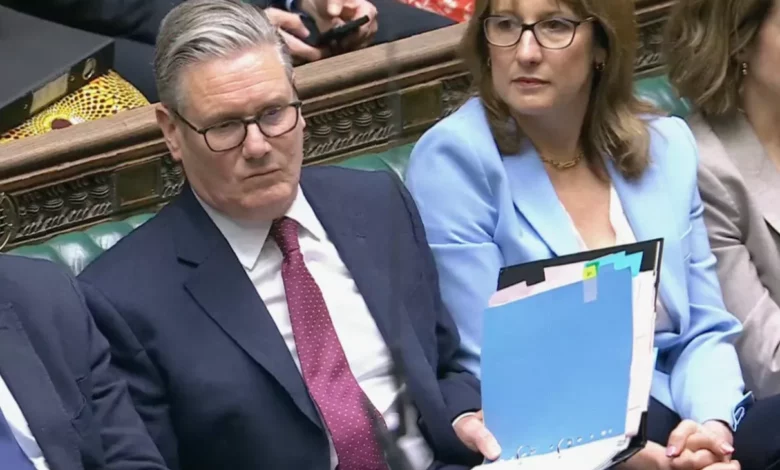
Sir Keir Starmer failed to guarantee that Rachel Reeves will remain as chancellor, leaving the prime minister exposed to a fresh wave of speculation about his cabinet’s future and fuelling the sense that a dramatic reshuffle is now being considered.
During a fiery session of Prime Minister’s Questions, the Conservative leader Kemi Badenoch pressed Starmer to say whether he would “listen to businesses, listen to the country and reshuffle the chancellor”. She described his premiership as “like a bad episode of Game of Thrones” and called Reeves “utterly incompetent”, adding that public complaints about her were rooted in performance rather than gender. “It sounds like she’s toast,” Badenoch said.
Starmer replied by pointing to various economic successes under Reeves but conspicuously stopped short of guaranteeing her future in the job. The omission was immediately damaging. Downing Street moved to shore up the line within minutes of PMQs, insisting the prime minister has “full confidence” in his chancellor and that the “position is unchanged”. By then, however, the impression of a leader unwilling to defend his Treasury chief had already taken hold.
The scene was strikingly familiar. Less than a year ago Starmer was forced into an impromptu show of support for a tearful Reeves just 24 hours after failing to guarantee her position in the Commons. Now, with Labour braced for what polling suggests could be a record-low performance in the local and regional elections on 7 May, the pressure on the prime minister to act has intensified.
The political minefield of sacking a chancellor
Any move against Reeves would carry immense risk. Sacking a chancellor is historically a precursor to a prime minister losing their own job. Liz Truss removed Kwasi Kwarteng in October 2022 weeks after their “mini-Budget” triggered market turmoil, a desperate attempt to regain control that did nothing to prevent her own premiership from collapsing days later. Tony Blair, despite private frustration with Gordon Brown, understood that forcing out a chancellor of his standing would be politically catastrophic, and Brown served throughout Blair’s entire tenure.
The last prime minister to change chancellor without immediately falling was Boris Johnson. He replaced Sajid Javid with Rishi Sunak in February 2020 after Javid resigned rather than dismiss his advisers. But within a month the country was in lockdown and reshuffle talk evaporated. Javid, who had not even delivered a Budget, later exacted revenge by quitting as health secretary, triggering a cascade of resignations that ultimately ended Johnson’s time in Downing Street.
Reeves, however, does not command the same network of political allies that protected Brown or even Kwarteng. Several Labour sources, cited in a Daily Mail report, have indicated that Starmer is weighing up her removal as part of a post-election shake-up, with one insider calling it “one final roll of the dice” to reassert his authority. The chancellor’s own economic record has drawn sharp criticism. Under her tenure of “securonomics” — a label for modern supply-side economics inspired by Joe Biden’s approach, focused on infrastructure, education and labour supply while rejecting tax cuts and deregulation — Britain has seen significant tax rises. The Spectator has argued the country has experienced the fastest-rising taxes in the world, with growth lagging. Labour counters that its strategy aims to deliver stability, boost growth and invest in renewal.
Starmer has already spent considerable political capital surviving the fallout from the Peter Mandelson scandal, and some Labour MPs have publicly called on him to step aside. If the local election results are as dire as projected, the prime minister will need something dramatic to halt the slide.
Who could replace Reeves?
The most obvious candidate with a markedly different economic vision is the energy secretary, Ed Miliband. Miliband has long been an influential figure on Labour’s left and has shaped the party’s industrial and economic policy. He is also, notably, a vocal opponent of Heathrow expansion — a third runway project that Reeves has championed. Her departure from the Treasury could put the entire scheme at risk, with concerns that the airport may not secure formal planning approval before the 2029 deadline without her driving urgency.
Other names being discussed include Yvette Cooper, and some on the left of the party are pushing for Miliband. There is also renewed chatter about bringing back Angela Rayner, the former deputy prime minister, and Louise Haigh, the former transport secretary, as part of a wider attempt to rebalance the cabinet to the left.
The backdrop of high turnover in Starmer’s administration only adds to the sense of instability. Within less than two years of taking office, he has appointed his third permanent under-secretary to the Foreign Office, his fourth director of communications, his third and fourth chiefs of staff (who now share the role), and his third cabinet secretary. A change at the Treasury would continue that pattern of churn, but it would also represent the most consequential personnel decision of his premiership.
With parliament set to rise until the King’s Speech on 13 May, the speculation over Reeves’s future — and Starmer’s own — will only intensify. The question now is whether the prime minister is willing to take a gamble that has undone so many of his predecessors.