Europe accelerates plans to shield against Putin’s hypersonic missiles following Ukraine attack

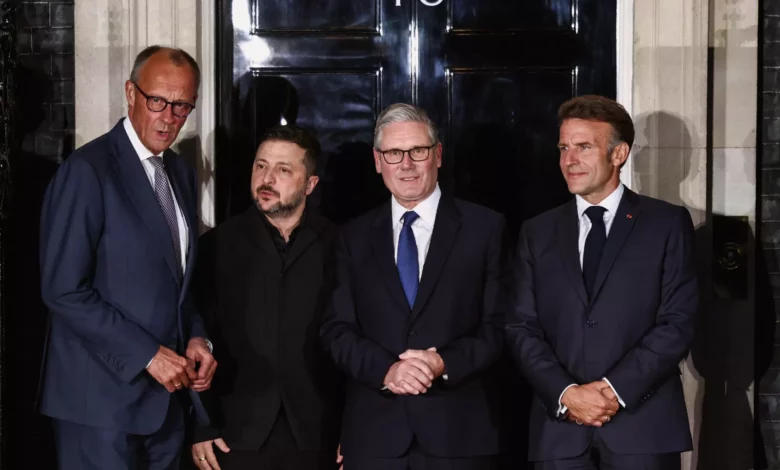
European leaders have warned of an “urgent need” to scale up the production of defensive weapons capable of countering Russia’s hypersonic Oreshnik missiles, following a late-night summit in Downing Street on Sunday attended by Sir Keir Starmer, French President Emmanuel Macron, German Chancellor Friedrich Merz and Ukrainian President Volodymyr Zelensky. The meeting, convened against the backdrop of escalating missile and drone attacks on Ukrainian cities, focused on closing a critical gap in Ukraine’s air defence capabilities that has left civilians increasingly exposed.
The Oreshnik, an intermediate-range ballistic missile (IRBM) capable of speeds exceeding Mach 10 — Ukrainian officials have reported speeds up to Mach 11 — poses a particularly acute threat because of its ability to evade conventional radar detection, leaving minimal response time for air defence systems. It is a Multiple Independently Targetable Re-entry Vehicle (MIRV) system, meaning each missile can split and deliver up to 36 separate strikes. Russian President Vladimir Putin has described the weapon as travelling at Mach 10 and claimed in 2024 that “there are currently no ways of counteracting this weapon”. However, forensic analysis of recovered missile fragments suggests the Oreshnik is not a new, state-of-the-art weapon; evidence points to assembly in 2017 using components from 2016 or earlier, a finding that contradicts Russia’s claims of advanced technology but does not diminish its destructive potential.
The Oreshnik has been recorded in combat three times. Its first known use was on November 21, 2024, targeting Dnipro. The second came in early January 2026, when it struck an aviation repair plant and a gas storage facility near Lviv. The third recorded use was in late May 2026, hitting Bila Tserkva in the Kyiv Oblast. Putin claimed in early June 2026 that these strikes had been conducted with inert payloads to “observe the results for future launches” and asserted there had been “no combat use of the Oreshnik missile in the true sense of the word”. Ukrainian officials and some analysts have disputed this, noting the missile’s capacity to carry nuclear warheads and the significant damage caused even by conventional payloads.
The summit’s readout condemned “Russia’s large-scale missile and drone attacks – including the repeated use of the Oreshnik missiles – on Ukrainian cities with a tragic toll on civilians, as well as irresponsible and dangerous Russian drone incursions into Nato territory”. The leaders underlined the urgent need to scale up the production of interceptors and co-develop anti-ballistic missile and deep strike capabilities, and to support the future sustainability of the Ukrainian armed forces. The meeting also announced plans for further military support for Ukraine and greater economic pressure on Russia. Ukraine’s shortage of air defence systems, in part because US stocks have been depleted by the Iran war, has left civilians especially vulnerable to ballistic missiles.
Europe has identified its own lack of sufficient deep-strike capabilities as a strategic liability, a gap that the war in Ukraine has accelerated efforts to close. Initiatives such as the European Long-range Strike Approach (ELSA), involving France, Germany, Italy, Poland, Sweden and the UK, aim to develop ground- and sea-launched cruise and ballistic missiles with ranges of 1,000–2,000 km or more. The need for European independence in this area has been underscored by recent US measures to reduce its military posture in Europe, including the cancellation of a planned long-range fires battalion deployment to Germany.
Five conditions for peace
Alongside the defence focus, the four leaders set out five conditions for any peace deal with Russia. They called on Putin to agree “an immediate and complete ceasefire” and said the “current line of contact” between the two sides should be the starting point for negotiations. Robust, legally binding security guarantees for Ukraine — potentially including a Multinational Force – Ukraine — were demanded. Russian assets will remain frozen until Moscow compensates Ukraine for war damages. The leaders also insisted that European security interests must be safeguarded, with any EU or NATO-related negotiations requiring the consent of EU and NATO allies.
The renewed diplomatic pressure comes after Russia suffered a series of military setbacks in recent months. President Zelensky had earlier proposed a face-to-face meeting with Putin, but the Russian leader rejected the idea, stating he saw “no point” in meeting before a peace deal was agreed. Putin has previously outlined terms for a ceasefire including Russia keeping occupied land and Ukraine abandoning NATO aspirations.
Chernobyl drone strike
The talks took place hours after a drone strike hit a storage facility for spent nuclear fuel located approximately nine miles from the Chernobyl power plant. The attack sparked a fire, which was extinguished within an hour, and radiation levels remain within safe limits, officials confirmed. The International Atomic Energy Agency expressed concern and said it would visit the site. President Zelensky described the attack as “extremely vile”.
In a post on social media ahead of the summit, Zelensky said the focus of the meeting would be “our defence in the war, greater cooperation for the security of all of Europe in the area of air defence” and discussion of diplomatic prospects. “Europe must be part of the negotiations and must be strong,” he said.
On Saturday, a large-scale Ukrainian drone attack targeted St Petersburg, Russia’s second-largest city, hitting an oil terminal and a naval base. This followed an earlier Ukrainian drone attack on St Petersburg’s oil terminal on June 3, 2026, highlighting Kyiv’s growing ability to strike deep inside Russian territory. The attacks aim to diminish Russia’s oil production and disrupt weapon manufacturing. “We will not just silently die. We will respond,” Zelensky told Sky News on Sunday. “We will be stronger and stronger each day.”