More than 43 million Americans have accumulated college credits but never completed a degree, according to the National Student Clearinghouse Research Center – a statistic that represents one in six adults and lays bare a quiet crisis in the nation’s education system.
The figure hides a deeper story of personal upheaval, financial strain and the persistent stigma of not finishing. In the United States, a college degree has long been viewed as the primary marker of success, leaving those who fall short grappling with internalised failure even when their lives take other meaningful directions. Societal expectations mean that many who leave college – whether because of mental health struggles, family responsibilities, addiction or burnout – rarely discuss their experiences openly. The shame attached to not completing a degree can be as debilitating as the circumstances that forced them out.
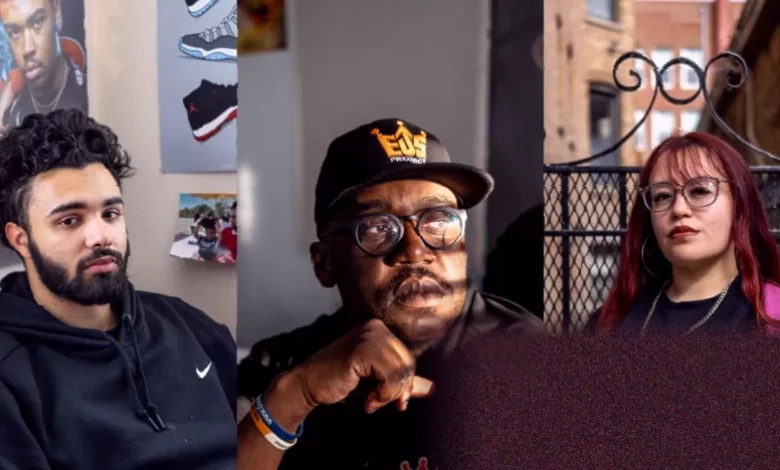
Aaron, 20, Santa Cruz, California
Aaron was 19 when the documentary photographer Rachel Bujalski met him working security at a homeless shelter in Santa Cruz, one of the most expensive housing markets in the United States. Growing up, he often felt out of place – describing himself as “a brown kid in rapper clothes” surrounded by wealthier white classmates. He fought often, spent time in the principal’s office and almost gave up during the pandemic. Still, college represented something larger: proof that his life could move in a different direction.
He enrolled at Cabrillo Community College with plans to transfer to a four-year university and study construction management. In his first year, he was diagnosed with bipolar disorder. He began failing classes and eventually lost the financial aid he depended on. His parents had been forced to leave the area because they could no longer afford housing, leaving him to navigate adulthood alone. Without a financial safety net, continuing school no longer felt possible.
On weekends, Aaron retreats into music. He has produced two autobiographical rap albums filled with lyrics about mental health, pressure and disappointment. He now shares a large rental house with roommates and has enrolled in barber school in San Jose. He continues to work overnight security, now at a bus yard, while building his skills as a barber. “My schedule is barber, work, gym and that’s it,” he said, describing the routine that helps him stay focused on his goals.
Alina, 26, Chicago, Illinois
Alina was balancing far more than most people her age when Bujalski met her in Chicago. Her days revolved around training young boxers at the Chicago Youth Boxing Club, working part-time at her daughter’s school and coordinating childcare, train schedules and family obligations. As a teenager growing up in a neighbourhood marked by gang violence and drugs, she saw college as a pathway to a new environment and a new future. She had planned to attend Hawaii Pacific University, drawn to the possibility of distance and peace. But shortly before leaving, she learned she was pregnant.
Instead she enrolled at National Louis University in Chicago so she could stay close to home and raise her daughter. For a time, she tried to make both worlds work. Between classes, a newborn baby, postpartum depression and a job that required nearly 30 hours a week, college became increasingly difficult to sustain. When the Covid-19 pandemic arrived, bringing further disruptions and unreliable internet access, the situation became impossible. After just one year, Alina left school.
She began boxing in middle school after her immigrant mother encouraged her to learn self-discipline and self-defence. She now coaches young athletes facing their own challenges, and hopes to see more girls enter the sport. Because her childcare arrangement ended shortly after the school day, she often had to bring her daughter Aliana with her to boxing matches and training sessions across Chicago. Since Bujalski photographed her, Alina has left both jobs – the boxing club and the school position (the latter lost to budget cuts). Three months ago, she started a full-time job at a Chevrolet dealership, where she was able to purchase a car for $1,500 from a coworker. The car has helped with transportation, but her daughter told her: “Mom, I love our car but I do miss our walks in the city and all the adventures we used to go on together.” A devout Catholic and proud daughter of Mexican immigrants, Alina starts most mornings with prayer and still speaks about finishing school and becoming a teacher someday.
Dupree, 42, Delray Beach, Florida
Dupree was running his own nonprofit, the EJS Youth Center (named after his father), helping young people avoid the kinds of mistakes that can alter a life. Growing up, he had few examples of academic success around him. Some family members dealt drugs, police regularly raided his mother’s house, and much of his childhood was shaped by instability. As a teenager, he attended Boca Raton high school and spent more time having fun than thinking about college. Football eventually became his pathway to higher education, earning him an opportunity to play at a community college in Minnesota.
Like many young athletes, Dupree was focused on staying eligible to play rather than earning a degree. When his grades slipped and financial aid disappeared, he left school and returned to Florida. He drifted back into dealing drugs before eventually finding his way back to school and transferring to the University of Minnesota Duluth, hoping football might open even bigger doors. Then life intervened again. The cousin he had helped raise was beginning to head down a dangerous path, and Dupree felt pulled back to his family and community. With only 18 credits remaining before graduation, he made the difficult decision to leave school and return home. Today, he channels those experiences into mentoring young people and supporting families. He still wishes he had finished his degree, but the lessons he learned along the way became the foundation for the work he does now.
Sylvie, 43, Charlottesville, Virginia
Sylvie responded to a Reddit post Bujalski made late one night asking strangers to share their experiences of leaving college before graduating. While many people described financial setbacks or family responsibilities, Sylvie’s story was shaped by years of addiction, mental health struggles and repeated attempts to start over. A self-described “artsy type”, she once imagined becoming a teacher or professor. But that path began to unravel after her parents divorced and the family moved from Arizona to Virginia during her teenage years. Struggling to adjust, she began drinking, smoking and acting out before transferring to an alternative high school with only a dozen students in her graduating class. There, she excelled academically even as her life outside the classroom became increasingly turbulent.
After high school, Sylvie enrolled at Virginia Commonwealth University, where she admits she was often more interested in partying than studying. Then one of her friends died by suicide, and Sylvie was among those who found him. Already battling anxiety and depression, she spiraled and eventually dropped out. Hoping for a fresh start, she later enrolled at Arizona State University, pursuing a double major in English and women’s studies. But a serious motorcycle accident led to surgery and an opioid addiction that would alter the course of her life. Around the same time, she became immersed in the punk music scene, married young and left school for a second time. The years that followed were marked by instability and reinvention. She moved back to Virginia, worked in restaurants and bars, earned a welding certificate and became a mother. Today, much of her energy is focused on maintaining sobriety and creating stability for her family. Recently, she applied for a union apprenticeship with an elevator mechanics local in Virginia, completed the aptitude test and interview process, and was ranked 70th out of roughly 200 applicants. As positions become available, the union contacts candidates based on their ranking.
The photographer’s perspective
Rachel Bujalski, a documentary photographer and storyteller whose work explores community, resilience and alternative ways of living, first began noticing the pattern while on assignments. “I kept meeting people who had left college without a degree,” she said. “I kept hearing versions of the same story: people would explain where they had landed in life by tracing it back to the moment college became impossible to finish.” Some had left only a semester short of graduating. Others had dropped out years earlier after financial instability, family responsibilities, illness, addiction or burnout. What struck her most was how common the experience was – and how rarely it was talked about openly because of the shame attached to not finishing.
Bujalski met Aaron while on assignment at a homeless shelter in Santa Cruz; Alina while visiting her old boxing gym in Chicago; Dupree through a mutual friend in Florida; and Sylvie after the Reddit post. The four individuals featured in her project represent only a small portion of the people she encountered while reporting. Additional stories and photographs from “Some College, No Degree” will be shared through the Lumina Foundation website and social media channels. The Lumina Foundation, a philanthropic organisation focused on increasing Americans’ access to education, is supporting the project. For Bujalski, the work is a reminder that lives rarely unfold according to plan. “I’ve started countless projects that never fully materialised,” she noted. “Some stories lose momentum. Others wait years before revealing what they are really about.”