A seven-month-old baby was killed and his parents wounded after Israeli troops opened fire on the family’s car in the occupied West Bank, despite the vehicle having come to a complete halt at the soldiers’ signal, according to the father, who has demanded an investigation and accountability.
The baby’s death and the father’s account
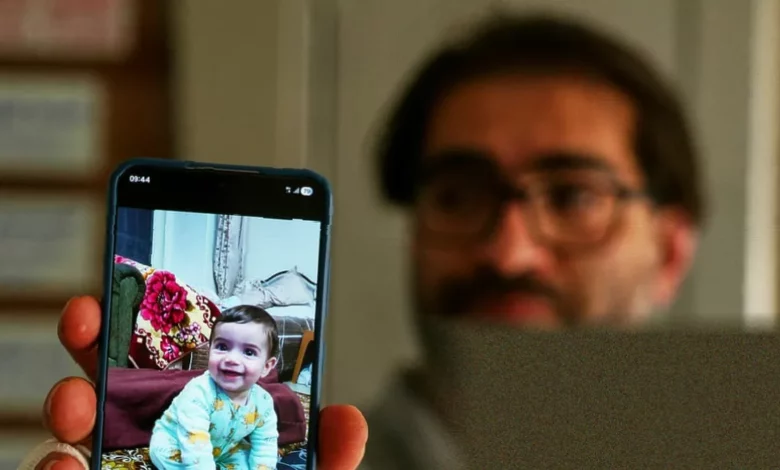
Sam Fahd Abu Haikal, who turned seven months old on the day he was killed, died after a bullet struck him in the face while he was being held by his mother in the back seat of the family car in the Tel Rumeida area of Hebron. His father, Fahd Abu Haikal, a lecturer at Bethlehem University, was shot in the hand. The boy’s mother suffered critical injuries, with shrapnel lodged close to her heart, and was told of her son’s death only just before the funeral prayers.
In detailed eyewitness testimony, Abu Haikal said the family – which also included the couple’s 11-year-old son and his own mother – was driving through Hebron on Friday evening when soldiers signalled for the vehicle to stop. He insisted the car was stationary at the time of the shooting. “The soldier signalled me to stop. I brought the car to a complete halt and raised my hands on the steering wheel. Immediately afterwards, they opened fire on the vehicle,” he told Haaretz.
Abu Haikal stated that the soldier who fired was approximately 10 metres away and could see clearly into the car, which had no tinted windows, in broad daylight. “The soldier was about 10 metres away from me. He saw me, he saw my wife and the children. The windows were not tinted, it was broad daylight and everything was clear. You can’t say he didn’t see that it was a family,” he said. A bullet passed through his hand and struck his son, who was in his mother’s arms. Other bullets hit the car’s windshield and hood, according to the father.
Rejecting the military’s version of events, Abu Haikal told Haaretz: “There was no clear checkpoint, just soldiers standing in the street. I stopped when I was asked to, and then the shooting started.” Speaking at his son’s funeral on Saturday, he said: “The car was completely stationary when he shot at us, it wasn’t moving at all. A seven-month-old infant killed in cold blood. He didn’t deserve this.” He added: “What happened to us is not a matter of an apology… To say it happened by mistake… no. There is no such thing as ‘by mistake’ in this case.”
The baby’s grandmother, Feryal Abu Heikal, who was also in the car, corroborated the account, stating that the family stopped and then the soldiers opened fire. She described the scene as horrific and questioned what kind of army would act in such a manner.
The baby’s body was wrapped in a Palestinian flag. His father carried him as men placed the small bundle at their feet and bowed in prayer. Photos of the car after the attack showed at least one bullet hole in the windshield, and the infant’s car seat was behind the driver’s seat.
The military’s response
The Israel Defense Forces said that troops “perceived a vehicle accelerating toward them” and that one soldier “responded with single shots toward the vehicle.” The military stated that as a result, three Palestinians were injured and evacuated for medical treatment, and that its initial inquiry found those injured were “uninvolved civilians.” The IDF expressed “deep sorrow for any harm caused to uninvolved individuals” and said the incident is “under review,” with findings to be submitted for consideration by the relevant authorities.
Fahd Abu Haikal called the military’s explanation baseless. “I stopped as I was instructed to, and then they simply shot at the car,” he said. At the funeral he stated: “The soldier opened fire, then pulled back his unit and just walked away without a single word or a second thought.” He demanded accountability: “I demand and expect, if there is any conscience, any law, any morality, that the soldier who fired the shots will be held accountable for his actions. This case must not be closed without an investigation and without accountability. At the very least, I do not intend to give up.”
The British consulate in Jerusalem said on X that it was “shocked and saddened” by the killing and called for an “immediate and transparent investigation and accountability.”
Broader context: violence and lack of accountability
Friday’s shooting is not an isolated incident. In a similar case on 15 March, Israeli troops operating in Tamoun, in the northern Jordan Valley, opened fire on a vehicle, killing a Palestinian couple – Ali Bani Odeh, 38, and Waad Bani Odeh, 36 – and their sons Othman, six, and Mohammad, five. According to the Israeli human rights group B’Tselem, soldiers removed two other children from the vehicle, Khaled, 11, and Mustafa, eight, who suffered minor shrapnel injuries. The organisation said troops subjected Khaled to a violent interrogation at the scene, initially prevented ambulances from reaching the area, and later confiscated the family’s vehicle, which was riddled with bullet holes.
The United Nations said last month that more than 1,000 Palestinians have been killed in the occupied West Bank and East Jerusalem since the war began, at least 240 of them children, and 49 people have been killed this year. The UN Human Rights Office has noted a pattern of “utter disregard for Palestinian lives” and a lack of accountability for Israeli forces and settlers.
Israeli soldiers accused of harming Palestinians are rarely penalised. According to the Israeli rights group Yesh Din, indictments were issued in less than 1% of cases based on 2,427 complaints alleging wrongdoing between 2016 and 2024.
Related developments in Gaza
On Saturday, Israeli strikes in the Gaza Strip killed nine people, according to medical sources and the territory’s civil defence, a rescue service that operates under the authority of Hamas. In Gaza City, a drone strike in the Jawazat camp for displaced people killed seven people and wounded 15 others. Al-Shifa hospital reported receiving six bodies. Israel’s military said one of the dead was a Hamas “terrorist cell commander,” without providing further details.
Farther south, Muhannad Othman Farwana, 25, was killed in a strike on a tent in Khan Younis, the civil defence confirmed. Nasser hospital reported that his body was brought in along with several wounded. The Israeli army said Farwana was “a terrorist cell commander in the military wing” of Hamas and was killed in a precision strike. The strike hit his tent on the roof of his house. Farwana was due to get married later that day. “The whole family was ready to celebrate his wedding. Now, we’re attending his funeral instead of his marriage,” his cousin Mohammed Farwana told AFP.