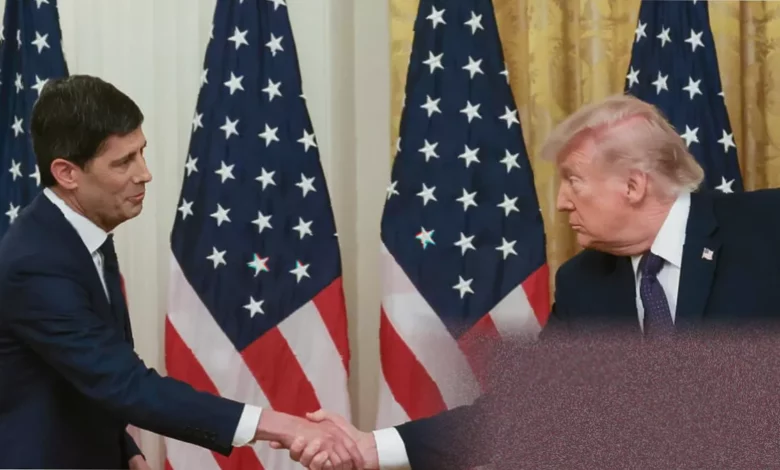
Kevin Warsh has been sworn in as chair of the US Federal Reserve, taking the helm of the world’s most powerful central bank at a moment when President Donald Trump is openly demanding interest rate cuts even as inflation climbs and the economic outlook darkens. The ceremony, held in the East Room of the White House – an unusual venue not used for a Fed swearing-in since 1987 – immediately raised questions about the institution’s long-cherished independence. Warsh, a former Fed governor and Wall Street banker handpicked by Trump, succeeds Jerome Powell, whom the president had repeatedly attacked for refusing to lower rates and who had warned of the inflationary risks of Trump’s own agenda.
The oath of office was administered by US Supreme Court Justice Clarence Thomas, whom Warsh later called “an esteemed friend”, as his wife Jane Lauder held a Bible. Among the attendees were Justice Brett Kavanaugh, former vice-president Dan Quayle, former secretary of state Condoleezza Rice, Treasury Secretary Scott Bessent and National Economic Council Director Kevin Hassett – who had himself been widely reported as a contender for the Fed chair. In his remarks, Warsh pledged to lead a “reform-oriented Federal Reserve”, declaring that “inflation can be lower, growth stronger, real take-home pay higher, and America can be more prosperous, and no less important”. He added that he would “learn from past successes and mistakes both, escaping static frameworks and models, and upholding clear standards of integrity and performance”. Yet his refusal during an April Senate banking committee hearing to answer whether Trump lost the 2020 election had already alarmed Democrats, and Senator Elizabeth Warren, the committee’s top Democrat, said on Friday that Warsh “starts his tenure with his credibility in tatters”, accusing him of being “Donald Trump’s sock puppet” who would “prioritize the President’s political interests over the economic wellbeing of American families”.
Warsh’s confirmation by the Senate was the most divisive for the position in history, passing 54-45 largely along party lines, with only Democrat John Fetterman breaking ranks to vote in favour. The new chair is reportedly the wealthiest Fed chief ever, but concerns have been raised about his refusal to disclose the sources of more than $100 million in assets, fuelling questions about potential conflicts of interest. Senator Warren also pointed to Warsh’s past record as a Fed governor between 2006 and 2011, calling him an “enthusiastic cheerleader for credit default swaps and complex securitizations” who dismissed concerns about subprime mortgages before the 2008 financial crisis, and later helped arrange bailouts for Wall Street. Warsh has said he has “no regrets” about his tenure.
Mounting economic pressures on American households
The Federal Reserve under Warsh inherits an economy facing severe strains. Inflation hit a three-year high of 3.8% in April, with energy prices climbing 17.9% annually. The national average price of a gallon of regular gasoline stood at $4.55 on Friday, according to AAA – up $1.35 from a year ago and the highest level in four years. Millions of Americans were set to hit the road over Memorial Day weekend, and the spike in fuel costs was driven in large part by the US-Israel war on Iran, which has unsettled financial markets and darkened the economic outlook.
Public confidence in the economy has collapsed. A Gallup poll released on the day of Warsh’s swearing-in showed that only 16% of US adults rated the economy as excellent or good, while 49% described it as poor – the worst reading in nearly four years. Gallup’s Economic Confidence Index fell to -45, the lowest since October 2022. A Quinnipiac University poll released earlier in the week found that just 33% of voters approve of Trump’s handling of the economy, the lowest approval rating of his presidency. A New York Times/Siena College poll put disapproval at 64%, and an AP/NORC poll found that even 37% of Republicans disapprove of Trump’s management of the economy. Three out of four Americans now say economic conditions are getting worse.
The political backlash is most vividly captured in a Morris Predictive Insights poll, which shows that 68% of Americans believe Trump is prioritising his controversial immigration crackdown at the expense of their economic wellbeing. The same proportion said his administration is too focused on mass deportations and not enough on affordability issues. The poll underscores the strength of public discontent following Trump’s admission that financial pressures from the Iran war were “not even a little bit” driving him to reach a peace deal. Dissatisfaction spans the ideological spectrum: even among Trump voters, 36% believe his administration has the wrong priorities; among those who have abandoned their previous support for Trump, the figure rises to 70%; and 27% of loyal Trump voters think the president is on the wrong track. On his once-signature issues of the economy and immigration, disapproval ratings now sit at -35% and -13% respectively.
A majority of voters – 53% – favour redirecting spending away from immigration enforcement towards reducing food and grocery costs, lowering health costs or supporting programmes such as Medicaid. Some 56% believe mass deportation of immigrant workers is damaging the economy by raising costs for US families, tearing families apart and driving up prices for everyone, compared with 34% who say it is making the country safer. Large majorities also criticise immigration enforcement as “going too far” when it results in higher grocery bills after farm and food workers are deported, immigrant children disappear from classrooms, elderly people and families lose care workers, and restaurants close because workers have been expelled.
Trump’s economic boasts and the battle for the Fed’s independence
Yet on Friday afternoon, in a sprawling nearly hour-long speech at Rockland Community College in Suffern, New York – a campaign event for Republican congressman Mike Lawler – Trump painted a radically different picture. He boasted that the stock market had reached “all time record highs since the election”, that “factory construction is up, new residential construction is way up and consumer spending is way up”, and that “American companies are ordering core capital goods to expand their operations at the highest rate in the history of our country”. He acknowledged climbing gas prices but blamed Democrats, and said of energy: “That’s the big one. And we’re going to get that down, it’ll get down to where it was, maybe even get down lower.”
Trump has been waging an unprecedented battle to exert greater control over the Fed, raising fears over its independence. At the swearing-in ceremony, he told Warsh: “I want Kevin to be totally independent. I want him to be independent and just do a great job. Don’t look at me. Don’t look at anybody. Just do your own thing, and do a great job.” But those words were immediately undercut by his next remark: “Unfortunately, in the eyes of many, the Fed lost its way in recent years.” Trump previously called Jerome Powell “incompetent or crooked” and expressed a desire to fire him. Powell, who was not present at Warsh’s ceremony, had repeatedly warned over the inflationary dangers of Trump’s agenda.
Warsh himself, during his confirmation process, said he would maintain Fed independence. But the poll data suggests that, beyond the walls of the East Room, a growing number of Americans are souring on Trump’s economic record. In a warning sign for Republicans ahead of the congressional midterm elections, the Morris survey found that 16% of Trump’s 2024 voters no longer plan to vote for the party in November. The primary reason: the faltering economy and rising living costs, cited by 51% of that cohort. Another 36% cited the president’s personal conduct and rhetoric, while 24% blamed immigration enforcement and deportations.
“While I’m not naive about the challenges we face, I believe, Mr President, these years can bring unmatched prosperity that will raise living standards for Americans from all walks of life, and the Fed has something to do with it,” Warsh said inside the White House on Friday. But as he takes up his post, the central bank is under extraordinary pressure from the White House to cut rates even as prices continue to climb, and the public’s faith in the economy has sunk to its lowest point in years.