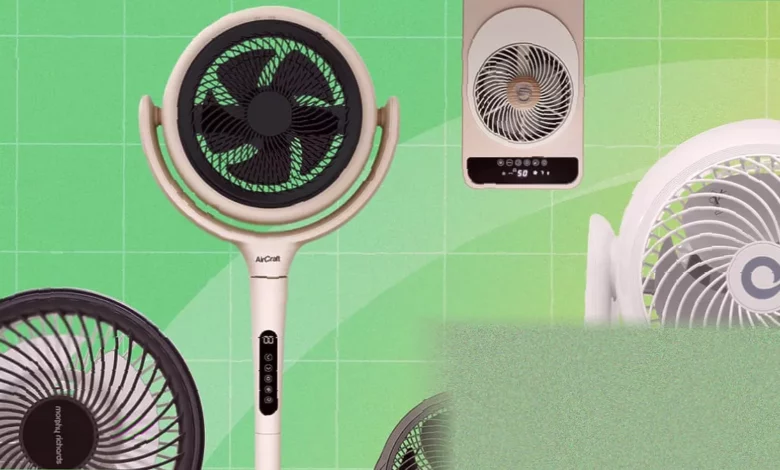
As the UK swelters through an early heatwave – with temperatures forecast to exceed 27°C across multiple regions from 17–26 May and amber health alerts in force – the choice between reaching for air conditioning or plugging in a fan has become a pressing household decision. Fans use significantly less electricity than air conditioning, a difference that translates directly into lower bills and a smaller carbon footprint. The Met Office has indicated a 40% chance of a hot summer overall, with potential for record-breaking highs of 40°C in July and August, making the case for energy-efficient cooling more urgent than ever.
The energy cost of keeping cool
A typical portable air conditioner uses 1,000W of electricity, costing about 26p per hour to run. By contrast, the fans tested by consumer technology journalist Caramel Quin used between 8W and 60W. Her favourite, the AirCraft Lume, consumed just 18W on its top setting. That means you could run it on maximum for 56 hours and still use no more electricity – and therefore spend no more money – than a single air conditioner running for one hour. Fans are not just cheaper; they are also kinder to the planet. As Quin notes, unless you are on a renewable tariff, electricity use accelerates climate breakdown.
The current energy price cap for electricity in the UK (1 April to 30 June 2026) stands at 24.67p per kWh. To put that in practical terms: running a 30W fan for five hours uses 150Wh, or 0.150kWh, costing just under 4p. Over a year of daily five-hour use, that adds up to about £14. Fans do not actively cool the air – they circulate it, creating a breeze that helps sweat evaporate and makes you feel cooler – but they achieve this at a fraction of the cost.
For those who want something more than a breeze, evaporative coolers offer a middle ground. The two models Quin tested – the Swan Nordic air cooler and a Honeywell unit – used 26W and 39W respectively, roughly 3% of the electricity consumed by a typical portable air conditioner. While they cannot turn a room “fridge cold” like air conditioning, Quin reports that they can cool the air enough to make a significant difference during a heatwave. The Swan Nordic cooler, for example, lowered a room’s temperature by 1°C in an hour during testing.
Which fan for which room?
Quin tested 15 fans spanning all major types. Pedestal fans are tall, with the fan mechanism at the top, and some models – such as the AirCraft Lume – can be converted into a desk fan by removing the pole. Bladeless fans, including models from Dyson, VortexAir and Shark, hide the blades inside the body and push air out of a nozzle; they look modern and are easy to clean, with no exposed moving parts. Tower fans are tall and narrow, oscillating side to side to distribute air across a room – the Dreo Cruiser TF518, named best tower fan, oscillates 90 degrees. Desk fans, like the Devola, sit on tables or bedside cabinets and are compact enough to store over winter. Evaporative coolers use a water reservoir to actively cool the air, while handheld fans are lightweight and portable.
Most fans oscillate (move back and forth) on their base, and some allow you to select the angle. Some also oscillate up and down to create a gentle breeze across the whole room. Sleep mode, found on most fans, automatically lowers the speed every 30 or 60 minutes to prevent you waking up cold while still saving energy. For positioning, Quin advises pointing the fan directly at you – the moving air displaces warm, humid air near your skin, aiding sweat evaporation – and never placing a fan against a wall, as air needs to flow into the back. If it is cooler outside, put the fan in front of an open window or door.
Quin’s top recommendations, based on her testing, are as follows. The AirCraft Lume (best overall) is a convertible pedestal/desk fan with 12 speeds, three modes (Normal, Natural, Sleep), a dimmable LED backlight, a remote control, a 12-hour timer, and vertical and horizontal oscillation. It is “ultra-quiet” – at lower speeds it is almost silent, and even at top speed it is compared to an electric toothbrush. Prices seen were £149 and £129. For a budget option, the Devola desk fan (best budget and best desk fan) uses a DC motor drawing as little as 28W, produces an air speed of 4m/s, and is near-silent at 20 decibels on low settings, though it can reach 70dB on high. It has nine fan speeds, vertical (62°) and horizontal (80°) oscillation, a 12-hour timer, a touch control panel with a remote, and a leather carry handle. It costs £64.99 but stock is expected at the end of May.
The Shark FlexBreeze Pro Mist FA300UK (best misting fan) offers an air speed of 4.7m/s, five speeds, a misting function, and side-to-side oscillation with an adjustable head. It costs £199.99. The Dreo Cruiser TF518 (best tower fan) is slim, oscillates 90 degrees, includes a 0–12-hour timer, sleep mode, and an auto mode that adjusts speed based on room temperature. Despite being billed as a “25dB silent bladeless fan”, Quin measured it at 60dB on top speed from a metre away. It costs £76.47. For travel, the Morphy Richards Air Flex USB fan (best travel fan) folds down flat, is cordless and USB rechargeable, with a battery life of four to 17 hours depending on speed. It produces an air speed of 2.6m/s, has four speeds, 90° horizontal oscillation, and adjustable vertical tilt. It was previously £129.99, now £89.99. The Swan Nordic air cooler (best evaporative cooler) impressed with 24 fan speeds, a 5‑litre detachable water tank, two ice packs, a 360° oscillating grille, a 24-hour timer, and a quiet, Scandinavian-inspired design with an oatmeal finish and wood-effect detail.
Other notable models Quin tested include the MeacoFan Sefte, frequently cited as the best overall quietest fan with whisper-quiet operation around 25dB; the Dyson Purifier Cool PC1 fan, which doubles as an air purifier at £349.99; the Shark TurboBlade High-Speed Multi-Directional Cooling Fan System, noted as the best bladeless fan with a magnetic remote; and the Levoit Classic LTF-F362-WUK tower fan, which is QuietMark certified and suitable for sleeping.
How the fans were tested
Quin, an award-winning consumer tech journalist with a degree in engineering and decades of experience testing gadgets, put the fans through a rigorous, scientific and subjective assessment. She used a power meter to measure electricity consumption, an anemometer to record air speed on the top setting, and the Sound Meter app to gauge noise at top speed – noting that all fans were too quiet to register on their lowest setting. Every measurement was taken from one metre away, although she points out that a tower or pedestal fan would usually be placed farther away and a desk fan closer, meaning desk fan noise matters more. She also measured the fans herself because official specifications can be misleading: one tower fan supposedly 17cm wide turned out not to include its base. For evaporative coolers, she used a thermometer to measure the temperature drop. Subjectively, she assessed how cooling each fan felt, how annoying the noise was, the quality of controls, appearance, how small it packed away, and the price.
All the fans that were not returned to manufacturers were donated to Furnishing Futures, a charity that furnishes empty social homes for women and children placed after domestic abuse. Founded by Emily Wheeler, the charity creates “healing homes” for survivors, combating furniture poverty and reducing landfill by using donated, returned, or ex-showroom items. The lack of basic necessities can be a barrier to leaving abusive situations, so the charity’s work provides a safe and nurturing environment for rebuilding lives.
For those keeping their fans, Quin recommends regular cleaning: unplug the fan, remove the front grille, and wipe the blades with a microfibre cloth. If the grille does not come off, a dry paintbrush or compressed air can be used – never water on electricals. When it is time to replace a fan, working models can be offered on local swap sites or community groups. Non-working fans can be taken to repair cafes; if beyond repair, check your council website or Recycle Your Electricals, as they do not belong in general waste.