Fair Isle’s drinking water contains higher levels of toxic PFAS than any other public water supply in Scotland, according to utility data that has left scientists searching for an explanation on this remote outpost. The island, Britain’s most isolated inhabited community, has no obvious industrial sources of the chemicals – no factories, no military bases – yet samples taken in November and December 2023 recorded the highest combined concentrations in the country. The sum of PFAS in the November sample was 23.1 nanograms per litre, equivalent to 23 per cent of the UK’s emergency action threshold of 100 ng/l.
High levels on a remote island
Scottish Water, which conducted its first annual PFAS survey in 2023, tested 631 drinking water sources across Scotland and found the chemicals in 349 of them. The utility noted that concentrations were generally higher at rural water treatment works, a pattern it is still investigating. No sample exceeded the UK’s emergency limit, though other countries – including the United States and Denmark – enforce far stricter standards. On Fair Isle, the puzzle deepened when documents from the island’s airstrip and community fire station were examined. Scottish Water initially suggested a fire at the bird observatory in 2019, or fire-fighting foam used at the airstrip, as possible local sources. But records show only seawater was used to extinguish the observatory blaze, and the National Trust for Scotland, which owns the island, said it uses only PFAS-free foam at the airport.
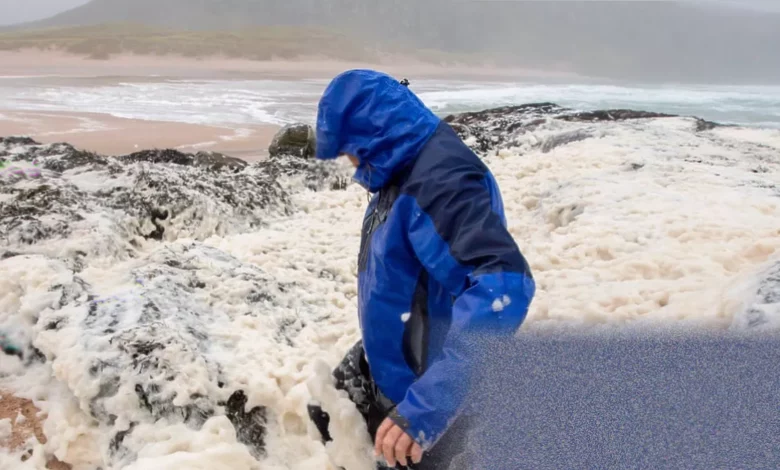
Researchers from institutions including Stockholm University, the University of Texas, the University of Liverpool and the University of Aberdeen reviewed the Fair Isle water data and agreed that the fingerprint of individual PFAS compounds matched the mix that would arrive not from a local spill but carried in seaspray and foam. Fair Isle is known for its dramatic seascapes, rare birds and knitwear, and its residents are used to seeing pale yellow seafoam drift across the fields during storms – a phenomenon so familiar it has its own place in local mythology, where it is said to be the butter churned by a troll named Lukki Minni. Tommy Hyndman, an artist who moved from upstate New York two decades ago, said: “When the Atlantic gets going, foam covers the whole island. Your windows get caked and your plants all die from the salt.” That same foam, scientists now believe, may be delivering the chemicals.
The seafoam theory
PFAS – per- and polyfluoroalkyl substances, often called “forever chemicals” because they do not break down in the environment – are highly surface-active, meaning they are attracted to the boundary between water and air. Bo Sha, an environmental chemist at Stockholm University who has researched how seaspray can transport PFAS for nearly a decade, explained that the ocean has long been considered the “ultimate sink” for persistent pollutants. But with PFAS, he said, “it’s like a pump that keeps pushing chemicals to the surface”. A bubble travelling through seawater “harvests” PFAS molecules towards it, and the seafoam floating above a given sample of seawater will contain more PFAS than the water itself. Once airborne inside bubbles or spray, the chemicals can travel hundreds of kilometres in the span of a few days.
Fair Isle’s extreme exposure to stormy Atlantic weather, combined with its small land area, means that PFAS from far away – released into the ocean from industrial sources, airports, fire stations and military bases around the world – are concentrated here in unusually high proportions. The theory is supported by evidence from elsewhere. Across Scotland, remote lochs from Orkney to the Western Isles would fail a proposed EU threshold for safe environmental levels of PFAS. An analysis of Scottish Water samples found that more than a quarter of surface waters tested contained unsafe concentrations; a loch on the Isle of Lewis was ten times over the EU’s proposed standard. In Denmark, recent studies have found PFAS accumulating in coastal groundwater and lichens, driven by seaspray and foam. And last year, scientists detected PFAS in Antarctic seabirds living in some of the most remote parts of the planet, with 22 different compounds – including both legacy chemicals and newer replacements – found in their liver tissue, carried against the grain of prevailing ocean currents. Scotland’s Centre of Expertise for Waters (CREW) has identified atmospheric transport as one of several potential sources of PFAS contamination, alongside industrial activities, landfill sites and wastewater, and has highlighted higher-risk areas in the Northeast, Central Belt, South and parts of the West Coast.
Monitoring gaps and global impact
Despite the findings, all of Scotland’s public drinking water remains below official safety thresholds for consumption. But scientists say the data from Fair Isle and other coastal sites reveals a troubling gap in the UK’s monitoring system. The Scottish Environment Protection Agency (Sepa) has not published any PFAS data since 2018 and has yet to release the results of a testing programme from 2025, despite promising they would be available before the end of the year. A Sepa spokesperson said the agency is still carrying out “validation and verification checks” on that data and added that it does not monitor airborne PFAS. That puts Sepa in line with the rest of the UK, according to Andrew Sweetman, an environmental chemist at Lancaster University who helps run the Department for Environment, Food and Rural Affairs’ (Defra) official air monitoring network. “There is no organised monitoring for PFAS in air; I’m hoping this year that will change,” Sweetman said. He plans to add airborne PFAS monitors into the network, but notes that most Defra monitoring sites were chosen in the 1990s with no thought to the marine environment. Only one site, on the north coast of Norfolk, could begin regularly measuring PFAS arriving in seaspray. “We are trying to think of a quick and dirty way of collecting that data,” he said. “If you drew a straight line from that site there’s nothing between it and the Arctic Circle.”
Understanding the scale of the problem is only the first step, Sweetman added. “The question is then: does that matter, and what can you do? Because it’s too late – there are no pristine parts of our environment any more, anywhere. We have contaminated just about everywhere.” In December, the UK government promised to prioritise “work on a long-term plan”, and in February 2026 it launched a PFAS Plan focused on understanding sources, tackling pathways and reducing exposure. The Environment Agency, which runs a PFAS monitoring network, has been allocated £2.7 million from Defra for PFAS-related work in 2025/26. But KIMO, an international network of local governments focused on marine pollution, has called the UK’s approach “inadequate” and published its own recommendations, urging local authorities to identify coastal areas at risk from seaspray and begin moving livestock, farms and wells inland. The EU, meanwhile, has proposed a comprehensive ban on PFAS under the REACH regulation covering more than 10,000 substances across 23 industrial sectors. Its revised Drinking Water Directive, which takes effect from January 2026, requires member states to monitor PFAS with limits of 0.5 µg/l for “PFAS Total” and 0.1 µg/l for the sum of 20 individual compounds. Further restrictions in 2028 will limit four highly toxic PFAS – PFOA, PFNA, PFHxS and PFOS – to 0.02 parts per billion. The EU has also banned PFAS in food contact materials from August 2026.
Health experts have linked the build-up of certain PFAS in the body to an increased risk of specific cancers, thyroid disease, immune system problems, fertility issues and developmental defects in unborn children. The Royal Society of Chemistry has called for tighter UK regulations. On Fair Isle itself, residents have reacted with a mixture of concern, activism and scepticism. Kathy Coull, a traditional knitter and textile maker, has been filtering her drinking water every night since the PFAS results were first made public in 2024, and wants Scottish Water to take more decisive action. “Water is one thing you can’t live without. To actively ingest something that’s not particularly good for you – it just makes sense to filter it out,” she said. She supports a programme of blood testing among islanders, though she acknowledges the sensitivity: “Nobody wants to highlight it because of the negative effect it could have on tourism. But if we’ve got these high levels, do a trial on it.” Dave Brackenbury, a retired engineer who lives at the island’s southern lighthouse, said he is “sceptical” about the dangers but believes Sepa should be monitoring Fair Isle more closely. “There’s nothing you can do about it but keep an eye on it. Sepa are a disappointment,” he said.
Tommy Hyndman, sitting in the old laird’s house just a few hundred metres from the coast, is not surprised that pollution can reach a place as isolated as Fair Isle – he sees plastic wash up most days. But for someone who moved here “to get away from it all”, the reach of human impact has left a deep impression. “We all live within the environment, and that’s being attacked by pollution wherever you are,” he said. “That’s the world we live in and it’s scary as shit.”