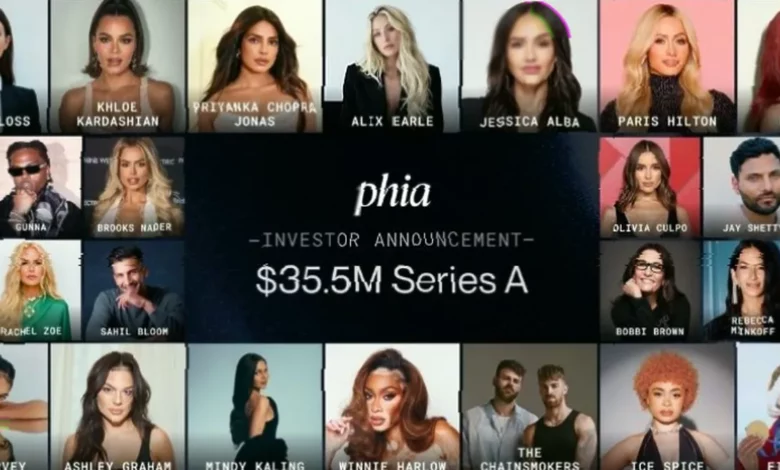
Phia, the AI-powered shopping assistant, has secured more than 30 cultural figures as investors in its oversubscribed Series A round, a list that includes Sydney Sweeney, Paris Hilton, Priyanka Chopra Jonas and Khloé Kardashian. The company, co-founded by Phoebe Gates and Sophia Kianni, revealed the angel cohort on CBS Mornings on May 29, turning what could be a standard cap table into what its founders describe as a deliberate distribution strategy.
Celebrity investors as a distribution engine
The investor line-up includes Sydney Sweeney, Paris Hilton, Priyanka Chopra Jonas, Khloé Kardashian, Jessica Alba, Mindy Kaling, Alix Earle, Karlie Kloss, Alexandre Arnault, Halsey, Ice Spice, Ashley Graham, Bobbi Brown, Rachel Zoe, Leila Hormozi and Winnie Harlow, among more than 30 others spanning fashion, music, film and sport. On the operator side, backers include Vlad Tenev of Robinhood, Naomi Gleit of Meta, Mellody Hobson of Ariel Investments, Charles Porch of OpenAI and Mati Staniszewski of ElevenLabs.
Phia’s core thesis is that shopping discovery is fundamentally social and taste-driven rather than purely algorithmic. The celebrity investor list is the commercial expression of that thesis: each name on the cap table is a potential content creator, brand relationship and audience gateway. “For us, it was about bringing those people and getting them around the table to build what we’re doing with the future of shopping,” Gates said on CBS Mornings.
The Series A round, led by Notable Capital with participation from Khosla Ventures and returning backer Kleiner Perkins, raised $35.5 million and valued the company at $185 million, according to details of the round. That followed an $8 million seed round in September 2025, also led by Kleiner Perkins, which attracted investors including Hailey Bieber, Kris Jenner, Sara Blakely, Michael Rubin, Desiree Gruber and Sheryl Sandberg. Total funding to date stands at $43.5 million.
Gates and Kianni met as roommates at Stanford University. Gates studied Human Biology and African Studies, graduating in June 2024; Kianni, an Iranian-American social entrepreneur and activist, founded the youth-led climate nonprofit Climate Cardinals and has served as a UN advisor. The pair also co-host the podcast “The Burnouts,” which focuses on their experiences as young entrepreneurs.
Growth metrics since launch
Since the app launched in April 2025, Phia has grown to 1.5 million users and expanded to nearly 10,000 retail brand partners spanning contemporary, resale and luxury. The company says it has generated more than one billion views across its platforms and built a social community of 2.7 million followers. It scans more than 350 million products in real time and attributes a 50% reduction in return rates to its recommendation model.
Phia operates on an affiliate marketing model, using AI models to compare items with hundreds of millions of products to find the best price, including secondhand alternatives. Brands on the platform see 13% higher conversion rates, 30% stronger new customer acquisition and 15% increased average order value, the company reports. It is on pace for nine-figure sales growth in 2026, with earlier metrics showing tens of millions of dollars in sales driven by September 2025 and millions of dollars in sales monthly by January 2026.
The platform has also received external recognition: Phia was named to Time Magazine’s “Best Inventions of the Year” list in October 2025, and Gates was named to Forbes’ 30 Under 30 list in 2025. Both founders appeared on Time Magazine’s Time100 Next rising stars list.
The market and the challenge ahead
According to MarketsandMarkets, the global AI in retail market stood at $31.12 billion in 2024 and is projected to reach $164.74 billion by 2030, growing at a compound annual growth rate of 32%. Phia sits in that expanding space, positioning itself as the “AI alignment layer between brands and consumers.”
The real question for Phia is whether a cap table full of cultural influence translates into sustained, organic user growth that keeps a shopping platform relevant beyond the initial wave of celebrity endorsement. The company has a year of strong data behind it, including growth from 500,000 users in five months to 1.5 million today, and a network of nearly 10,000 retail partners. The next year will show whether the audience follows the investors.