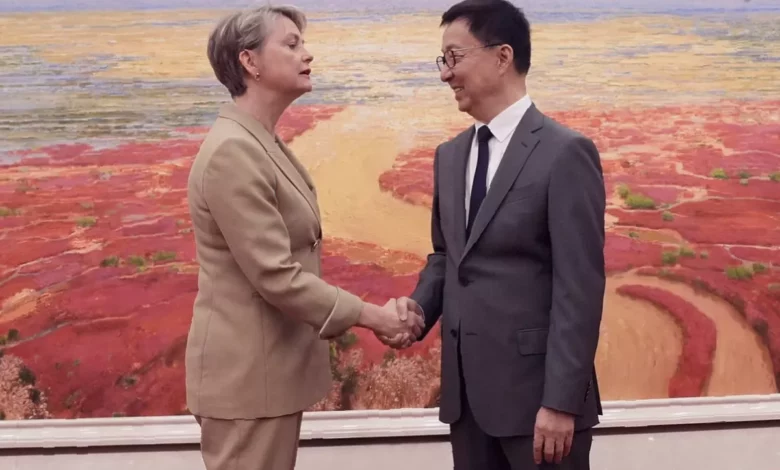
Foreign Secretary Yvette Cooper has called for the UK and China to cooperate on global crises, arguing that as two of the five permanent members of the United Nations Security Council the nations share a responsibility to address pressing international challenges. Speaking during her first visit to Beijing, Cooper said the wars in Ukraine and Iran, as well as health emergencies such as the Ebola outbreak in the Democratic Republic of the Congo, demand joint action between two “P5 powers”.
Cooper’s visit marks a deliberate effort to reset relations after what officials have described as a diplomatic “ice age” between London and Beijing. It follows Prime Minister Sir Keir Starmer’s trip to China in January — the first by a British prime minister in eight years — which was framed as the start of a “new chapter” in bilateral ties. Starmer and Chinese President Xi Jinping pledged at the time to deepen dialogue and cooperation, and Cooper is now seeking to build on that momentum with a series of ministerial meetings and a visit to the technology hub of Shenzhen.
Global challenges demanding joint action
At the heart of Cooper’s message is the view that a rules-based international order serves the “shared interest” of both the UK and China. This framing is intended to anchor the relationship in established international frameworks, even as the two countries remain at odds over a range of security and human rights issues.
The conflicts in Ukraine and Iran were cited by Cooper as the most immediate flashpoints requiring UK-China cooperation. In the case of Ukraine, the UK is likely to press China on its strategic ties with Russia, which have drawn scrutiny since Moscow’s 2022 invasion. Beijing’s diplomatic and economic relationship with Moscow remains a point of friction, and Cooper is expected to raise it directly during her discussions with Chinese Minister of Foreign Affairs Wang Yi and Vice-President Han Zheng.
On Iran, the agenda includes the stability of the Strait of Hormuz, a critical global shipping route where Iran’s actions have raised maritime security concerns. The Foreign Secretary has identified cooperation on de-escalation in the region as a priority.
Alongside geopolitical crises, Cooper highlighted the Ebola outbreak in the Democratic Republic of the Congo as a global health emergency that demands joint international attention and resources. The emphasis on health security reflects a broader recognition in Whitehall that pandemics and disease outbreaks cannot be tackled without the active involvement of major powers such as China.
Broader reset and areas of cooperation
The visit is set against a complex backdrop of economic interdependence and persistent security concerns. China is the UK’s largest trading partner in Asia, while the UK is China’s third-largest trading partner in Europe. Official trade figures show total trade in goods and services between the two countries stood at £104.9 billion in the four quarters to the end of Q4 2025, with UK exports to China rising 5.9% year-on-year in the first quarter of 2026.
Both governments have expressed a desire to deepen economic engagement in areas such as trade, investment, artificial intelligence, green development, and climate change. A Memorandum of Understanding on climate change cooperation was signed in 2025, building on earlier dialogues and partnerships focused on power market reform, offshore wind, and clean hydrogen. The UK has also shown past interest in China’s Belt and Road Initiative, and there are ongoing discussions about “greening” the initiative through shared environmental standards.
Yet the reset is not without its tensions. Security concerns remain acute: the UK has restricted Chinese investment in sensitive sectors and removed Huawei equipment from its 5G networks. The use of “burner” phones by the Foreign Office delegation during the visit underscores continuing espionage anxieties. Human rights issues are also expected to be raised by Cooper, including China’s treatment of the Uighur population and the imprisonment of British citizen and pro-democracy activist Jimmy Lai. Critics of the Labour government have urged a firmer stance on Beijing’s record.
The UK’s 2021 strategic defence and security review identified China as a “systemic competitor” and the “greatest state-based threat to the UK’s economic security”, a designation that has not been formally rescinded. Cooper’s visit therefore represents a pragmatic effort to manage a complex relationship — cooperating where interests align while maintaining a clear line on areas of disagreement.
Cooper met Wang Yi and Han Zheng in Beijing on 2 June for what officials described as the most comprehensive senior foreign policy engagement since the Labour government took office. On 3 June she was due to visit Shenzhen, China’s southern technology hub, for a programme focused on science and technology. The Foreign Secretary is then scheduled to travel to India on 4 June to meet External Affairs Minister S. Jaishankar as part of a wider diplomatic tour.