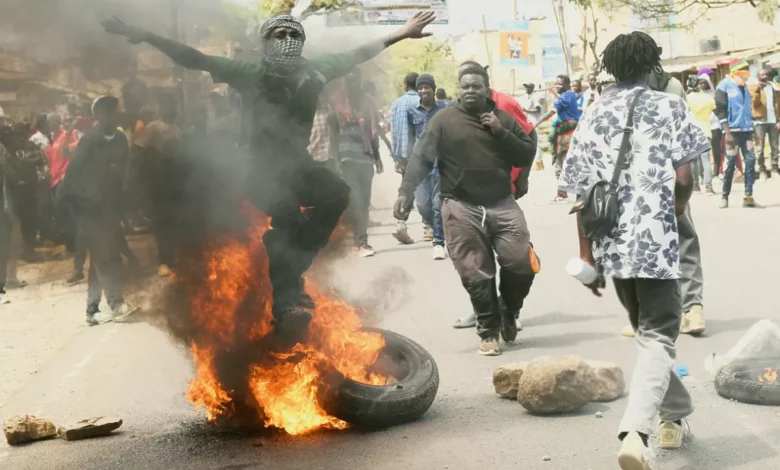
Two people have been killed in central Kenya after protests against a planned US-backed Ebola quarantine facility turned deadly, as residents voiced fury that their country was being turned into a holding zone for Americans exposed to the virus.
The violence erupted on Monday in Nanyuki, a town near Laikipia Air Base, where the facility was to be located. The deaths were confirmed by protest organiser Patrick Wahome and a security source. Businesses in the town were forced to close as demonstrators took to the streets, reflecting a deep well of public anger that has been building since the plan was first revealed.
At the heart of the opposition is a belief that Kenya is being asked to shoulder a risk Washington is unwilling to take for itself. The proposed centre, intended to quarantine and treat US citizens who may have been exposed to Ebola while working in the Democratic Republic of Congo or Uganda, was due to become operational on 29 May. It would have housed up to 50 beds and was to be staffed by members of the US Public Health Service, with the American government committing $13.5 million (about Sh1.7 billion) towards Kenya’s Ebola preparedness.
But for many residents, the promise of financial support has been overshadowed by what they see as a fundamental inequity. “If it’s too dangerous for America, it’s too dangerous for Kenya,” protesters have said. Critics have also pointed to the Trump administration’s own travel restrictions, which ban green card holders and other travellers who have recently been in the DRC, Uganda or South Sudan from entering the United States — a move that, in the eyes of many Kenyans, underlines the very risks the quarantine facility is meant to contain.
The current outbreak, caused by the rare Bundibugyo strain of Ebola, has added to the alarm. Unlike the more widely known Zaire strain, there is no licensed vaccine or specific treatment for Bundibugyo. The World Health Organization declared the outbreak a Public Health Emergency of International Concern on 17 May. As of late May, more than 1,200 suspected and confirmed cases and at least 241 deaths had been reported across the DRC and Uganda. By 1 June, the DRC had confirmed 321 cases and 48 deaths, while Uganda had confirmed 11 cases and one death. The case fatality rate for the Bundibugyo virus is estimated at between 30 and 50 per cent.
Fears that Kenya could become a staging ground for America’s Ebola problem have been amplified by the US administration’s own historical position. During the 2014-2016 West Africa Ebola outbreak, Donald Trump — now president — publicly criticised Barack Obama for allowing infected Americans to be brought home for treatment. The decision to build a quarantine centre on foreign soil this time has been seen by many as a direct reversal of that earlier stance, raising questions about why Kenya should accept a risk the US once considered unacceptable.
Legal challenge and medical union threat
Opposition has moved beyond the streets. Last week, Kenya’s High Court issued temporary conservatory orders suspending the establishment of the facility, following a lawsuit filed by the Katiba Institute and the Law Society of Kenya. The orders bar the government from facilitating, approving or operationalising any Ebola-related facility linked to the US, and prohibit the admission or transfer of Ebola-exposed or infected individuals into Kenya under the proposed arrangement. The court is due to hear the case further on 2 June.
The Katiba Institute argued that the plan was secretive and unilateral, raising constitutional concerns over the rights to life, health, fair administrative action, public participation and parliamentary oversight. The Law Society of Kenya said any agreement reached without public participation and proper legal safeguards should be nullified.
Kenya’s main medical union has also weighed in, threatening industrial action and demanding that the full terms of the agreement be released within 48 hours. “The US clearly would not allow Ebola on its soil, and Kenya should not become a dumping ground,” the union stated.
Adding to local suspicions, flight-tracking data showed a US military C-130 transport aircraft landed in Nanyuki on Friday, 29 May, and residents reported seeing military aircraft heading towards the base over the weekend — movements that many interpreted as evidence of the plan progressing despite the court order.
President Ruto’s defence
President William Ruto hit back at critics on Monday night, insisting the facility was part of a broader national emergency preparedness strategy and not a special arrangement for the United States. “We are a responsible government. We know what we are doing,” Ruto declared, urging Kenyans not to panic.
He confirmed that he had approved the plan after a personal request from President Donald Trump, citing decades of cooperation between Kenya and the US on major health crises, including HIV/AIDS, Covid-19 and earlier Ebola outbreaks. Ruto argued that the Laikipia Air Base facility would not be unique, claiming similar health preparedness centres already exist across Kenya. He listed Kenyatta Hospital, the Police Hospital in Nairobi, Moi Teaching and Referral Hospital in Eldoret, Kenyatta Hospital in Thika, and Alupe Hospital in Busia as examples of existing isolation and treatment sites. He also stated that the facility could be used by Kenyans if Ebola cases emerge.
Ruto did not refer to the court order while defending the plan, instead dismissing the backlash as politicisation of a serious public health issue. Kenyan authorities have insisted that no Ebola cases have been detected inside the country, and that border screening has been intensified, with around 3,000 people checked daily at airports and land crossings.
The administration has also pointed to Kenya’s own health security frameworks, including the National Action Plan for Health Security (2026–2030) and the Kenya National Public Health Institute Strategic Plan (2023–2027), which aim to improve the country’s capacity to detect and manage health threats through real-time data use, strengthened emergency preparedness, and a “One Health” approach.
Yet for many residents, the promise of preparedness has been overshadowed by the sight of American military aircraft and the suspicion that Kenya is being asked to carry a burden the United States has chosen to avoid. The deadly protests on Monday have shown just how explosive the issue has become.