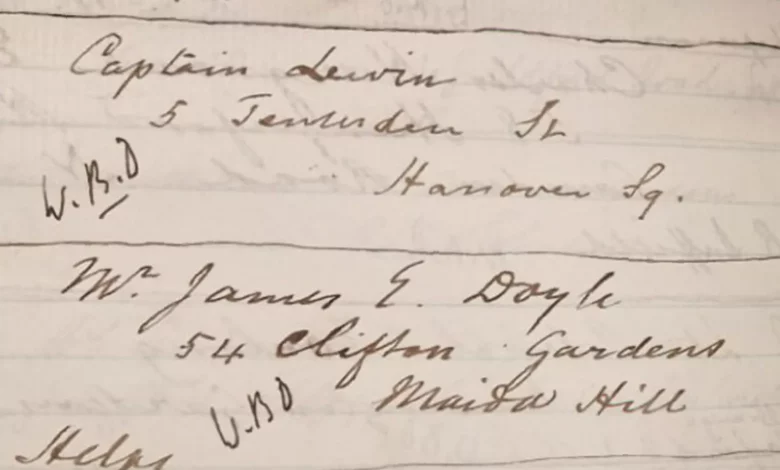
The London Library has thrown open its archives to the world, making the historic membership records from its foundation in 1841 up to 1950 freely available online for the first time. The digitised ledgers and membership forms, supported by the Unwin Charitable Trust with seed funding from Mark Storey, allow anyone to search for names and uncover the social and literary networks that shaped Victorian and Edwardian Britain.
Originally kept in hefty ledger books and later evolving into formal membership forms from 1874 onwards, the records have been painstakingly disbound, transcribed and uploaded. The Library, a private subscription institution still operating from 14 St James’s Square, has made the archive searchable by name, giving researchers, genealogists and the simply curious a direct line to the past. Visitors can look up an ancestor, a literary hero, or even themselves, and see who nominated whom — building a picture of the circles in which they moved.
A library born of frustration
The London Library was founded in 1841 by the Scottish essayist and historian Thomas Carlyle, who had grown deeply frustrated with the conditions at the British Museum Library. He complained of a shortage of seating, a “museum headache” from being confined with other readers, and, critically, the inability to borrow books. Carlyle envisioned a private subscription library where members could take volumes home to read in peace. His campaign gained momentum after a pivotal speech at the Freemasons’ Tavern in Covent Garden in June 1840. The Library moved to its current home in St James’s Square in 1845, and the building was largely rebuilt in 1896–98. It has survived wartime damage, including a bomb strike in 1944 that destroyed 16,000 books.
At a time when no lending libraries existed in London — and before state-funded public libraries — the institution quickly became a hub for the nation’s literary and intellectual life. Its collection today numbers around one million books and periodicals, with 95% of stock dating from 1500 to the present day available for browsing and borrowing. The unique classification system, devised by former librarian Charles Hagberg Wright, deliberately juxtaposes subjects in unexpected ways, encouraging serendipitous discovery.
The treasure hidden among the famous
The digitised records naturally contain a roll call of the great and the good. Charles Dickens, a founding member, also nominated other prospective members. Thomas Hardy joined in 1906, proposed by his close friend Frederic Harrison. E.M. Forster is listed simply as “lecturer”. Arthur Conan Doyle became a member late in his career, after he had been knighted. Bram Stoker was a member, though his wife joined only after his death; Stoker’s notes for Dracula were later discovered inside a library book about Whitby slang. Charles Darwin signed up within months of the Library’s opening. Virginia Woolf was a member — her father, Sir Leslie Stephen, had served as president — and T.S. Eliot later held the same office. Mark Twain’s joining card was found by librarians; he was nominated in 1896 by his publishers, Chatto & Windus. Constance Wilde, Oscar Wilde’s wife, appears in the ledgers, as does a Lord Tennyson — though the records note it is not the famous poet.
But the real value of the archive, the Library has emphasised, lies not in the famous names but in the ordinary people. A long-dead relative may be recorded here, and their entry reveals who sponsored their membership or whom they subsequently put forward. This allows researchers to reconstruct the social fabric of literary London — the connections between neighbours, colleagues and friends who were not themselves celebrated authors yet moved in the same circles. For example, Eliza Lynn, one of the first female journalists in the capital, joined in 1887 and was nominated by Charles Dickens. Such details, the Library says, offer a far richer picture than any list of celebrities alone could provide.
The digitisation project, funded by the Unwin Charitable Trust — which supports literacy and the book trade — and initial seed funding from Mark Storey, a former Treasurer and Trustee of the Library and now Vice President of its International Friends group, covers membership records up to 1950. The archive is open to all, free of charge, and can be searched at the Library’s website.