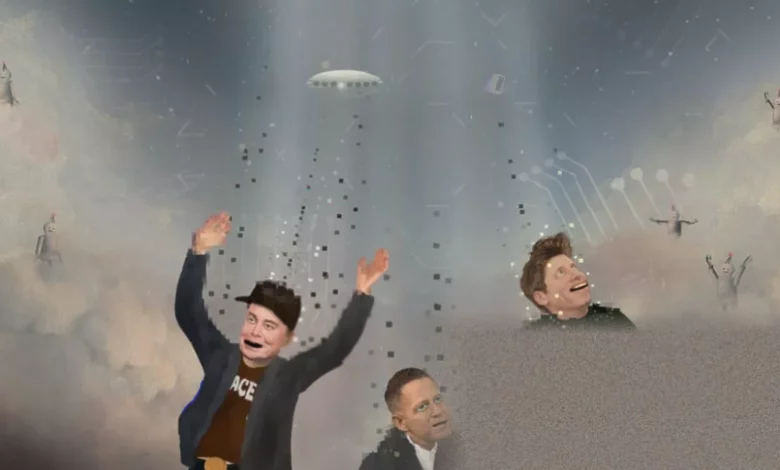
Tech elites are quietly constructing a new religion, one centred on the ambition to transcend the human condition through technology. In Silicon Valley, the ancient impulse to find cosmic meaning has found a secular outlet: transhumanism, the belief that humanity is merely a stepping stone to a superior, digitally enhanced form of existence. As Elon Musk, the world’s richest man, posted on his platform X: “Atheism left an empty space. Secular religion took its place.”
The comparison is more than metaphorical. “Silicon Valley has been a militantly secular space,” one prominent technology thinker told this newspaper. “It created a God-shaped hole, which it filled in its image.” Rejecting the moral constraints of organised religion, the tech oligarchs have turned to science fiction‑infused dreams of immortality, cosmic expansion and the ultimate goal: distilling human consciousness into binary code, to be uploaded onto a silicon chip or beamed through space as electromagnetic waves. This is not idle fantasy; it is the worldview guiding the men and women at the helm of the most powerful companies on Earth.
The religious analogy runs deep. OpenAI’s chief executive, Sam Altman, has proposed that homo sapiens will be the first species “to design our own descendants”. Writing a few years ago, he imagined a “merge” between humans and artificial intelligence within the next fifty years. The alternative – a separate machine civilisation – he warned, would lead to conflict: “If two different species both want the same thing and only one can have it – in this case, to be the dominant species on the planet and beyond – they are going to have conflict.” Altman has already invested in Nectome, a startup that aims to retrieve the brain’s anatomical layout and molecular details to replicate consciousness in the future. “I assume my brain will be uploaded to the cloud,” he told the MIT Technology Review.
Musk, for his part, has described humanity as a “biological bootloader for digital superintelligence”, reducing our entire species to the low‑level code that starts a computer before sophisticated programs can run. Yet Musk’s own vision is slightly different: he wants to enhance humans with computers, via his brain‑to‑computer interface company Neuralink, while preserving the flesh. He has also founded SpaceX to establish a backup civilisation on Mars. According to Silicon Valley lore, Musk once pushed back against Google co‑founder Larry Page’s claim that our next manifestation would necessarily be digital in order to spread across the galaxy – and Musk testified in court that those concerns prompted him to co‑found OpenAI with Altman. Meat and bones, Page argued, do not make for efficient interstellar travellers.
Peter Thiel, of PayPal and Palantir, rejects the idea of “just a computer program that simulates me” but is drawn to “this radical transformation where your human, natural body gets transformed into an immortal body”. Despite their differences, the visions converge. Page once told Charlie Rose that rather than giving money to charity, he might give it to Musk’s Mars project, calling it a worthy goal. A shared cosmology has emerged, borrowing from an eclectic mix of ideologies.
From effective altruism to the stars
The philosophical foundation of this new faith is built on a chain of reasoning that starts with effective altruism (EA). EA seduced the tech elite with its appeal to unflinching rationality: philanthropy should be directed where it does the most good for the most people, not squandered on local libraries. This logic encouraged laudable efforts such as eradicating malaria. But it soon departed from the needs of present earthlings. A subset called longtermism argued that improving the world of the far future – potentially filled with trillions of post‑human beings across the galaxy – is worthier than spending on today’s poor. From there, it took only a small step to shift the goalposts to the cosmos. Academics like William MacAskill and Nick Bostrom, funded by the oligarchs’ mushrooming wealth, refined these ideas in university departments and think‑tanks, drawing on unorthodox ethics and idiosyncratic readings of physics.
The earlier Extropians, active in the 1990s and including Bostrom, Eliezer Yudkowsky and economist Robin Hanson, proposed in their core principles “Boundless Expansion: Seeking more intelligence, wisdom, and effectiveness, an unlimited lifespan, and the removal of political, cultural, biological, and psychological limits to self‑actualization and self‑realization. Perpetually overcoming constraints on our progress and possibilities. Expanding into the universe and advancing without end.”
Effective accelerationism and the will of the universe
The most recent and aggressive branch is effective accelerationism, or “e/acc”. Its adherents have tried to conscript physics to their cause. The movement’s leading light, Guillaume Verdon – known online as Beff Jezos – argues controversially that maximising intelligent life is an imperative because life is good at extracting available energy from the environment and dissipating it, increasing what physicists call “entropy”. In Verdon’s words: “Effective accelerationism aims to follow the ‘will of the universe’: leaning into the thermodynamic bias towards futures with greater and smarter civilizations that are more effective at finding/extracting free energy from the universe and converting it to utility at grander and grander scales.”
This thermodynamic framing provides a pseudo‑physical justification for rampant techno‑capitalism, unhindered by regulation, government or any other constraint. The faster humanity consumes the universe’s resources and dissipates the residue, the more it “captures civilizational utility”. The goal is to ascend the Kardashev scale – a measure of a civilisation’s energy consumption. Present humanity does not even consume all the energy of the Earth. Advanced civilisations consume that of their star, or even the entire galaxy. The oligarchs’ dream is to harness such power to transcend biological limits and populate the cosmos with future transhuman beings.
The danger of indifference
Weird though these worldviews may appear, they are not harmless. As Nobel‑prize winning economist Daron Acemoglu wrote: “The handful of people unleashing this technology on the world are guided by an ideology of control (over humanity) and by a conviction that machines are uniformly better than humans.” The immediate risk is that the tech elite’s cosmic fantasies redirect vast resources – capital, energy, minerals, water – away from pressing present‑day needs such as healthcare, education and poverty reduction, and towards turbocharging AI to deliver a transhuman future that only looks like utopia to its architects. Altman himself noted disparagingly that “it also takes a lot of energy to train a human”, as if human life were merely a cost item.
The flat‑out indifference is evident in the oligarchs’ own statements. Venture capitalist Marc Andreessen wants to “ensure the techno‑capital upward spiral continues forever” and lists “sustainability”, “social responsibility” and “tech ethics” as enemies. Musk has called empathy “the fundamental weakness of western civilization”. Thiel, though fiercely committed to an idiosyncratic Christianity in which anyone standing in the way of technology appears as the antichrist, is contemptuous of government redistribution and views charity as a waste of resources needed for technological transcendence. As computer science pioneer Jaron Lanier put it: “If you create God but you own God you become the dictator.”
There is also a profound lack of understanding of the technology being unleashed. “People outside the field are often surprised and alarmed to learn that we do not understand how our own AI creations work,” wrote Dario Amodei, co‑founder of Anthropic, last year. “They are right to be concerned: this lack of understanding is essentially unprecedented in the history of technology.” Amodei and his sister Daniela, Anthropic’s president – who is married to a founder of effective altruism – have recently distanced themselves from that movement.
Despite growing public unease – a recent Times‑Siena poll found more than twice as many registered voters say AI is mostly bad compared with those who say it is mostly good – the Trump administration has shown little interest in imposing regulatory guardrails. Tech billionaires are pouring hundreds of millions into political campaigns to fend off attempts at accountability. For now, no one with the power to stop them is butting in.
Pushback is emerging from unexpected quarters. Rural communities in Virginia are resisting data centres that hog power and water. Evangelical Christians are wary of a cosmopolitan elite claiming recourse to a tech‑inflected higher authority. College graduates have booed commencement speakers who extol AI. And from the Vatican, Pope Leo published the encyclical Magnifica Humanitas, warning against unfettered AI development that creates “a paradox of material progress and anthropological regression”. Donald Trump briefly expressed concern over the potential criminal capabilities of Anthropic’s new Mythos model, but decided against regulation.
The historical parallel that comes to mind is Henry Ford’s Fordlândia, an attempt to build a harmonic social order around an industrial‑scale rubber plantation in the Brazilian rainforest. Fordlândia today lies in ruins – a pointless water tower, decrepit houses, a lifeless playground, nurseries where children were fed soy milk shipped from miles away because Ford disliked cows, schools where they were taught about Henry Wadsworth Longfellow. The ruins are testament to an oligarchy that overvalued its power and confused its appetites with the greater good.