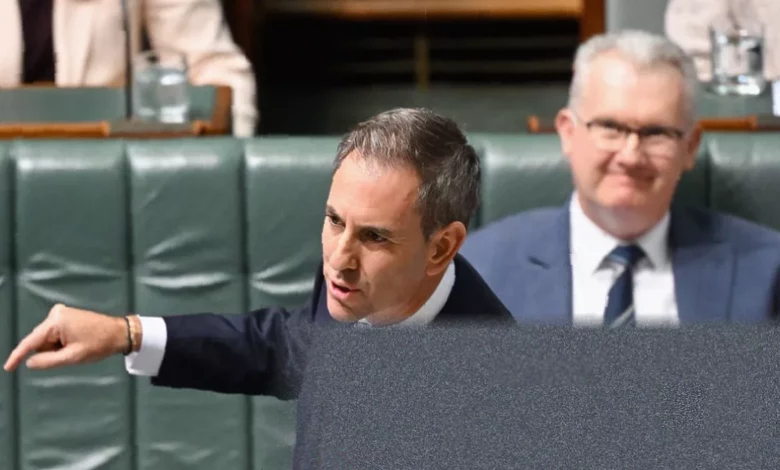
Treasurer Jim Chalmers came under direct personal attack from the opposition over tax during a heated question time, with the shadow treasurer, Tim Wilson, demanding he confirm that bracket creep had extracted an extra $410 from the average worker in the past year and that the working Australians tax offset would be “chewed up by bracket creep within a year”. Chalmers, who has been treasurer since May 2025, responded by calling Wilson “not the sharpest tool in the shed” and accusing the Liberal Party of voting against tax cuts for 13 million Australian workers on the same day they questioned the government’s record. Wilson rose on a point of order, Labor MP Luke Gosling made an interjection and was ejected from the chamber by the speaker, Milton Dick. Dick then told Chalmers to stop discussing opposition policies. Chalmers countered that the government had returned bracket creep on five occasions using three different mechanisms, and that the Coalition would leave Australians paying higher income taxes if it had its way.
Tax debate
The opposition also pressed Labor on the estimated $77bn revenue gain from changes to capital gains tax, with questions focused on the tax take. During the exchanges, the housing minister, Clare O’Neil, was rebuked by the speaker for repeatedly attacking the Coalition instead of answering a question about migration’s impact on the housing market, with Dick warning she was “going close to defying the speaker”. Later, Nationals MP Michelle Landry sought clarity on the definition of a “new build” for housing tax concessions — asking whether a second dwelling on an existing title would qualify — but received only a brief response from O’Neil that “a new dwelling is one that genuinely adds new to housing supply”.
Aged care assessments under scrutiny
In Senate estimates, the Department of Health, Disability and Ageing provided data to Liberal Senator Anne Ruston showing that almost one‑quarter — 24 per cent — of assessments for aged care support at‑home packages are conducted remotely, with no in‑person contact, and are then fed into an algorithm that has no human override over the decision. The waiting list stands at 200,000, encompassing both older Australians waiting to be assessed and those waiting for the package they have been approved for. Senator Ruston said older Australians are waiting months just for an assessment, and when the appointment finally comes, one in four never meets their assessor in person. “Labor has designed a system where support is determined by a faceless, phone‑based assessment that’s fed into a computerised algorithm with no human override,” she said, adding that people with worsening health conditions, including those living with ALS, dementia and other progressive, degenerative diseases, are already having their support cut back by this flawed tool.
The implications of this system were highlighted when independent MP Rebekha Sharkie asked the aged care minister, Sam Rae, what it takes for a dying person to “actually get support at home”. She described the case of a constituent named Greg, who has 12 months to live but has been assessed as medium priority and will wait most of his remaining life for support, with contact from the minister’s office having been “fruitless”. Minister Rae acknowledged the population is ageing rapidly and that demand for care is growing, stating that in some cases people like Greg go through the assessment process and are still waiting. He assured the chamber that the budget had allocated additional funding to examine the prioritisation and mechanism of the national priority system to ensure people receive the care they need.
Minimum wage clash
In the Senate education and employment legislation committee, the increase in the minimum wage was debated. The environment and water minister, Murray Watt — who previously served as minister for employment and workplace relations — said he was not entirely clear where the Liberal and National parties stood on the issue, and cited Senator Jane Hume as having described real wage increases as “the worst things for Australians”. Senator Hume interjected, saying Watt could not have watched her most recent press conference because she said nothing of the sort. Watt also noted that Senator Pauline Hanson did not support an increase in the minimum wage, which he found surprising given she says she stands up for battlers, and declared that the government welcomes and supports the fair work commission’s decision.
Neale Daniher honoured
The Victorian parliament paid tribute to Neale Daniher, the former AFL footballer and coach who died last week, 13 years after being diagnosed with motor neurone disease. Premier Jacinta Allan led condolence motions in the lower house, describing Daniher as a “deep thinker” and “fierce competitor” whose influence reached far beyond the football field. She said that instead of stepping away from public life after his diagnosis, he co‑founded the charity FightMND and created an “army to fight this cruel disease”, and that because of him there is now more research, more support, more awareness, and more hope.
Labor MP Emma Vulin, who was diagnosed with MND in 2024, told the chamber that Daniher was one of the first people to reach out to her. She said he invited her and her partner into his home, gave an honest conversation about what lay ahead, and offered “kindness, generosity and hope”. The opposition leader in Victoria, Jess Wilson, said Daniher was a constituent in her electorate of Kew who “faced one of life’s cruelest challenges with a level of courage, grace, and good humour that few of us could ever hope to match”. A state funeral service will be held for Daniher on Wednesday 10 June at the Melbourne Cricket Ground, just two days after the AFL’s Big Freeze — an annual fundraising and awareness campaign spearheaded by Daniher that has raised more than $100m for research projects. Daniher was named Victorian of the Year in 2019 and Australian of the Year in 2025, and FightMND has now committed over $141m to MND research and care.
Ben Roberts-Smith war crimes charges
Former SAS corporal Ben Roberts-Smith, who was arrested at Sydney airport in April and charged with five counts of the war crime of murder, will not see the full brief of evidence against him for months because the case contains classified national security information. Each federal charge carries a potential penalty of life imprisonment. Roberts-Smith was released on bail under strict reporting conditions and after surrendering his passport, following a $250,000 surety posted by his father, Len, a former Western Australian supreme court judge. He previously mounted a failed defamation case against three newspapers after they printed allegations of war crimes in 2018; a federal court judge found, on the balance of probabilities, that Roberts-Smith had committed four murders while serving in the Australian military.
The five counts relate to three alleged incidents. In 2009, he is alleged to have shot dead a disabled man, Ahmadullah, who had a prosthetic leg, machine‑gunning him outside a compound called Whiskey 108 after Ahmadullah and his father surrendered unarmed to Australian troops. Roberts‑Smith is also alleged to have been complicit in the execution of Ahmadullah’s father, Mohammed Essa, by a junior soldier ordered to shoot him. In September 2012, in the southern Afghan village of Darwan, he is alleged to have kicked a handcuffed prisoner, Ali Jan, off a 10‑metre cliff before ordering that the injured man be shot dead. One month later at Syahchow, Roberts‑Smith — as patrol commander — and two subordinate soldiers allegedly took two handcuffed prisoners to the edge of a corn field and executed them, at least one on his orders, with Roberts‑Smith then allegedly throwing a grenade that exploded on the bodies to disguise the murders.
At Sydney’s Downing Centre local court on Thursday, crown prosecutor Chelsea Brain said Roberts‑Smith could not be given the full brief until orders protecting sensitive information are made under the National Security Information (Criminal and Civil Proceedings) Act 2004. The application over the secret material was made by the commonwealth government. Roberts‑Smith’s solicitor, Karen Espiner, told the court that her client, crown prosecutors, and the government would likely agree on how the classified documents should be handled. Judge Susan Horan will need to be convinced the orders are necessary during a hearing on 1 September. Roberts‑Smith has not entered pleas but has said he will use the trial to clear his name. He was awarded the Victoria Cross for Australia for his actions in Afghanistan in 2011.
Magnet toys removed from online retailers
The Australian Competition and Consumer Commission has ordered online retailers including Amazon, eBay, Kogan, and Fruugo to remove products marketed for children that contain small high‑powered magnets, which can be deadly if swallowed. The ACCC said the magnets can cause catastrophic, life‑threatening internal injuries, particularly for young children, as multiple magnets can stick together in the intestine or digestive tissue and also pose a choking risk. Deputy chair Catriona Lowe said the watchdog is “extremely concerned that our investigation has detected sellers listing these banned products on online marketplaces”. All four retailers have committed to taking down the listings, contacting affected customers about the safety risks, and — in the case of Kogan, Amazon, and Fruugo — providing or offering refunds to customers who purchased the affected products. Separately, the ACCC has also initiated legal action against Amazon’s Australian unit over alleged breaches of product safety labelling laws for children’s backpacks.
Union security costs
The Department of Employment and Workplace Relations has confirmed it paid around $3.8m in personal protection for the former administrator of the CFMEU, Mark Irving, who served 20 months in the role, during which he fired hundreds of people and received death threats. On top of this, $5m has been set aside in the 2026‑27 budget to protect his successor, union executive Michael Crosby. The environment minister, Murray Watt, said it is the government’s responsibility to keep the administrator safe, noting that “the organised crime elements who have infiltrated the construction industry have made their profits by dealing with the union and some employers”. The Australian Federal Police currently have three investigations into unlawful conduct across the building industry. The threats against Irving were made by organised criminals outside the CFMEU, according to the department. First Assistant Secretary Sarah Godden said the AFP conveyed that the threats against Irving’s life were “not only credible but by people with the means and motive to carry them out”.
Aukus security pact questioned
The shadow defence minister, James Paterson, has claimed Labor is in “revolt” over the Aukus security pact after backbencher Ed Husic called for a rethink of the trilateral agreement between Australia, the UK, and the US. Paterson said defence minister Richard Marles should haul Husic into line and demonstrate that Labor is “100%” committed to the submarine deal. He told reporters in Parliament House that it is legitimate to ask questions about how the government is delivering Aukus, but far more concerning is having a former cabinet minister questioning the merits of the pact altogether. “How would that be interpreted in foreign capitals in Washington DC, in London, in Beijing?” Paterson asked. Under the Aukus partnership, the first UK and US submarines are expected to be based in Australia from 2027, with Australia acquiring US‑built Virginia‑class submarines in the early 2030s and then the jointly built SSN‑Aukus class in the late 2030s.
Earlier in question time, independent MP Allegra Spender asked the government why it had not implemented the Murphy review’s recommendation to ban all gambling inducements such as bonus bets and boosted odds, which former anti‑gambling advocate Tim Costello called “the most evil and predatory feature of the gambling industry”. The communications minister, Anika Wells, responded by outlining the government’s broader gambling reforms aimed at minimising children’s exposure to wagering advertising, but did not use the word “inducements” once during her answer. Independent MP Kate Chaney shouted “what about inducements?” from her seat, and Spender rose on a point of order, but the speaker ruled Wells was being relevant.