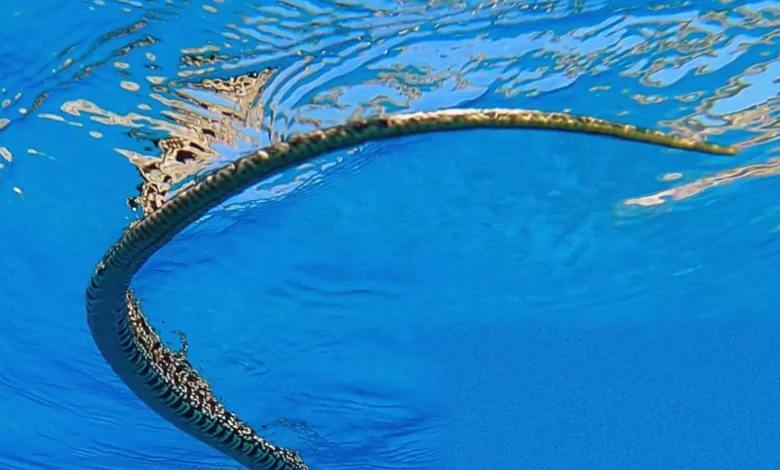
A grainy video captured a snake swimming to a new island. The footage, shot by a local wildlife ranger in April 2024, showed a pale horseshoe whip snake gliding through turquoise waters separating Ibiza’s east coast from the minuscule islet of Santa Eulària, 450 metres away. For years, Spanish researchers and wildlife experts had suspected the snakes were making this crossing; fishermen and tourists had reported sightings. But this was the first proper evidence, said Oriol Lapiedra, a biologist at the Centre for Ecological Research and Forestry Applications (Creaf) in Catalonia. The arrival confirmed that the insatiable invader from the Spanish mainland had opened a new front, threatening the endemic Ibiza wall lizard populations that had long sought refuge on offshore islets.
How ancient olive trees became snake superhighways
The horseshoe whip snake, a non-venomous reptile native to southern and eastern Spain, first appeared on Ibiza around two decades ago. Its rapid colonisation has been traced directly to a landscaping fad among wealthy property owners: importing ancient olive trees from the mainland to adorn their grounds. Those trees, hollowed by age, offered ideal hiding places for hibernating snakes and their eggs. The first documented sighting on the island occurred in the village of Sant Josep de sa Talaia, after a man inadvertently disturbed a snake that fled from an imported olive trunk. Other early sightings were recorded at plant nurseries in San Lorenzo and Santa Eularia. The practice began in the early 2000s, coinciding with a Mediterranean garden trend, and has since been implicated in the introduction of other invasive species, including the common yellow scorpion and a large European spider (Macrothele calpeiana).
The snake’s spread has been relentless. By 2018 it had invaded about 49% of the island’s land area; forecasts from the Balearic regional government, which is working with Creaf and other groups, suggest it will be found across 100% of Ibiza by the end of 2027. On the mainland, the snakes tend to be skinny, rarely exceeding 1.8 metres in length. On Ibiza, however, they are thriving to an extraordinary degree. Specimens have been found longer than 2 metres and weighing two and a half times as much as their mainland counterparts. “We’ve found animals that are as thick as my wrist,” Lapiedra said. More than 3,500 horseshoe whip snakes were captured on the island in 2025 alone, and more than 16,000 have been culled since 2016. In total, over 12,000 invasive snakes have been culled since 2016; in 2025 more than 4,400 were captured across Ibiza and Formentera. The regional government has committed €2.5 million to snake control, deploying more than 2,600 traps.
But despite the trapping effort, the snakes’ swimming ability has opened up a new dimension of invasion. Lapiedra and his colleagues, whose research was published recently in the journal Ecology, believe that increased competition for food on Ibiza may be driving the snakes to swim to nearby islets. The video evidence from Santa Eulària proved what had only been anecdotal: the snakes are capable of crossing open seawater, a behaviour previously unobserved in this species. That has allowed them to reach refuges that once seemed safe for the island’s endemic lizards.
The lizards’ catastrophic decline
The Ibiza wall lizard (Podarcis pityusensis) is the primary prey of the invasive snakes, making up more than half of their diet on the island. The impact has been devastating. In October 2022, the International Union for Conservation of Nature moved the species up its extinction red list from “near threatened” to “endangered”. The lizards are treasured for their aesthetic appeal and tame natures, but they are also a keystone species that controls insect populations – including agricultural pests – and pollinates flowers and disperses seeds. “All that changes when they disappear,” Lapiedra said.
Worse still, the Pityusic Islands (Ibiza, Formentera and their dozens of small islets) each host distinct lizard populations that have evolved in isolation for millions of years. Their colourations include green, blue, black, brown, grey and orange. These lineages are now being wiped out one by one by the snakes’ swimming raids. On Santa Eulària, a 4.67-hectare islet, researchers counted 72 lizards in 2016, just three in 2023, and none detected in 2025. The population is now considered completely extirpated. Unique lizard populations on at least 10 islets – including Santa Eulària and S’Ora – have become extinct. “Each, or most, of the islets have these unique lineages that are being completely lost to science and to humanity right now,” Lapiedra said. “So this is a tragedy – it’s like a fire in an old church.” The snakes have also been found on Ibiza’s neighbouring island of Formentera.
In an effort to safeguard the species, a “Noah’s ark” captive breeding programme was set up at Barcelona Zoo last year. It involves lizards from eight populations. As of June 2025, 17 individuals – ten from Ibiza and seven from Formentera – were housed at the zoo as the initial breeding group, and the first hatchlings were born in July 2025 as part of the pilot project. The programme is reportedly doing well. Yet the small size of the islets, combined with the snakes’ voracity, leaves little room for optimism. Lapiedra compared the situation to the brown tree snake invasion on the Pacific island of Guam, where 10 of the 12 native forest bird species were wiped out after the snakes arrived on US military ships 80 years ago. “The only difference is that the snakes in Guam aren’t reported to swim,” he added. “So there are islands around Guam that still have the species that Guam used to have.”
There is, however, an ironic twist. The safest lizard populations in Ibiza are now those in urban areas. “In the largest cities in Ibiza the populations are fine,” Lapiedra said. “Basically what’s happening is that in the urban areas, the snakes get run over and people there also kill them because they don’t like snakes. So for now, some of these urban areas have good lizard populations.” Researchers have identified small gardens in cities as potential refuges. The Balearic regional government, working with Creaf and other partners, is also urging Spain’s Ministry for Ecological Transition to classify all introduced colubrid snakes as invasive across the archipelago, and efforts are underway to restrict the import of ornamental plants that can carry snakes, though EU free movement of goods regulations present challenges. But the losses already sustained are irreversible. As Lapiedra put it: “The rapid disappearance of the lizards is both an ecological and a cultural disaster.”