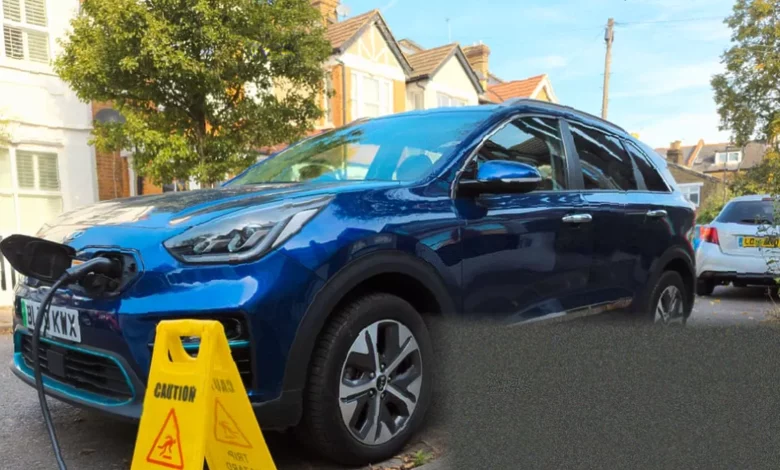
Millions of UK households may be unable to benefit from a simple electric car charging technology because their local councils are refusing to allow charging cables to cross pavements, despite government promises to streamline the process. The energy secretary, Ed Miliband, has championed charger gullies as a way to cut costs for drivers, but more than 20 local authorities are holding out against installations, leaving many residents without access to cheaper home charging.
Among the holdouts are Kent, Leicester, Worcestershire, and a cluster of London boroughs including Westminster and Hackney. London has the highest number of electric vehicles in Britain and also the highest number of households without off-street parking, making the impasse particularly acute in the capital.
How the technology works – and why it matters
Charger gullies are channels cut into the pavement that allow households to run a cable from their home to a car parked on the street. Companies such as Kerbo Charge, Gul-e, Pavecross and ACO manufacture these systems, which they say sit flush with the surface and eliminate trip hazards. Michael Goulden, co-founder of Kerbo Charge, said his company is working with 48 local authorities that either allow gullies or are trialling them, but each council has its own process. “We’re getting more and more streamlined with local authorities to make that more efficient,” he said.
The appeal of the technology lies in the cost of electricity. Home charging attracts a VAT rate of 5%, compared with 20% at public charge points – a gap campaigners have labelled a “pavement tax”. According to the consultancy Field Dynamics, 9.3 million UK households do not have access to off-street parking, meaning they are locked into more expensive public charging unless their council permits a gully.
The government has removed the need for planning permission for cross-pavement charging and introduced permitted development rights in an effort to “slash red tape”. It has also reformed regulations so that Electric Vehicle Charge Point Operators can use street works permits instead of the more complex Section 50 licences – a move welcomed by Energy UK as a “pragmatic, faster, and cost-effective solution”.
Yet installers still require street works licences controlled by councils. “It’s still going to require local authority approval before each installation,” said Goulden. Adam Dolphin, director of Gul-e, added: “They all have their different processes. I wouldn’t say they’re an intentional barrier. They’re just working through the process, how it works.”
Safety and logistical concerns behind council resistance
The objections raised by councils are wide-ranging and go beyond simple reluctance. Several local authorities have pointed to safety risks, including the potential for cables to become trip hazards, particularly for vulnerable groups. Ealing Council in west London said it had “accessibility and safety concerns, particularly for elderly residents, disabled people, wheelchair users and those with visual impairments”. It is instead focusing on installing public chargers in lamp-posts – an approach it says benefits all residents rather than a small number of households.
Kent County Council cited the risk of electric shock if cables become damaged. Worcestershire County Council said it does not “permit the breaking or any damage to the highway to install an EV charger connection”, although it allows cable protector ramps across the pavement. Leicester City Council raised the challenge of parking availability for residents of terraced housing, noting it is not always possible to park directly in front of one’s property, and also highlighted accessibility problems.
Liability and maintenance are further sticking points. Councils are uncertain who would be responsible if someone tripped over a gully or cable and injured themselves, and who would maintain the infrastructure once installed. Westminster Council said gullies “did not work in dense urban areas” and has instead prioritised a public charger network of more than 2,500 on‑street charge points – the highest of any local authority in the UK. Hackney Council said it wanted to “minimise street clutter and prioritise vulnerable road users, such as people walking and wheeling over private vehicles” by keeping chargers off pavements and expanding its public charger rollout. The borough is partnering with Zest to install 2,500 public charge points by 2030, bringing the total to 3,000.
Ealing has more than 1,000 charge points and plans to reach 2,500 by 2030, also using lamp‑column installations as its preferred method. The council’s position reflects a broader pattern: almost a fifth of 83 local authorities or combined authorities in England counted by the government either did not apply for funding allocated to cross‑pavement solutions or did not take their full allocation. “Many inner London boroughs have no plans to do cross‑pavement right now,” said Goulden. “This change in the legislation will make no difference to their residents in the near future.”
Government action and the remaining barriers
Ed Miliband has said the government is looking at ways to address the VAT discrepancy and “surging charge point standing charges” to make charging more affordable. A UK First‑tier Tribunal has already ruled that public EV charging can qualify for the reduced 5% VAT rate under existing “de minimis” rules, challenging HMRC’s longstanding position that public charging is a service taxed at 20%. Campaign groups including Zapmap and FairCharge have pushed for equalisation, and an open letter backed by 44 MPs called on the Chancellor to act.
Financial support is available through several government schemes. The Local Electric Vehicle Infrastructure (LEVI) Fund has provided councils with capital for public charging; Worcestershire received £3.5 million. Households can apply for up to £500 towards installing a cross‑pavement solution if they have only on‑street parking, while renters and flat owners can claim up to £500 (75% of the cost) for a home charge point. A £10 million funding package was announced in November 2025 to support cutting‑edge charging technologies and grid solutions.
Despite these efforts, the patchwork of council policies means that where you live determines whether you can benefit from cheaper home charging. Westminster alone has 2,746 on‑street charge points – more than the combined total of Liverpool, Leeds, Manchester, Newcastle and Sheffield, five northern cities with 2.7 million residents that together have only 2,485 public chargers. By contrast, Coventry, with 350,000 people, has 2,578 chargers. The disparity underscores the postcode lottery facing drivers without off‑street parking.
Worcestershire’s EVCI Strategy focuses on meeting the needs of residents without off‑street parking, but it does not currently support cross‑pavement charging. The county provides guidance for cable protectors instead. Hackney, meanwhile, aims to install 3,000 charge points by 2026 and has said it will keep chargers off pavements to protect vulnerable road users. For the millions of households locked out of gully installations, the only option remains public charging at the higher 20% rate – a double penalty for those without a driveway.