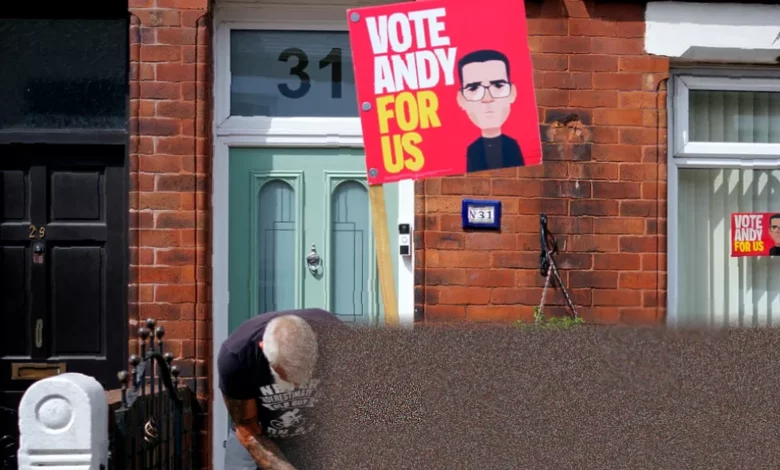
Misinformation in local Facebook groups jumped fourfold during the Makerfield by-election campaign, a study by the Social Market Foundation (SMF) has found, with nearly one in six news posts shared in those groups now classified as false. The surge, which overwhelmingly targets Labour and its candidate Andy Burnham, raises fresh questions about the ability of social media platforms to police harmful content during elections and the wider role of engagement-driven algorithms in amplifying lies.
The SMF analysed more than 1,800 posts across four local Facebook groups representing different towns and settlements within the Makerfield constituency. The groups have a combined membership of 66,000. Before the by-election was called, only 4% of news posts in those groups were classified as misinformation. During the campaign, that figure rose to 16% – a fourfold increase. All of the misinformation analysed in the groups was anti-Labour or pro-Reform UK in nature, with the exception of a single post related to 5G conspiracy theories.
Specific examples of fake news circulating include conspiratorial stories claiming that Burnham covered up scandals involving grooming gangs, false allegations that his wife benefited from Greater Manchester’s electric-vehicle infrastructure procurement, and erroneous claims that Ed Miliband had banned tumble dryers, that Shabana Mahmood had taken part in a violent pro-Palestine protest, and that Burnham had lost his seat in 2017 – when in fact he had stood down. AI-generated imagery has also been deployed, including faked pictures of council blocks, streets lined with Reform UK flags, and Labour and Green hot-air balloons over the constituency.
The flood of misinformation appears to be driven in part by fake accounts and fabricated news organisations. Some of these accounts have few friends, no profile picture, and are marked as newly created. However, the SMF’s report highlights that the social media platforms themselves play a critical role in boosting false content through their algorithms.
How algorithms amplify falsehoods
The SMF report explains that a shift towards “engagement-driven feeds” rather than recency-driven feeds can raise the prominence of misinformation. When users interact with a post – whether by agreeing with it, challenging it, or simply clicking – the platform’s algorithm interprets that engagement as a signal of interest and pushes the post to more users. This mechanism means that even well-intentioned efforts to correct false claims can backfire, because each comment or share feeds the algorithm and keeps the misinformation visible. The problem is particularly acute in local Facebook groups, where a small number of highly engaged posts can dominate what members see.
The practical effect is stark. In one Makerfield Facebook group, five of the top ten posts were misinformation; in another, eight of the top 25 were false. The SMF notes that because the posts were generating high levels of interaction – including heated arguments – the platform’s system continued to boost them, regardless of their factual accuracy.
The findings come at a time when social media has become a primary source of local news for a large share of the British public. According to the SMF report, nearly half of Britons (46%) now seek out local news through social media, second only to television and ahead of every other source. More than a third (34%) use local social media groups for this purpose, despite the fact that these online spaces lack the fact-checking and editorial guidelines associated with traditional press.
Separately, the Reuters Institute for the Study of Journalism has published its annual Digital News Report, which found that for the first time, social media and video networks are, on average across the markets covered, more popular than both television and owned news websites and apps as sources of news. The report also notes that legacy platforms such as Facebook and X are reducing the prominence of news, while video-led platforms like TikTok, Instagram and YouTube are growing in importance. Concerns about misinformation have risen globally, with around six in ten people expressing worry.
The SMF’s research also draws a direct link between the decline of local journalism and the prevalence of fake news. Earlier this month the thinktank published a report showing that areas with no or limited local news outlets – so-called “news deserts” – have nearly three times as much fake news as the national average. An estimated 4.4 million people in the UK live in such areas. Misinformation also spikes during election periods: in the run-up to polling day, misinformation as a share of news posts increased by 56% compared with earlier in the year.
The most common topics of misinformation across Facebook and X were identified as immigration and Islamophobia. A fifth of all fake news posts in Facebook groups related to local issues, including planning, transport, local services and council politics.
Theo Bertram, director of the SMF, said the Makerfield report shows why Ofcom should be doing more to tackle fake news on platforms like Facebook. “Voters in Makerfield are being exposed to harmful misinformation – and at an even greater intensity than we have seen in the rest of the UK,” he said. “Too often local misinformation goes unchecked by big tech and unchallenged by national media. We need stronger enforcement from the companies and sustained investment in local news and reporting.”
Ofcom is tasked under the Online Safety Act 2023 with tackling illegal content and misinformation by regulating platforms’ systems and processes, rather than individual posts. The regulator also has a duty to promote media literacy and help users understand the nature and impact of disinformation.
The SMF report – titled “No news is bad news”, published on 8 June 2026, with a subsequent blog post “Deep Fakerfield” on 16 June – makes a series of recommendations. It calls for stronger enforcement of existing rules by tech companies, and suggests that the BBC and ITV should expand their local news content onto social media platforms. It also advocates strengthening and expanding the Local Democracy Reporting (LDR) Service, which provides coverage of local councils and public bodies. Without such measures, the thinktank warns, voters in by-elections and general elections will continue to be fed falsehoods that algorithms are designed to amplify. The Makerfield by-election is scheduled for Thursday, 18 June 2026, and has been described as one of the most consequential in recent British history, with Burnham seeking a route back to Parliament ahead of a potential challenge to Prime Minister Keir Starmer for the Labour leadership.