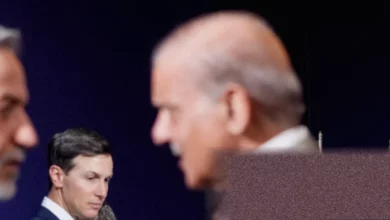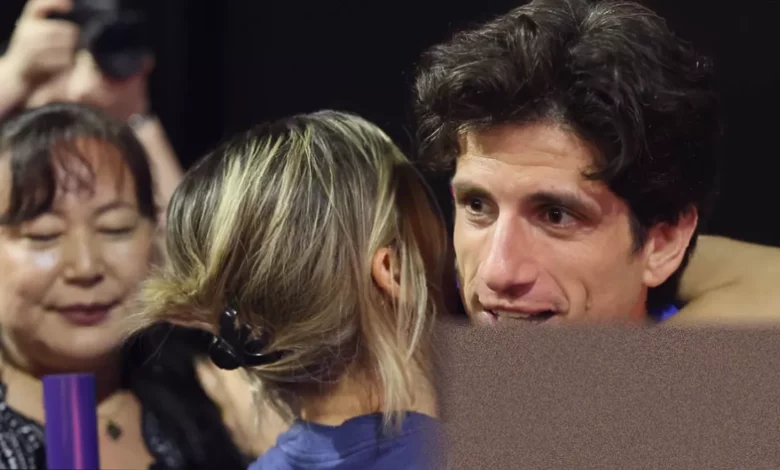
In Manhattan’s 12th congressional district, a safely Democratic seat that also happens to be the wealthiest and smallest in the country, the primary election has become a bizarre spectacle: a Kennedy heir with more than 2m Instagram followers is squaring off against a Republican-turned-Trump-critic who races around in a leather jacket, while a self-described nerd and a former software engineer bankrolled by rival artificial intelligence companies scrap for the same slice of Upper East Side and Upper West Side voters.
Few predicted the race to replace retiring Congressman Jerrold Nadler would turn into such a carnival of contrasts. The four white men still in contention – Jack Schlossberg, George Conway, Micah Lasher and Alex Bores – represent not just competing résumés but competing visions of what the Democratic Party should look like in the closing years of the Trump era. With early voting already under way and the primary set to close on 23 June, the outcome remains deeply uncertain.
Schlossberg, 33, has never held elected office. He has a Harvard MBA, a law degree and a brief, largely inactive stint as a Vogue political correspondent – but what he lacks in experience he makes up for in star power. As the grandson of John F Kennedy, he has the backing of former House Speaker Nancy Pelosi, who called him “the best of his generation”. His social-media feed, which has attracted more than 2m followers, is a carefully curated mix of paddleboarding, surfing and goofy antics, a deliberate contrast with the gerontocratic image of a party still reeling from Joe Biden’s age-related collapse. At a recent appearance at Barney Greengrass, a Jewish deli on the Upper West Side, about 20 people – several of them young women – turned up to see him. The deli created a “Jack Stack” sandwich in his honour. When asked about criticism that his campaign was all style and no substance, he struck back with sarcasm: “The Democratic party has been way too cool. We’ve been way too exciting.”
George Conway, by contrast, is leaning hard into an entirely different kind of performance. A former Republican who co-founded the Lincoln Project and became a household name as a Trump critic on CNN, the 62-year-old has adopted the persona of a hard man. He has appeared in adverts wearing a Top-Gun-style leather jacket, scored a goal on a hockey rink in another, and, in his most recent spot, gives the finger to a presidential motorcade. “The only thing your name is going to be left on when I’m done with you is an orange jumpsuit you’re going to have to wear in prison,” he says to Trump in the ad. The antics may seem silly, but his fundraising is not: as of 3 June, he had raised $6.6m, including a $2m loan from himself, the most of any candidate.
I’m proud and excited to endorse @micahlasher for Congress. He’ll bring a sense of urgency, creativity, and fearlessness to Washington. pic.twitter.com/aaQvKIMh4b
— Jerry Nadler (@JerryNadler) February 9, 2026
The nerds and the résumé
Micah Lasher, a New York state assemblymember and self-described nerd, is running on a slogan of “Ready for the Fight” and a résumé that spans more than two decades in public service. He managed his first campaign at 19, served as chief of staff to the New York attorney general, as policy director to the governor and as an aide to Jerrold Nadler himself. The retiring congressman has endorsed him, calling him “New York’s protector-in-chief against all things Trump”. Lasher has also been endorsed by Michael Bloomberg, Kathy Hochul, Eric Schneiderman and other heavyweights. Yet his Instagram following stands at barely 8,000 – a hundredth of Schlossberg’s – and he trails in prediction markets among younger voters. A recent AARP New York/Siena College poll shows him leading only among voters aged 50 and older.
Alex Bores, another state assemblymember, brings a different kind of expertise. He is the first Democrat elected at any level in New York with a degree in computer science, and his professional background includes a stint at Palantir, the data-mining company, which he left after expressing concerns about its immigration-enforcement work. His campaign has focused single-mindedly on regulating artificial intelligence, advocating for safeguards such as the RAISE Act. That single-issue focus has made him the unlikely centre of a proxy war between two of the world’s most powerful AI companies.
The AI money war
The influence of artificial intelligence companies in the race goes far beyond a standard campaign issue. Outside groups have spent roughly $12m either supporting or opposing Bores, turning the primary into a high-stakes laboratory for how corporate money from the tech sector can shape a Democratic contest. A political action committee with ties to Greg Brockman, the co-founder of OpenAI, has spent $6.2m on attack ads against Bores. Meanwhile, groups linked to Anthropic – OpenAI’s main rival – have poured a similar amount into backing him. The spending has spilled into public view: during a recent televised debate, Lasher pointed out that Anthropic backers and a billionaire crypto investor, Chris Larsen, had funded Bores’s campaign. Bores defended himself as the staunchest critic of the AI industry, arguing that the regulation he champions – the RAISE Act – is exactly what the companies fear most.
The battle reflects a wider debate within the Democratic Party and across the US about how to regulate AI. The Trump administration has pushed for a national framework to preempt a patchwork of state laws, while Democrats remain divided between those who see rapid innovation as a threat and those who worry about corporate capture. In New York’s 12th District, the voters are being asked to decide not just on a candidate but on a question: can outside spending from rival AI giants be ignored, or does it taint the office-seeker?
A party in flux
The primary is playing out against a broader reckoning within the Democratic Party. Nadler, who is 79, announced his retirement by saying he wanted to “pass the torch to a new generation”, a phrase that echoed the soul-searching that followed Biden’s decision to suspend his 2024 re-election campaign over concerns about his age and acuity. The race in Manhattan’s 12th is essentially a contest to define what that new generation should look like.
Age and vitality are pitted against experience and wonkishness. Schlossberg is offering youth and energy; Lasher is offering a proven record of legislative achievement. Conway is betting that fury at Trump will trump all else, and Bores is banking on a single, deeply technical issue that rarely animates voters outside Silicon Valley. The four candidates have largely avoided the Israel-Gaza litmus test that has dominated other Democratic primaries in the city and across the country – none of them has been willing to call Israel’s military campaign a genocide – but on every other front, the race is a compressed version of the party’s larger identity crisis.
The district itself, the smallest by area in the US and the nation’s wealthiest with a per capita income above $237,000, is also the most Jewish congressional district in the country. Its population of roughly 752,000 is 65.2% white non-Hispanic, 14.1% Asian, 11.2% Hispanic and 4.7% Black. With a Cook Partisan Voting Index of D+33, the Democratic primary is effectively the general election – meaning whoever wins on 23 June will almost certainly hold the seat.
When the polls close, the answers may begin to emerge: is the party still drawn to the familiar comforts of institutional experience, or is it ready for a candidate who can surf, skateboard and bring 2m followers along for the ride? And will the millions spent by AI companies prove decisive, or repellent?