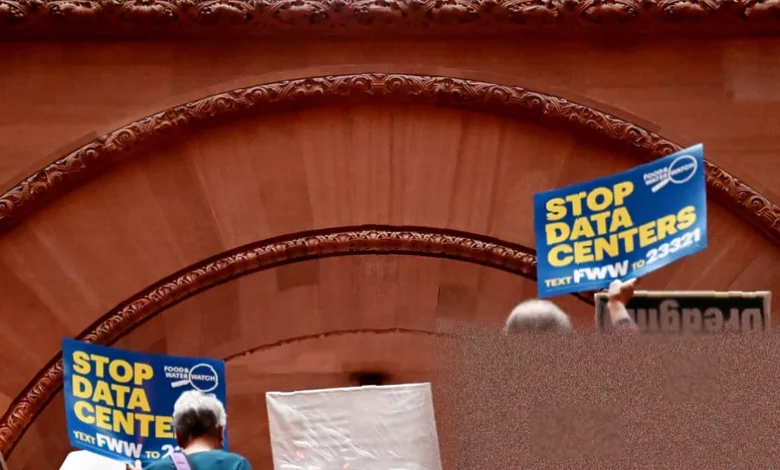
New York lawmakers have approved a one-year ban on large-scale artificial intelligence datacentres, bringing the state closer to becoming the first in the US to impose a statewide moratorium on the facilities driving the AI boom. The measure, passed by both houses of the New York State Legislature on Thursday, now heads to Governor Kathy Hochul, who will decide whether to sign it into law.
Legislative vote and bill details
The legislation, formally titled the Responsible Data Center Development Act (S.10642), targets so-called hyperscale datacentres with a peak load of more than 20 megawatts. It was co-authored by state senator Kristen Gonzalez, chair of the Senate Internet and Technology Committee, and assemblymember Didi Barrett. The original proposal had called for a three-year pause, but the period was reduced to one year as a compromise.
The moratorium applies to new permits for large datacentres and does not affect facilities that already possess the necessary state permits. Senator Gonzalez said the bill was aimed at “tech goliaths” that have long been able to “write their own rules” when it comes to new technology. “This is one of the first times that we’re really drawing a line in the sand,” she said, adding that the state legislature has a responsibility to ensure New Yorkers are “in the driver’s seat.”
In addition to the one-year pause, the bill requires the Department of Environmental Conservation to conduct a comprehensive statewide environmental impact report documenting water and electricity usage, pollution, electronic waste and other effects. It also mandates public hearings in local communities before any future permits are approved, creates a new electric rate class for datacentres over 20 MW, and introduces labour standards, energy efficiency goals and renewable energy targets — including a target of 90% renewable energy by 2040 for facilities over 5 MW. The bill prohibits incentives for fossil fuel power agreements and requires that host communities benefit from development. Ratepayer protections are included in an effort to keep energy bills low for residents.
Energy and environmental impacts
The vast energy demands of modern datacentres lie at the heart of the pushback. AI systems consume enormous and rapidly growing amounts of power. A single query on an advanced generative AI model such as ChatGPT requires approximately 2.9 watt-hours of electricity — nearly ten times that of a conventional Google search, according to data from research sources. The power needed to train frontier AI models has been doubling every year.
US datacentres accounted for about 4.4% of total US electricity consumption in 2023, a share projected to rise to between 6.7% and 12.0% by 2028. The International Energy Agency projects that datacentre electricity consumption for AI workloads alone could grow by 30% annually, accounting for almost half of the net increase in global datacentre consumption between 2024 and 2030.
New York’s grid operator, NYISO, has warned that datacentre projects will put additional strain on an already constrained and aging grid and complicate efforts to retire gas-fired power plants. The state is currently evaluating at least 28 large datacentres, which Senator Gonzalez said would “add an additional 9,682 MW of energy onto the state’s already constrained and aging grid.” In the last 16 months, NYISO has received 30 connection requests from large datacentres — a dramatic increase from the typical one or two per year. The proposed facilities collectively seek approximately 9,000 MW of power, roughly enough to serve every household in the state. That surge could push up residents’ electricity bills and risk blackouts during extreme weather, grid officials have indicated.
Water use is another major concern. Large datacentres can consume 3 to 7 million gallons of water daily for cooling — equivalent to the needs of a town of 10,000 people. By 2028, US datacentres could demand as much water as 18.5 million households. Indirect water use linked to power generation can greatly exceed on-site consumption, and wastewater discharges from cooling systems can contain concentrated minerals and treatment chemicals, potentially affecting rivers and municipal treatment systems.
Environmental justice advocates have pointed out that datacentres are often sited in overburdened communities already suffering from pollution. The NAACP is working with communities on the environmental and climate justice challenges posed by the facilities, including water contamination and air pollution. The bill is supported by groups such as Food & Water Watch and NY Renews. “Modern hyperscale data centres are a new and unregulated industrial sector,” said Bridge Rauch, an environmental justice organiser. “Our communities and our state need time to develop and pass local and state regulations.”
The expansion of datacentres also runs counter to New York’s Climate Leadership and Community Protection Act, which aims to reduce climate pollution. By 2030, the AI boom is projected to generate up to 5 million tons of electronic waste annually. Senator Gonzalez specifically cited generative AI’s use for “AI slop” as a reason for introducing the bill, and noted that many major AI model providers do not disclose sufficient information to reliably estimate their total energy use or carbon footprint.
National pushback and local fears
New York is not acting in isolation. More than a dozen US states have considered moratoriums in response to residents’ fears about higher utility bills and negative environmental impacts. A recent Heatmap poll found that almost three-quarters of Americans oppose a datacentre project being built near their homes, while a separate Gallup poll reported that 71% of adults oppose the construction of AI datacentres in their local area, with nearly half strongly opposed. Opposition is especially strong among Democrats, rural residents and young people: 80% of those aged 18 to 35 oppose such facilities.
Maine came closest to following New York’s path when its legislature passed an 18-month moratorium on new datacentres over 20 MW, but Governor Janet Mills vetoed the bill in April 2026, citing the lack of an exemption for a specific $550 million project in Jay that had strong local support. Nevertheless, Mills acknowledged that a moratorium is appropriate given the impacts on the environment and electricity rates, and she later issued an executive order creating an advisory council to study datacentre impacts.
Other states are also taking action. Legislation has been introduced in Pennsylvania to make datacentres provide their own energy, and Illinois has suspended tax incentives for the industry. Meanwhile, local moratoriums have proliferated across New York itself — the town of Oneonta passed a 12-month pause over concerns about rezoning farmland, and Perth, a town with fewer than 5,000 residents, imposed its own ban to avoid energy spikes and maintain local control.
Some critics question the economic benefits. A $77 million subsidy for a datacentre near New York’s border with New Jersey reportedly created only one permanent job, raising calls for greater scrutiny of the scale of tax breaks awarded to the sector. The Data Center Coalition, a trade association, has warned that a statewide moratorium would “discourage further investment, undermine New York’s economy, and send a signal that the state is closed for business.” The group argues that datacentres are the backbone of the digital economy, powering remote work, telemedicine, e-commerce and education.
Assemblymember Paul Bologna, a Republican, echoed industry concerns during Thursday’s floor debate in Albany, describing the bill as a “one-size-fits-all measure that would stifle economic growth and supersede local control.” He said: “We shouldn’t be imposing blanket moratoriums that punish every community in the state for a problem that may not be universal. We should be letting markets and local governments drive this policy, not fear and environmental overreach in Albany.”
Senator Gonzalez rejected that argument. “It’s an abdication of our responsibility to ask a local government to engage and take on the wealthiest companies in the world,” she said. “That is what state government is for. This notion that we can let these local governments take on tech goliaths and assume that everything will be OK is, for me, very misguided.”
Governor Hochul has said she will review the legislation. Her office previously indicated she prefers municipal-level regulation, but she has also advocated for protecting New Yorkers from taking on additional energy costs driven by datacentres. The governor faces re-election in November 2026, adding political pressure to act before the campaign season intensifies.
For residents in communities already confronting datacentre development, the outcome in Albany cannot come soon enough. Cheryl Cordes, a retired nurse who has lived in the town of Alabama in rural Genesee county for more than four decades, has spent months trying to pressure local officials to stop developers from building a massive datacentre campus just over half a mile from her home. “They’re trying to shove this datacentre down our throats,” she said. Cordes worries about noise pollution, potential health effects and disruption to the nearby habitat of bald eagles, trumpeter swans, Canadian geese and snowy owls. After knocking on dozens of doors, she recalls one neighbour telling her: “If my electric bill goes up another $50 I can’t live here.”
Cordes hopes Hochul signs the moratorium. “These regulations have to come from above,” she said. “I’m not a person who’s about big government — but come on: please help us here in these small rural towns.”