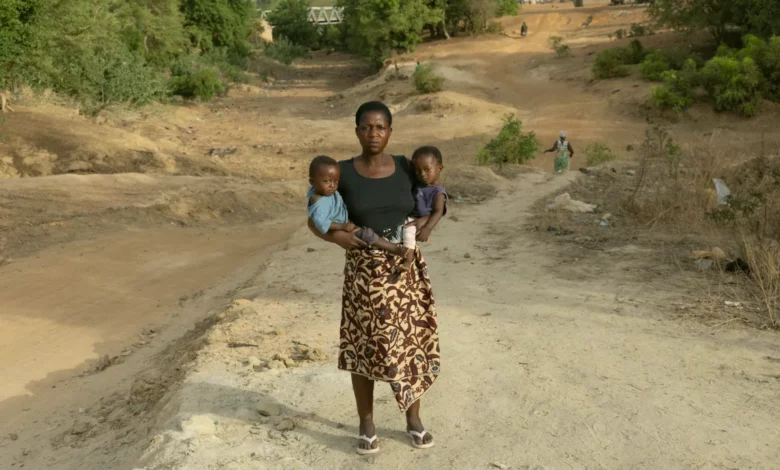
For women in northern Ghana’s Upper East Region, the journey to give birth can mean crossing swollen rivers by canoe under a dark sky, or walking for hours along flooded clay paths, doubled over with contractions, clutching plastic bags filled with baby clothes and sanitary pads. Some ride bicycles because no motorbike can get through the mud. Many do not make it to a clinic at all.
Journeys of risk
Dorcas Azongo, 29, gave birth to her twins after crossing two rivers at night while in labour, riding part of the way on her husband’s motorcycle. “When we reached the [first] river, it was difficult to cross because during the rainy season it is always full… I was in too much pain to speak,” she says. By the time she reached Bongo Hospital, exhausted and in agony, it was too late to get her inside. She delivered in the yard as the babies were already coming; midwives helped her there, then took her inside to clean her and the newborns.
It was not her first dangerous delivery. Her first child was born in the yard after her husband failed to find transport in time. For her second, relatives balanced her on the back of a bicycle and pushed her for nearly an hour to another clinic. “I feel bad and a bit down sometimes when I sit and think back on how difficult my deliveries were,” she says. “Sometimes I feel like giving up and tell myself I never want to give birth again because of all that pain.”
Rejina Abane, a midwife working across remote communities in Bongo district, describes the reality when women arrive too late. “If they delay and reach the riverside and cannot cross, we sometimes have to deliver them there. Delivering on the ground is not good. There is risk of infection, and the place is not prepared. Cutting the cord and other procedures are not safe there, especially when it has rained and the ground is muddy.”
In villages such as Beo Tankoo and Atampiisi, close to Ghana’s border with Burkina Faso, childbirth is shaped by water. In the dry season, streams disappear and boreholes fail. In the rains, rivers swell and cut entire communities off from hospitals and maternity wards, leaving pregnant women stranded on riverbanks in the middle of labour, waiting for canoe operators to return in the dark. Sophia Atule, 31, eight months pregnant with her fifth child, knows the local clinic has no midwife and no water. She has already planned the long route around the rivers to Bongo Hospital for when labour begins. “If you are in labour as a pregnant woman, the rivers are too dangerous to cross during the rainy season. When it’s rainy season and you have to go the long way, some of the women might end up delivering on their way to the facility,” she says.
Inside the clinics: a crisis of water and hygiene
Inside the health centres themselves, conditions are scarcely safer. Women arrive carrying their own water from home because clinics have none. Midwives fetch buckets from boreholes 200 to 300 metres away before they can begin work. Patients needing urine tests squat behind buildings because there are no toilets.
Both health centres in Beo Tankoo and Atampiisi have no running water and no borehole. Previous drilling attempts failed because fluoride levels in the groundwater were too high. Pregnant women are told to bring water from home when they come for antenatal appointments, while health staff queue at a community borehole. For Rejina Abane, the midwife, it means starting work 90 minutes to two hours late. “That I use to fetch water I could use it to attend to 3 or 4 people but the women are also delayed because they have to stand and wait for me,” she says. When there is no water at all, she uses hand sanitiser between palpations—knowing it is not the right protocol. “If I don’t wash my hands and continue examining women one after another, I risk spreading infections. In the end, the women may go home, develop infections and then have to go to the hospital.”
New research by development economist Guy Hutton for WaterAid puts Ghana’s annual maternal sepsis burden at 101,645 cases and 149 deaths. It finds that improved water, sanitation and hygiene in healthcare facilities could cut both figures roughly in half. The cost per sepsis case is estimated at $154 (£114), and across more than 100,000 cases annually that amounts to $15.7 million (£11.7m)—of which $7.9 million (£5.9m) could be directly avoided with better WASH provision. Nationally, 98 per cent of health centre births in Ghana take place without basic sanitation, and a third happen without any water access at all.
“Women are being forced to risk their lives in labour, crossing flooded rivers just to reach basic care. No woman should have to endure this to give birth safely,” says Ewurabena Yanyi-Akofur, WaterAid Ghana’s country director. “This crisis highlights how essential water, sanitation and hygiene are to maternal health and how climate change is making an already difficult situation worse. I see every day how women are disproportionately affected. It is deeply disheartening that running water in a healthcare facility is still considered a luxury when it should be the standard.”
WaterAid and local authorities are attempting to change this through a project called Good Health Begins Here, which aims to install mechanised solar-powered water systems, storage tanks, toilets and incinerators at clinics including Beo Tankoo and Atampiisi—infrastructure designed to handle the fluoride problem that defeated previous drilling attempts and eventually to make a permanent midwife posting viable. The sanitation work has started but the water is not yet in. Fatima Mumuni, an engineering technician with the Bongo district assembly, says the ambition goes beyond a new borehole: “In these communities, people usually get water from boreholes within the community and bring it to the health centres. If somebody is about to give birth, they have to carry their water from their house.” She hopes the new infrastructure will change that.
Aid cuts and a fragile health system
The crisis comes as years of progress on maternal health across parts of Africa become increasingly fragile under deep cuts to international aid. In January 2025, Donald Trump functionally dismantled the United States Agency for International Development (USAID), with more than 80 per cent of its programmes stopped or terminated. That has been followed by cuts from the UK, Germany and other nations. Across this period, the UN Population Fund has recorded sharp drops in procurement of essential supplies across sub-Saharan Africa. Organisations that relied on US bilateral funding to run community health programmes are operating on emergency reserves or not at all. WaterAid staff working in Ghana say clinics in Bongo district still lack the most basic water, sanitation and hygiene infrastructure needed for safe childbirth, and the money that was already too thin is getting thinner.
The impact of the cuts is visible in regional health data. The Upper East Region has recorded a sharp increase in maternal deaths, rising from 40 in 2024 to 60 in 2025, pushing the institutional maternal mortality ratio to 132 per 100,000 live births—nearly double the Universal Health Coverage target of 70 by 2030. Institutional neonatal mortality also rose, from 5 to 6 per 1,000 live births. Anaemia in pregnancy increased from 17,020 cases to 17,377. The proportion of pregnant women registering for antenatal care in the first trimester has stagnated at around 60 per cent, a critical gap for early detection of complications. A severe shortage of medical officers compounds the strain: only six of 35 posted doctors reported for duty, and only one accepted a posting to a district hospital.
Midwives in rural areas, the backbone of maternal healthcare, face inadequate infrastructure, a lack of beds and physical space, severe staff shortages, and limited access to essential supplies. They report a lack of motivation, partly because rural incentive allowances provided to doctors are not extended to them, and opportunities for in-service training are scarce. The UK’s aid budget cuts, redirected towards national defence, have drastically reduced direct bilateral funding to African countries, affecting frontline health workers and community health promoters. The UK’s Official Development Assistance budget is projected to shrink significantly by 2027. Germany, through GIZ, has supported Ghana’s healthcare system in areas such as non-communicable diseases and vaccine production, but the broader trend of reduction could affect sustainability. The withdrawal of USAID and PEPFAR funding poses a severe risk to existing HIV/AIDS programmes, potentially leading to increased mortality and drug resistance.
WaterAid Ghana continues to push for change through its Time to Deliver campaign, calling on governments to prioritise water, sanitation and hygiene in healthcare for every woman, every birth and every future. The Bongo District Assembly, in collaboration with WaterAid, has signed a WASH Compact aiming for universal access to safe water, sanitation and hygiene within ten years. But for now, the rivers still rise when the rains come, women still arrive at clinics carrying jerrycans alongside their hospital bags, and midwives are still spending the first hours of their working day searching for enough water to wash their hands.