Farm machinery and equipment, from retired sprayers to hay-turning contraptions, are providing unexpected nesting sites for birds and other wildlife on a working farm, where a pause between chores has revealed a hidden world of breeding activity.
The farmer, who keeps a shire cross horse on the land, noticed that a seasonally redundant reversible five-furrow plough had become home to a pair of blue tits. The birds were seen bringing caterpillars from nearby oak trees and dropping down a narrow shaft at the end of the plough’s hollow steel frame, above the landwheel. A close look inside revealed a long, thin nest brimful of chicks, their yellow clown-like gapes pressed shut in the presence of the farmer – safe from the bills of woodpeckers.
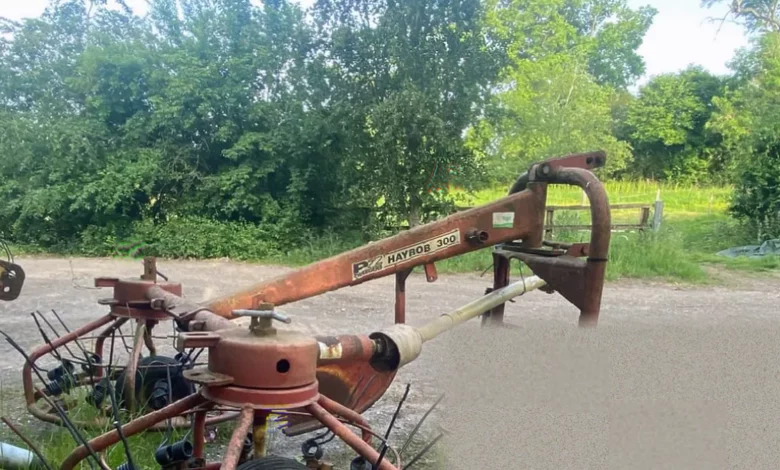
A second blue tit brood was discovered in a hole in the cap of a Haybob 300, a machine used for spreading, tedding and “whuffling” cut hay to dry in the sun before gathering it into windrows for baling. The farmer noted that the machine was likely to be pressed into service soon, making the timing of the nest critical.
Blue tits typically nest in holes or cavities in trees, walls, or nest boxes, with a small entrance hole of around 28mm. Their nests are made of moss, leaves, hair and grass, lined with down, feathers or hair. Females lay between five and twelve eggs – sometimes up to sixteen – and incubation lasts 12-16 days. Many blue tits do not migrate and stay close to where they hatched, seeking shelter in trees or nest boxes during winter. The two broods on this farm fledged just a day ahead of an approaching heatwave that could have suffocated those in the steel plough casing and risked a dangerous accident for the others.
Other farm equipment has also been adopted as nesting sites. A retired sprayer sits squatly among nettles, with the skeletal wings of its mechanical arms folded up. Beside it, a hydraulic post-banger vibrates loudly, as if it is still in use. Careful inspection revealed a tree bumblebee nest inside its hollow mechanism. Tree bumblebees, a relatively recent arrival to the UK first recorded in 2001, nest in cavities above ground such as bird boxes, roof spaces or trees. They are identified by a ginger thorax, black abdomen, and white tail. Their colonies last about two to three months, with males swarming around nest entrances in May and June waiting for queens to emerge – though these males are harmless as they lack stingers.
Not all nesting spots involve complex machinery. New bales of hay must be opened with caution. The farmer narrowly avoided pulling down a robin’s nest inside one – the adult bird happily resettled on her eggs. Robins nest in a wide variety of concealed locations, often close to the ground: dense vegetation, sheds, log piles, old watering cans, and even boots. They build a fresh nest for each of their two to three broods per year, using grass, dead leaves and moss lined with hair. The nesting season typically runs from March to August, though in mild winters it can begin as early as January. Two years ago, one side of a haystack had to be avoided completely until a tawny owl had raised two owlets in it. Tawny owls, which prefer natural tree cavities but will also use disused nests of other birds or nest boxes, begin breeding early in the year – often in February or March – making them one of the earliest nesting owls in the UK.
A precarious sanctuary
The farmyard itself is a hive of activity beyond the machinery. Wheelbarrow trips to the muck heap are attended by pied and grey wagtail pairs making small aerial assaults on insects, though their precise nests remain undiscovered. Wagtails generally nest in cavities, often near water, and will use ledges or crevices in man-made structures. Swallows are well served by the midges and flies that swarm around warm-blooded animals, and there is always mud for nest repairs – from the regular slosh of water buckets and hosing down of sweaty horses. Swallows, which typically arrive in the UK around April or May, build cup-shaped nests from mud in barns, sheds or under eaves. They feed exclusively on flying insects and can have two to three broods per season. Their numbers have fluctuated and declined since 1970 due to climate change and habitat loss.
That broader decline reflects a national crisis. Farmland bird populations in the UK have fallen by an average of 48% across 19 key indicator species since 1970. Several familiar species are now on the Red List, including the yellowhammer (down 54%), skylark (51%), and grey partridge (87%), as well as the swift, greenfinch, rook, linnet, and lapwing. Intensive farming practices – the removal of hedgerows and grass banks, frequent cutting, and immediate ploughing after harvest – have reduced nesting habitat and created a severe food shortage each year, particularly during the “hungry gap” from January to early May. Many farmers now participate in agri-environment schemes and supplementary feeding to support threatened species. Initiatives such as the Big Farmland Bird Count aim to measure the impact of this conservation work.
Heatwaves pose an additional threat, especially to nestlings. Prolonged hot and dry weather can cause overheating in nest boxes and reduce insect food availability. Heavy rain can also dislodge caterpillars from vegetation, reducing food for chicks. On this farm, both broods of blue tits fledged in time, but the risk remains for others. The farmer reflects that while farmland birds may be struggling in the fields, there is a precarious sanctuary for some in the farmyard – among the tangled eras of farm machinery, the retired sprayers, the hollow steel frames, and the hay bales that must be opened with care.