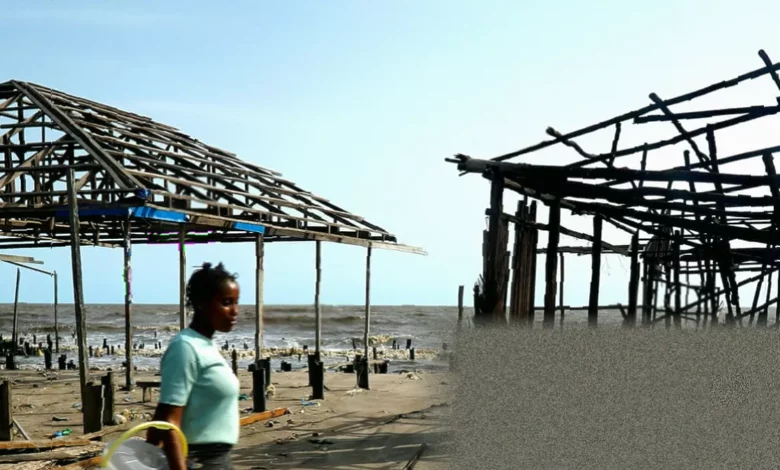
In the early hours of 15 February 2019, Arowo Victoria, a 60-year-old retired midwife, was woken by neighbours banging on her door. The Atlantic Ocean was coming for her livelihood. By the time she reached the small shop she had built with borrowed money after a lifetime helping women give birth, it had already been swept away. “There was nothing I could save,” she says, staring at the shoreline where her shop once stood. “The sea took everything away.” Now Victoria faces mounting debts on a business that no longer exists. “I am paying for something that doesn’t exist any more,” she says. “They come to collect their money every month.”
Victoria’s story is one of many in Ayetoro, a historic coastal settlement in Nigeria’s south-western Ondo state once known as the “Happy City”. Founded in 1947 by the Holy Apostles’ Community – a group of Christian prophets who envisioned a utopian society based on communal living, shared resources and collective labour – the town achieved remarkable self-reliance. By 1953 it had electricity, schools, a maternity centre, and thriving industries in boat building, fishing, weaving, carpentry and tailoring. Today, the Atlantic Ocean has swallowed more than half of that community, washing away hundreds of homes, schools and churches over the past two decades.
The human cost is staggering. Emmanuel Aralu, 35, remembers vast stretches of land where children played football. “All that space is gone now,” he says. “At times, it feels like the entire community is being erased.” His uncle’s house is now perilously close to the water. “We already know it may not survive another big tide,” he says. Motunrayo Asakasiki, 28, recalls the day her mother lost her grocery store to floodwaters driven by the encroaching sea. “The water came very fast. People were screaming and trying to save what they could, but some things had already been washed away.” The family moved the business to Alaba Street, which they considered safer, but the ocean continues to advance. “My mother always wonders how many times she should start over,” Asakasiki says.
For Lawrence Lemanu, 79, the sea took everything he had worked for. He lost his 10-room house in 2023, a home where he raised his children. “Everything I’ve laboured for was inside,” he says. “You cannot fight the sea. You just watch it take everything.” The fishing industry, once the lifeblood of Ayetoro’s economy, has become dangerous and unpredictable. Fisherman Egba Taiwo says the water no longer behaves as it used to. “Now the tides are very rough. There are times you fear going out fishing because the sea has become so dangerous.” Even when fishers return safely, their hauls are smaller.
Essential public services are under direct threat. Hannah Olanrewaju, officer in charge of the Ayetoro primary health centre (PHC), describes how close the sea has come to the facility. “When you open the back door, you see the sea directly,” she says. “When I came here in 2016, it was never like this. Now we struggle to carry out immunisation and malaria tests because it is so difficult to walk on the community’s wooden bridges.” Health workers fear continued erosion may cut off access to essential care. At Ayetoro College – known as Happy City College – principal Ogungbure Isaac says students and teachers work under constant fear that the building could one day be submerged. “It breaks my heart watching our young people trying to plan their future in a town that is steadily losing land to the sea,” he says. “The situation is taking a psychological toll, which is affecting the children’s academic performance due to the fear of the incursions.”
The causes: climate change and human interference
Environmental experts say Ayetoro represents one of Nigeria’s starkest examples of climate vulnerability. Dr Nnimmo Bassey of the Health of Mother Earth Foundation describes the situation as a “profound injustice”. “When global discussions on climate change are held, and people talk about loss and damage, there are communities that are already almost totally lost and damaged,” he says. “The interests of communities like Ayetoro should be central to these discussions.”
The causes of the relentless erosion are complex. Global warming is a primary driver, raising sea levels and intensifying tidal surges. Nigeria is one of the countries most vulnerable to climate change. But human interventions have made the problem far worse. Dr Joseph Onoja of the Nigeria Conservation Foundation says weak environmental protections have accelerated destruction. “What is happening in Ayetoro is a warning sign for many coastal communities across Nigeria,” he says. “Major [human] interventions have reshaped the behaviour of the Atlantic along the coast.”
He points to the construction of the Commodore Channel, a three-kilometre waterway built from the sea into Lagos’s major ports. This channel disrupted the natural eastward currents of the Atlantic, intensifying wave action and increasing erosion in unprotected communities such as Ayetoro. Dredging and breakwater construction for the channel have altered sand transport, causing erosion in some areas and sediment build-up elsewhere. The Ilaje area, where Ayetoro sits, is also a major crude oil-producing region. Underwater oil drilling and frequent spills have contributed to environmental damage, with the ground potentially sinking as resources are extracted. The loss of mangrove forests, which act as natural coastal barriers, has further weakened the shoreline. Sand mining for construction in urban centres, while less prevalent in Ilaje, also disrupts sediment balance. Inadequate environmental regulations and a lack of government action have allowed these forces to combine unchecked.
Research confirms the scale of the loss. One study published in MDPI in December 2023 analysed shoreline changes from 1986 to 2020 and found significant erosion in Ayetoro. Another study in Taylor & Francis in July 2024 highlighted unprecedented exposure of Ondo State’s coastline, with many settlements washed away. Estimates suggest that over half of the community’s landmass has been lost, with as much as 86% of its coastline eroded between 2008 and 2023. In three decades, more than ten square kilometres of land have disappeared. The broader economic cost of coastal degradation is enormous: a 2018 estimate put losses in just three Nigerian states – Cross River, Delta and Lagos – at $9.7 billion, equivalent to 2.4% of the country’s GDP.
Resilience in the face of relentless loss
Despite the devastation, many residents refuse to abandon the place they call home. They have adapted as best they can: rebuilding repeatedly, moving homes and businesses further inland, and relying on faith. The traditional ruler’s palace has become a shelter for those who have lost everything. Yet the land available is shrinking, and each rebuild is a gamble. “This is our home,” Aralu says. “Where do we go?”
The community’s population has plummeted from an estimated 26,000 in 2006 to around 5,000 today, as families have been forced to migrate. Those who stay face a daily struggle. Stephen Tunlese lost his clothing shop and house and now repairs boats to survive. Thompson Akingboye, a church leader, has watched the sea claim places of worship. The physical evidence of Ayetoro’s prosperous past is being submerged; only folklore remains for younger generations.
Government intervention has been slow and, in the view of many residents, largely ineffective. The Niger Delta Development Commission (NDDC) awarded a coastline protection project about twenty years ago, but locals say it has never started and remains “ongoing” in name only. In June 2026, the Ondo State Oil Producing Areas Development Commission stated that approximately N94 billion is required to save Ayetoro from extinction, and appealed for international aid. A proposed Lagos-Calabar Coastal Highway, a major infrastructure project that began construction in March 2024, traverses vulnerable coastal areas and has raised concerns about inadequate environmental assessments. Meanwhile, initiatives such as the Lagos State Partnership for Coastal Resilience Initiative (2024-2025) and the FAO-Nigeria UK PACT project on mangrove restoration (concluded June 2026) aim to address coastal risks using nature-based solutions, but they have focused on Cross River State, leaving Ayetoro without direct support.
For the people who remain, the sea is a constant, encroaching presence. They cannot afford sea walls. They simply rebuild each time the water comes. “My mother always wonders how many times she should start over,” Asakasiki says. “At times, it feels like the entire community is being erased,” Aralu adds. Arowo Victoria still pays her monthly loan instalments, staring at the shoreline where her shop once stood. “The sea took everything away,” she says. “There was nothing I could save.”