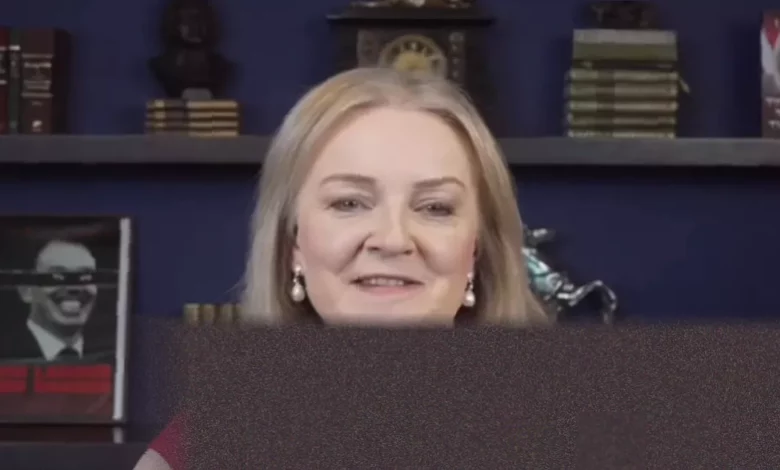
Liz Truss’s YouTube show has become something of a mini-classic – though not in the way its host might hope. With each new episode, the former prime minister manages to surpass herself in sheer awfulness, lurching from one self-inflicted embarrassment to the next. These days she lives a mysterious half-life, split between the real world and the meta-world, occasionally spotted making incoherent speeches to small gatherings of the far right in the United States, but mostly confined to the small attic space that doubles as the studio for The Liz Truss Show on her YouTube channel. Each outing is a masterclass in increasing desperation.
Truss’s media presence: a strange half-life
Since her 49-day premiership – effectively 39 days, once the ten days of state mourning for Queen Elizabeth II are deducted – Truss has maintained a peculiar existence. She remains convinced that the problem was not that the country had too much of her, but that it never got enough. In her own telling, she was thwarted by “the Blob”, a term popularised by Michael Gove for the permanent, unelected bureaucracy within the civil service, quangos and regulators that she believes resisted her reforms. She has railed against this “administrative state” at far-right conferences such as CPAC, where she has called for a “Trump-style revolution” in Britain. The Cabinet Secretary, Simon Case, has described the term “Blob” as “insulting” and “dehumanising”, but Truss remains undeterred. Her YouTube channel is now her primary platform for promoting her vision – a vision in which she remains the saviour waiting to rise again.
The latest video: “Labour’s Secret Plan”
Late on Wednesday, Truss released her latest offering, boldly titled “Labour’s Secret Plan: Labour PANICKING as Reform surges in Makerfield By-Election”. It promised to be an on-the-ground exposé of what all the major media outlets had missed. To help her, she turned not to established psephologists such as Professor John Curtice or Dr Rob Ford, but to June Slater – a former UKIP member, political blogger and occasional talking head on GB News. Slater, the self-styled psephologist’s psephologist, wasted no time in setting out her analysis.
The pair’s central claim was that Labour were panicking – or, as Truss put it, “PANICKING” – in the Makerfield constituency, where a by-election has been triggered by the resignation of Labour MP Josh Simons to allow Andy Burnham, the Mayor of Greater Manchester, to stand for Parliament. This is the first by-election since 1965 triggered specifically to provide a seat for a politician not already in Parliament. Recent polling suggests a close race between Labour and Reform UK, with Labour holding a narrow lead of around five points and undecided voters potentially decisive. Yet Truss and Slater saw things differently. Slater had spent a day campaigning with Reform’s candidate, Rob Kenyon, and reported that voters were throwing palm leaves at his feet. “Rob is a very busy man,” she confided. “A quiet man, a bit of a thinker. Like my husband. When someone brought up a problem he got his phone out.”
Kenyon, a local plumber and councillor, has attracted significant controversy. He has been criticised for unearthed social media posts including alleged transphobic slurs, COVID-19 misinformation, objectifying comments about women, and strong anti-abortion statements, which he called “the cowardly act of murdering a defenceless baby”. Reform UK has defended him, describing some comments as “locker room banter”. Kenyon himself has said: “I’m sexist, sorry but I am.” He has also refused to apologise for remarks about Carol Vorderman, suggested Russia “had a point” when it invaded Ukraine, and appeared uncertain whether he supported Brexit or not. He has, however, welcomed the endorsement of Ant Middleton, a figure from whom the party had previously distanced itself because of his “extreme views”. Slater seemed unaware of any problem. She did concede that some people were reluctant to vote Reform because “they don’t want to appear hateful”, but appeared bewildered as to why. Truss simply nodded.
The conversation then turned to “Labour’s Secret Plan”, which turned out to be so secret that everyone had heard of it – except Truss and Slater. The plan, they claimed, was that Andy Burnham was trying to get back into Westminster to challenge Keir Starmer for the Labour leadership. This is indeed widely understood as the motivation for the by-election, and Burnham’s candidacy is seen as a significant threat to Starmer. However, while Burnham has a net favourability rating of +7 in the constituency – significantly better than Starmer’s -48 – more recent polling suggests his favourability has declined. Reform UK’s strength in Makerfield, where it performed well in local elections and the 2024 general election, is also complicated by the emergence of Restore Britain, a party launched by former Reform MP Rupert Lowe, which may split the right-wing vote.
Slater then admitted that before the Brexit referendum she had considered voting remain, but changed her mind after her husband pointed out that the EU was “basically a communist state”. Truss nodded eagerly, apparently having no recollection that she herself had been a Tory minister actively campaigning for remain a decade ago. (Truss now states she would back Brexit, arguing the predicted economic disruption has not materialised – despite her own mini-budget having caused a plummeting pound and soaring government borrowing costs.) The pair moved on to COVID-19 and the importance of not getting vaccinated. Slater suggested that seeing a picture of Starmer provoked a kneejerk response that he was Chinese, while photos of Farage made people think of Russia – which she saw as a definite plus.
Slater grew maudlin. She used to have a house in Austria, she said, but now there was nowhere she really wanted to live; “the Blob” was everywhere. She implied it would not be long before she holed up in the wilds of Montana with a few dozen semi-automatic weapons. The last word went to Truss. She too saw the malign influence of “the Blob” in every nook and cranny of the British state. The country, she said, was being lost. Labour had infiltrated every organisation. But at least we would always have her. While she still drew breath, there was hope. Never underestimate the power of the quarter-wit.
Truss’s political self-perception: the messiah complex
Truss’s view of herself remains unshakeable. Her 49-day premiership, marked by the disastrous mini-budget that sent the pound into freefall and forced emergency intervention by the Bank of England, is recast not as a catastrophic failure but as an unfinished project. She believes an entrenched “deep state” – “the Blob” – sabotaged her policies, and she continues to call for a revolution to sweep it aside. At far-right gatherings in the US, she has railed against bureaucrats, lawyers, judges, quangos and civil servants as unelected forces resisting change. She has also expressed a willingness to work with Nigel Farage to change the Conservative Party. Farage himself has used the murder of student Henry Nowak – whose handcuffing by police while dying became a political flashpoint – to call for “pure cold rage” and to highlight “anti-white prejudice”, linking the case to immigration. US Vice President JD Vance has blamed the death on “mass invasion of migrants”. Reform UK’s immigration policy, meanwhile, has seen public disagreement: Treasury spokesman Robert Jenrick suggested foreign nationals in social housing would not automatically be deported, but home affairs spokesperson Zia Yusuf publicly corrected him, insisting that living in social housing at taxpayer expense would lead to automatic failure of the economic test and deportation. Nigel Farage has stated that a Reform government would give such tenants three months to move into private accommodation or face deportation, and the party plans to abolish indefinite leave to remain and increase salary thresholds for visas. Truss, for her part, sees all this as part of the same battle – a battle she believes she is destined to lead.
In Truss’s world, the problem is not that the public had too much of her, but that they never got enough. And in a strange way, there is almost a price worth paying for the entertainment. A UK on its knees, perhaps – but at least we have the show.