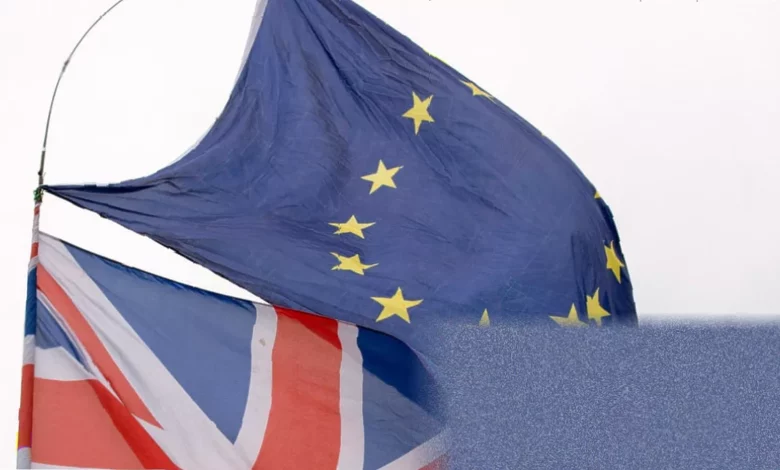
The UK government’s proposal to create a single market for goods with the European Union has been rejected by Brussels, sources have confirmed, underlining the depth of the challenge Sir Keir Starmer faces in forging a closer economic relationship with the bloc while holding firm to his post-Brexit red lines.
Michael Ellam, the Cabinet Office’s most senior official on EU relations, pitched the idea during recent visits to the Belgian capital as the centrepiece of a broader strategy to reintegrate British trade into Europe. But EU officials rebuffed the plan and instead suggested alternatives: a customs union or alignment through the European Economic Area (EEA).
Neither is acceptable to the prime minister. Starmer stated in 2024 that the UK would not rejoin the EU, the single market or the customs union in his lifetime. The EEA, a single market of 30 mostly EU countries, would require accepting the free movement of people – another policy the Labour government has ruled out.
UK government sources have denied that the EU definitively rejected the single market for goods proposal, insisting it remains one of several options under discussion ahead of a summit provisionally pencilled in for 13 July. Nevertheless, the episode is the clearest signal yet that Labour’s ambitions for a deeper economic partnership are colliding with the same political realities that derailed Theresa May’s Chequers plan, which sought a “common rulebook” for goods without free movement of people.
EU’s concerns over a precedent for populists
At the heart of the EU’s resistance lies a deep anxiety that any special arrangement for the UK – a non-member – could become a model for anti-EU populists inside the 27 member states. Officials argue that if Britain were seen to enjoy the benefits of the single market without the obligations of full membership, it could embolden Eurosceptic candidates. One scenario cited involves France’s 2027 presidential election, where a populist hopeful might argue that Paris should pay less attention to single market rules. Other countries, it is feared, could question their contributions to the EU budget if the UK is perceived to be getting privileged treatment.
“If you start going back on those principles – leading to a non-member being treated better than an actual member – you certainly would trigger an internal debate on the fundamentals of EU cooperation,” one EU diplomat said.
UK government sources acknowledged that Brussels has always been nervous about London’s red lines, though they pointed out that the EU has already opened talks on access to its single market for food, agricultural products and electricity. The European Commission declined to comment on the pitch for a single market in goods, instead confirming it is working to conclude a sanitary and phytosanitary (SPS) agreement, a linkage of emissions trading schemes (ETS) and a youth experience scheme – the three accords promised at the last UK-EU summit in 2025.
Veterinary deal, carbon market and youth mobility
Both sides hope that the July summit will see the announcement of a veterinary agreement to ease trade in food, drink and animal products. According to research analysis, such a deal could boost UK agri-food exports to the EU by 22.5% by cutting red tape and checks. However, concerns have been raised that a proposed provision requiring dynamic alignment with EU standards – without UK input – could undermine British animal welfare policies.
An accord linking the UK and EU emissions trading schemes is also on the table, following a political agreement reached in May 2025. The linkage is expected to create a more stable carbon market, reduce costs for businesses, encourage green investment, and provide a clearer signal for long-term spending on carbon capture and storage technologies.
Negotiations over a youth mobility programme remain stalled. The UK has confirmed it is working with the EU on what Starmer has called an “ambitious youth experience scheme” that would allow young people to live, work and study across borders for a limited period. But the EU continues to reject UK proposals for a cap on numbers and a requirement that EU students pay the higher international tuition fees rather than the domestic rate. The EU is instead seeking “home” fees for its students, a demand the UK government and universities oppose. Compounding the difficulty, the EU lacks the legal competence to negotiate a full scheme that includes work rights and must rely on individual member states for such commitments.
Steel, cars, defence and the Ukraine loan
Beyond the three headline deals, the UK is pushing for agreements in other areas. Cabinet Office minister Nick Thomas-Symonds told reporters in Brussels last month that the government wants deals on steel and electric cars to protect British industry from imminent changes in EU regulations. The chancellor, Rachel Reeves, has described a “strategic imperative for deeper integration between the UK and EU – in our shared need for greater economic resilience”, drawing on themes from her Mais lecture.
Defence cooperation is another front. The prime minister announced earlier this month that he would like the UK to enter talks to join the EU’s €90bn (£78bn) loan facility for Ukraine, a move that would allow British firms to compete for defence contracts for Kyiv. A European Commission spokesperson confirmed the bloc sees “scope to deepen co-operation where it matters most now: defence industrial cooperation”, referencing the UK’s wish to start talks on the Ukraine loan. The spokesperson also pointed to continuing discussions on an innovation fund for hi-tech industries and joint work to curb irregular migration.
UK government sources have said the package of measures being negotiated – including the SPS and ETS deals – could alone add up to £9bn a year to the UK economy by 2040, according to a Cabinet Office spokesperson.
Political headwinds before the Makerfield by-election
EU officials are not expecting significant progress on defining a future UK-EU agenda before the Makerfield by-election in June, where Labour faces a strong challenge from the anti-EU Reform party. The Labour candidate, Andy Burnham, who is expected to stand to replace Starmer as prime minister, has said he will not try to return the UK to the EU and promised “a relentless domestic focus”.
Starmer, in a speech earlier this month intended to rescue his premiership, said his government would be defined by “putting Britain at the heart of Europe”. He called for an ambitious youth experience scheme as an example of the stronger relationship he wants. Yet the negotiations remain bogged down, with the EU refusing to accept UK limits on numbers or the higher fee structure for its students. The European Commission confirmed it is working on the SPS agreement, ETS linkage and youth experience scheme, while declining to comment on the single market for goods pitch. It also noted the potential for deeper ties on defence, the Ukraine loan, an innovation fund for hi-tech industries, and joint action on irregular migration.