
Britain is fast-tracking new long-range strike weapons for Ukraine, with successful test launches already completed at a military range in the Hebrides and government officials hoping the systems could be delivered to Kyiv within a year. The initiative, known as Project Brakestop, is designed to produce munitions more quickly and cheaply than existing weapons such as the Storm Shadow missile, while also reducing reliance on US components and export controls.
The Ministry of Defence has set an ambitious goal of delivering the new weapons to Ukraine within twelve months, following further trials both overseas and in Ukraine itself over the coming months. Although no final timetable has been confirmed, officials are confident that the systems will be ready for battlefield use in that timeframe. The weapons have already been fired from launchers at the Hebrides range, with all three prototypes successfully launching despite minor technical hiccups – a result that was anticipated under the project’s “fail fast” approach.
Project Brakestop: A Race Against Time
Project Brakestop was launched in late 2024 with a deliberately compressed development schedule. The MoD challenged defence firms to design weapons that could exceed 600 kilometres per hour, reach targets at least 500 kilometres away, carry a 225-kilogram warhead, and cost around £400,000 per unit. Crucially, the department also demanded production of at least 20 missiles per month within months of an order – and the chosen companies have indicated they could ramp up to 40 units per month within three to four months. These figures are roughly half the cost and a fraction of the unit price of a Storm Shadow, which is estimated at around $1 million (£760,000) each.
The project began with a highly unorthodox procurement process. The MoD received 27 industry bids and then held “Dragon’s Den”-style pitches last February. Six companies were awarded contracts worth around £5 million each to design and test their systems in just seven months. By last December, that field had been narrowed to three: MBDA UK – the manufacturer of the Storm Shadow – and two British SMEs, MGI Engineering and Rotron Aerospace. MGI Engineering brings expertise from Formula 1 technology, specialising in lightweight composites and autonomous systems, while Rotron Aerospace has a long history of working with the MoD on fast-turnaround projects.
The three remaining suppliers have now moved into the second phase of Project Brakestop, with follow-on contracts worth approximately £15 million each. Under these contracts, each company will develop 15 improved effectors, along with launchers and support vehicles. The prototypes have already shown promise: MBDA’s design, known as “Crossbow,” uses an in-house visual navigation system free of US components, while MGI’s “TigerShark” drone – which resembles a cruise missile – has been flown at speeds of up to 750 km/h, can operate in GNSS-denied environments, and carries a 300-kilogram payload over ranges exceeding 1,000 kilometres. MGI’s navigation system is built by Auterion, a European firm. Rotron Aerospace, which has a history of working with the MoD, has not yet disclosed its prototype’s specific details.
Sovereign Capability and British Industry
A central requirement of Project Brakestop is that all systems be free from the International Traffic in Arms Regulations (ITAR) – the US rules governing the export of defence and military resources. This means no US components, no US navigation data, and no US export licences that could slow or block deliveries. The MoD explicitly challenged firms to design weapons that could be produced and operated entirely with UK sovereign capability, a deliberate move to reduce dependence on Washington and to ensure that the UK can independently support Ukraine and its own defence needs.
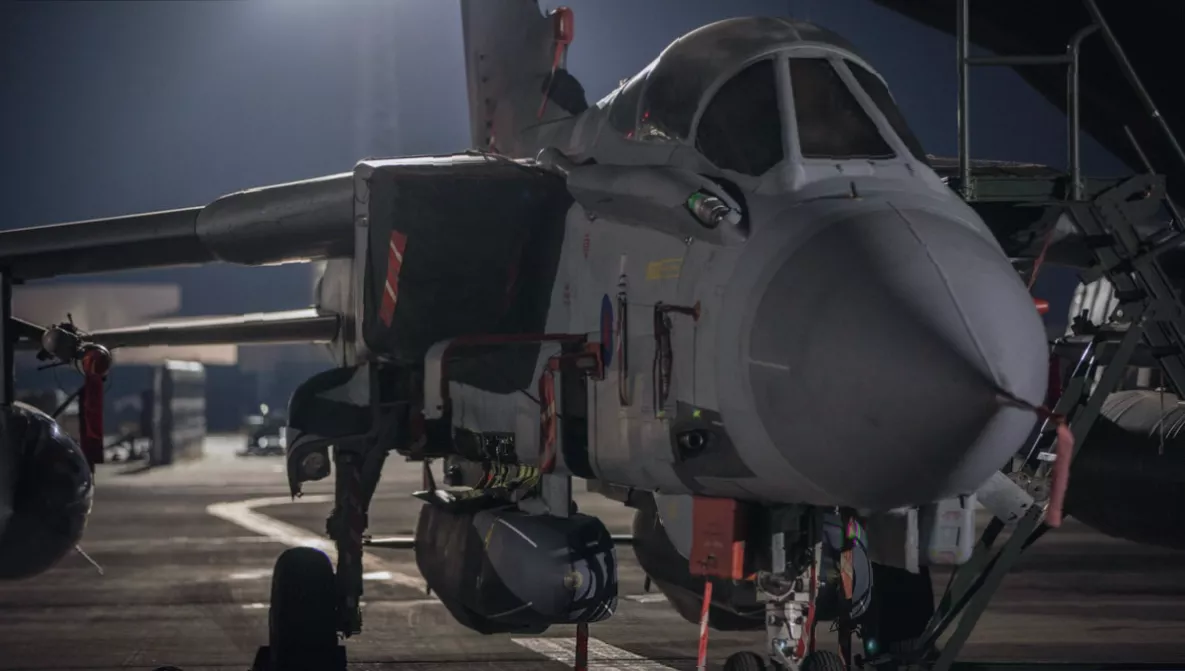
Armed Forces Minister Louise Sandher-Jones emphasised the dual purpose of the project. Asked how important it was that the UK was not relying on America for this development, she told reporters: “That’s always the broad question, isn’t it? About how we interoperate with our allies, but also what we have as a sovereign capability. There’s two parts of this we’re looking to test: one is producing a capability that can deliver an operational effect, that’s always going to be number one, but number two is when we start to transition towards talking about resilience as a nation, able to test our industry, and what we can produce here in the UK.”
She added that the new weapons would “complement” others, such as the Franco-British Storm Shadow missile, which Ukraine already uses to strike deep into Russia but which carries a higher cost and restrictions due to US components. The Brakestop munitions are expected to be slightly less precise than the Storm Shadow, but their lower unit cost and freedom from ITAR controls make them more suitable for mass production and rapid deployment.
Ms Sandher-Jones said: “The UK stands shoulder-to-shoulder with Ukraine, and we will continue to provide the support it needs to defend itself against Russian aggression. Project Brakestop shows what happens when we combine that commitment with the talent and ingenuity of British industry. In less than a year, UK companies have taken an ambitious concept from the drawing board to flight testing, delivering a new generation of capability at remarkable speed. This is a clear demonstration that Britain has the industrial strength, innovation and determination to meet the challenges of modern warfare and support our allies.”
The project is part of a wider push by the UK to accelerate defence innovation, including the launch of “UK Defence Innovation” in July 2025 with a £400 million budget and schemes such as Commercial X to give accelerated contracts to small, innovative companies. Western officials have noted that Ukraine’s battlefield performance has improved significantly in recent months, partly due to its growing drone capabilities, which have pinned down Russian troops on the front line and disrupted oil production deep inside Russia. Ukrainian drone attacks have reportedly doubled in frequency since early 2026, targeting refineries and oil depots and causing a domestic fuel crisis in Russia. Meanwhile, G7 leaders earlier this week pledged to increase the delivery of air defence capacities, additional systems, interceptors, and long-range capabilities to Ukraine, without specifying the type of weapons. Ukraine also faces acute shortages of interceptor missiles to counter cruise and ballistic missiles – a gap that the new British systems could help fill. MBDA has additionally signed a memorandum of understanding with Ukrainian defence company LUCH to jointly develop the NEPTUNE cruise missile, indicating growing cooperation in deep strike capabilities.