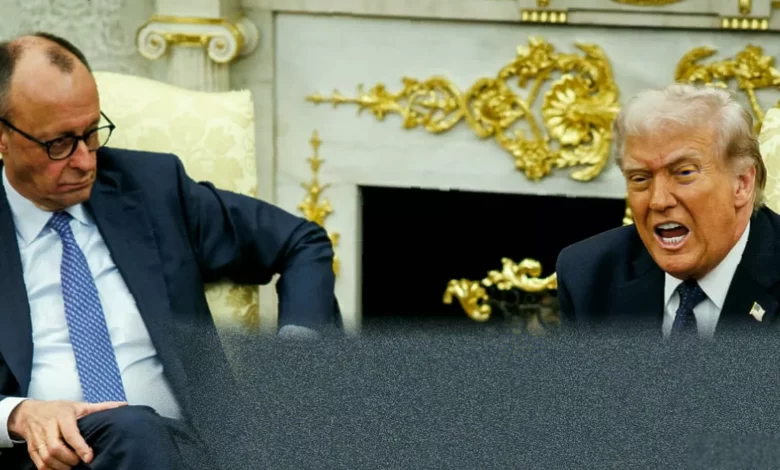
Friedrich Merz, the German chancellor, is confronting the most serious rupture in postwar transatlantic relations after the Pentagon announced the withdrawal of 5,000 US troops from bases in Germany and the withholding of vital long-range weapons. The decision, described by a senior Pentagon official as a response to what it called Mr Merz’s “inappropriate and unhelpful” remarks about US strategy in the Middle East, follows weeks of escalating pressure from Washington on European allies who have refused to back the war on Iran. Mr Merz had accurately observed that the US has no convincing strategy on Iran, comments that drew a swift and punitive reaction from the Trump administration.
The troop withdrawal — expected to be completed within six to twelve months — is being officially framed as a return to pre‑2022 force levels in Europe, before the increase triggered by Russia’s full‑scale invasion of Ukraine. But the timing and the explicit linkage to Mr Merz’s criticism have left little doubt about Donald Trump’s intent. The US president, whose second term has been overshadowed by plunging poll ratings and what the original analysis calls an illegal, ill‑advised war in the Middle East, has increasingly singled out European leaders for what he sees as disloyalty. Sir Keir Starmer’s refusal to militarily back the attack on Iran led to unfavourable comparisons to both Winston Churchill and King Charles. “Unfriendly” Spain has been threatened with a full trade embargo after it refused to allow US aircraft to use its military bases for strikes on Iran. Italy’s prime minister, Giorgia Meloni, previously viewed as a key political ally, has also been cast aside: Mr Trump said last month he was “shocked by her”, adding, “I thought she had courage. I was wrong.” Italy had refused the use of a base in Sicily for US planes carrying weapons for the war. For good measure, Mr Trump has now threatened to raise tariffs on European car manufacturers to 25% — a measure that would hit Germany hardest, with its vehicle shipments to the US already having dropped 9% after earlier tariffs.
At the weekend, Mr Merz was at pains to stress that he was not “giving up” on either the transatlantic relationship or his own relationship with Mr Trump. Given the stakes, he was right to do so. But the US president’s thin skin, vengeful instincts and overt hostility to the European Union mean the next flare‑up will never be far away. German defence minister Boris Pistorius acknowledged the troop withdrawal was “foreseeable” and stressed the mutual benefit of the US military presence in Europe, while also emphasising the need for European allies to increase their own defence capabilities. Mr Merz himself has denied that the withdrawal is direct retaliation for his criticism, suggesting it formed part of a longer‑standing plan, and insisted the US remains Germany’s most important NATO ally. Yet even some Republican lawmakers have expressed concern that reducing US forces in Europe sends the wrong signal to Russia, suggesting troops be redeployed eastward rather than withdrawn entirely. Mr Trump has indicated further withdrawals could follow, pointing to a potentially dramatic scaling‑back of the American security guarantee that has underpinned the continent since 1945.
The gathering momentum behind European defence
The latest evidence of Washington’s desire to disengage from its postwar role has accelerated thinking about how Europe might defend itself. Over the past year the potential shape of future European defence cooperation has gradually become clearer. The French president, Emmanuel Macron, has said that France’s strategic nuclear deterrent could be extended across the continent under a “forward deterrence” doctrine, with talks already under way with eight nations — Britain, Germany, Poland, the Netherlands, Belgium, Greece, Sweden and Denmark — about temporarily deploying French nuclear‑capable aircraft to allied countries. France retains exclusive control over nuclear decision‑making, but the initiative reflects growing doubts about US reliability. The EU has meanwhile made €150bn available in cheap loans for security spending through its Security Action for Europe (SAFE) instrument, complementing the €8bn European Defence Fund (2021‑2027) and the broader “ReArm Europe / Readiness 2030” plan, which aims to establish an EU‑wide military mobility area by 2027. European nations have significantly increased defence spending since Russia’s invasion of Ukraine. Germany, under former chancellor Olaf Scholz, initiated a €100bn special fund for military modernisation, and Mr Merz has pledged to continue that direction, with plans to raise defence spending to 3.5% of GDP by 2029. Germany’s defence budget in 2025 was already the largest in the EU, and Berlin aims to become Europe’s strongest conventional army by 2039.
Yet when it comes to strategic priorities and procurement policies, too much of the picture remains fragmented along national lines. Mr Merz has continued the direction of travel initiated by Mr Scholz, but tensions persist over the extent to which Berlin should buy European, and the implications of Germany — the EU’s biggest economic power — also becoming its military hegemon. Allies including France and Poland have voiced concerns about potential continental division and power imbalances. Discussions are under way about whether Germany should prioritise European defence products over American ones, a choice that carries both industrial and political weight. The way to defuse these tensions, the original analysis argues, is by making more resources available at an EU level through joint borrowing, ensuring that this money is used to boost European manufacturers, and deepening cross‑border collaboration over how it is spent.
Mr Merz has hitherto displayed the traditional German aversion to sanctioning more EU debt, preferring instead to relax domestic borrowing rules in order to finance greater defence spending. That may make short‑term political sense as he seeks to manage his increasingly fractious coalition government. But Germany has already used a special fund and loosened its debt rules to finance increased defence expenditure, and the latest round of warnings and threats from Washington has underlined the already obvious: from the green transition to migration and security, the 21st‑century challenges that Europe faces must be collectively confronted if they are to be successfully addressed. A new model of European security for a new era must have solidarity and joint decision‑making at its core.