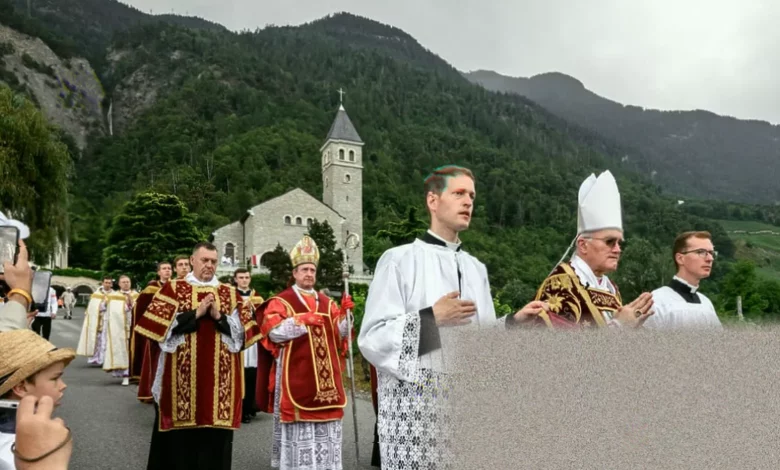
The Vatican has excommunicated a rebel Catholic group from the Society of Saint Pius X (SSPX) for defying Pope Leo XIV by ordaining four bishops without his consent, a move that the Holy See has formally declared an act of schism. The decree, announced on Thursday by Cardinal Víctor Manuel Fernández, head of the Dicastery for the Doctrine of the Faith, applies beyond the newly consecrated bishops to all SSPX priests and any Catholic who “adheres formally” to the society, triggering automatic excommunication under canon law.
The ordination ceremony took place on Wednesday in the Swiss village of Ecône, where the SSPX was founded in 1970 by the late Archbishop Marcel Lefebvre. An estimated 16,500 people attended, including members of the Italian neofascist party Forza Nuova and the far-right group Futuro Nazionale. The Vatican’s response went further than many expected: rather than targeting only the bishops, it declared that all priests of the society and all Catholics in formal adherence were in a state of schism — a severe, formal rupture within the Church. Canon law defines schism as “the refusal of submission to the supreme pontiff or of communion with the members of the Church subject to him,” and it carries the penalty of automatic excommunication, the most severe sanction, placing an individual outside the communion of the faithful and denying access to the sacraments.
Pope Leo made a last-ditch effort to prevent the ordinations, calling them a “schismatic act” and a “sin of extreme gravity.” The society, however, insisted that ordaining bishops “who are entirely faithful” to Catholic tradition was “a sacred duty.” That defiance lies at the heart of the dispute. The SSPX rejects central changes introduced by the Second Vatican Council (1962–1965), including the celebration of Mass in local languages — until then, the liturgy was conducted only in Latin — as well as dialogue with other religions and recognition of other Christian churches. The society believes the modern Church is riddled with heresies and errors, and it holds that its own mission is to preserve the pre-conciliar faith.
Andrea Vreede, Vatican correspondent for the Dutch public broadcaster NOS, explained three reasons the society pushed ahead with the ordinations. First, the SSPX had only two ageing bishops left and needed new ones. Second, after Pope Leo was elected in May 2025, the society hoped he would prove more tolerant than his predecessor Francis, noting that Leo wore classic papal vestments and revived the tradition of spending summer at Castel Gandolfo. But they soon discovered that Leo largely followed Francis’s approach to church unity. “The world is so much turning towards extremism, and they think they might flourish with that,” Vreede said, citing the third reason: the society is seeking to gain traction from the global far-right resurgence. “Leo will be very unhappy about what’s happened, but he saw it as inevitable,” she added. “It has happened in the past and it might happen again. It’s a nuisance but it won’t damage him. It’s not a very important schism and I think people will appreciate his coherence.”
The SSPX, though a splinter group, has built a substantial following estimated at between 150,000 and 200,000 people worldwide, with significant concentrations in the United States, France and Argentina. As of early 2026, the society had approximately 733 priests, 264 seminarians, 144 religious brothers and 250 sisters, though other estimates place global adherents between 500,000 and 600,000. It operates five seminaries — in Switzerland, France, Germany, Argentina and the United States — and is organised into 17 districts across more than 75 countries. The current Superior General is Davide Pagliarani. The bishops involved in the recent ordinations were identified as Alfonso de Galarreta and Bernard Fellay, who acted as consecrators, and the four newly ordained bishops: Pascal Schreiber, Michael Goldade, Michel Poinsinet de Sivry and Marc Hanappier.
A history of rupture and attempted reconciliation
The clash between the Vatican and the SSPX is not new. The first major schism came in 1988, when Archbishop Marcel Lefebvre consecrated four bishops without the permission of Pope John Paul II, including a British bishop, Richard Williamson. All were excommunicated for committing a “schismatic act” — the first such rupture in the Catholic Church since 1870. In 2009, Pope Benedict XVI lifted the excommunications of the four surviving bishops — Fellay, Tissier de Mallerais, Williamson and Alfonso de Galarreta — but the SSPX retained no canonical status within the Church, and its ministers’ authority remained illegitimate. Benedict stated that doctrinal issues still needed to be clarified for full communion. Shortly before the excommunications were lifted, Williamson caused international uproar by denying the Holocaust in a 2009 Swedish television interview. He was later expelled from the SSPX in 2012 for disobedience and died in January 2025.
Under Pope Francis, the Vatican made limited concessions: SSPX priests were allowed to validly absolve sins during the sacrament of reconciliation, and marriages celebrated by SSPX priests were deemed valid under certain conditions. But the fundamental rift over papal authority and the reforms of the Second Vatican Council remained unresolved. Pope Leo, since his election, has made church unity a priority and worked to heal rifts with traditionalists. This excommunication is the first significant crisis of his pontificate. Vreede said the Vatican hopes that by being harsh on the bishops, priests and faithful, “maybe some of them will repent and turn back to mother church. Because it’s not nice to be excommunicated.”