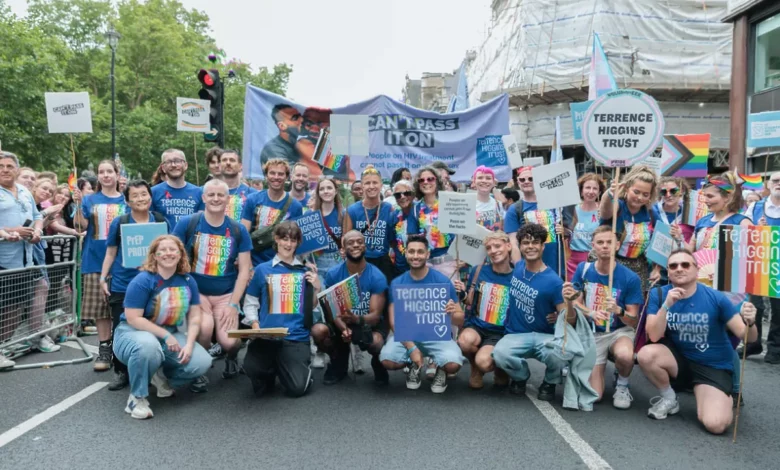
Forty-four years ago, Rupert Whitaker received a phone call at Durham University telling him to return to London to see his partner, Terry Higgins, before he died. He rushed back, but was left in a waiting room just off the ward as Terry passed away. Higgins would become the first named person in the UK to die of an Aids-related illness.
That same year, in 1982, Whitaker, alongside friend Martyn Butler, founded the UK’s first charity set up in response to HIV and Aids, initially named the Terry Higgins Trust. The charity was formalised in August 1983, adopting a constitution and opening a bank account, before becoming a limited company in November 1983 and gaining charitable status in January 1984. From the outset, it provided direct services such as buddying and home help, counselling, drug education and sex education. Princess Margaret was an early prominent patron – the first time a member of the royal family publicly associated with an Aids and sexual health charity.
The charity, now known as Terrence Higgins Trust, remains the UK’s leading HIV and Aids charity and the largest in Europe. Its mission today: to end new HIV transmissions by 2030, support everyone living with HIV, eradicate stigma and promote good sexual health. The charity supports people from the moment of diagnosis through every stage of living with HIV. Its services range from the long-running THT Direct helpline, peer support and counselling, to hardship funds, benefits advice, housing referrals and nutrition support through partners such as The Food Chain – a London-based charity founded on Christmas Day 1988 that delivers meals and groceries, offers cookery and nutrition classes, and provides communal eating opportunities for people living with HIV.
Opt-out testing: a game-changer for undiagnosed HIV
Applying pressure on government for policy change, fundraising and roll-out is a central plank of the Terrence Higgins Trust operation. “We’re pushing and prodding government to make sure they’re doing their bit,” said chief executive Richard Angell OBE. That has meant campaigning for opt-out HIV testing in A&E departments, which means all bloods taken are tested for HIV alongside hepatitis B and C. It was first piloted by the Elton John Aids Foundation in Lambeth, Lewisham and Southwark from 2018, before expanding across London and into hospitals around the country. The innovation has been a game-changing success story for finding people living with undiagnosed HIV.
“We secured from government the £20 million to take it capital-wide,” Angell told The London Standard. “That then worked with hepatitis, which took it to 38 hospitals across the country, and it’s now in 90.” Data from the charity shows the results have been life-saving: 1,900 new HIV diagnoses across the country, with 93 per cent of those people unlikely to have had an HIV test elsewhere. Of the first 800 cases, mostly in London, it is estimated nearly 200 HIV-related deaths and 28 new HIV transmissions will be averted. The Terrence Higgins Trust played a key role in securing significant government funding for the expansion – over £67 million in four years – and opt-out testing now operates in 96 hospitals across England and Scotland.
The charity’s advocacy has also focused on removing state-sanctioned stigma still attached to HIV. “Over recent years, we changed the rules on what was still termed driving with Aids, on not being able to fly with HIV as a commercial pilot, not being able to join the military if you’re living with HIV, and not being able to donate egg and sperm if you’re undetectable,” Angell said. Now, all of that has changed, alongside blood donation exclusions for gay and bisexual men and individuals from UK Black communities. “Anyone can get HIV,” Angell added. “It’s just a virus. It doesn’t discriminate, it preys on the discrimination in our society.”
Government commitments and a new HIV action plan
The Government has since pledged £9 million over three years to support people living with HIV, and Terrence Higgins Trust is working to ensure that money reaches the right services. In opposition, Sir Keir Starmer pledged that work would begin on a new HIV action plan within 100 days of forming a government. “They actually started with it in 88, which was very impressive,” Angell said. There followed the first Downing Street reception for World Aids Day in 17 years, where the Prime Minister committed £26 million to boost opt-out testing across all 90 sites, before he then took an HIV test live on camera. “It was not just front-page news here in the UK, but in South Africa, Zimbabwe, Kenya and other places,” Angell said. “A genuine global first.”
A new HIV Action Plan for England, backed by over £170 million in funding, was published on 1 December 2025. It focuses on five core priorities: prevention, testing, rapid antiretroviral therapy, reducing stigma and new partnerships. Around 90 per cent of the funding is allocated to HIV prevention, with more than 10 per cent dedicated to re-engaging people living with HIV who are disconnected from care. From April 2026 to March 2029, £156 million is earmarked for opt-out HIV, hepatitis B and hepatitis C testing in high-prevalence areas, and £4.8 million goes to the HIV Prevention England programme to improve awareness among at-risk and underserved populations. A £5 million trial for open-access HIV home testing via the NHS app and a review of expanding digital provision for HIV prevention, including online PrEP, are also part of the plan.
For Angell, such moments matter because leadership has always shaped the course of the epidemic. He points to Norman Fowler fighting within Margaret Thatcher’s government to get public health campaigns into every home, Matt Hancock signing up to the goal of ending new HIV cases by 2030, and now Starmer backing a new action plan. “Leaders really matter,” Angell said. “We do thank Keir Starmer for crossing the street to help people living with HIV.”
Challenges ahead: stigma, ageing and disconnection from care
Despite progress, thousands remain undiagnosed, while stigma, poverty, racism, homophobia and shame continue to stop people from testing, taking medication or seeking support. Stigma remains a major barrier to universal access to HIV prevention, treatment, care and support, associated with lower uptake of testing and treatment, reluctance to disclose status and fear of discrimination from healthcare workers. Intersecting prejudices – including racism and homophobia – can exacerbate HIV stigma, particularly for gay and bisexual men and Black African communities. A 2022 survey indicated that one in three people living with HIV reported low self-esteem due to their status, and almost half reported feeling ashamed.
As progress is made, the epidemic is changing. Angell is concerned about the first generation ageing with HIV, many of whom now face the care system with “understandable trepidation”. “The majority of people in England now living with HIV are over 50,” he said. For some, entering a care home can mean losing control over the very medication that has kept them alive. “If you’re on one pill a day… that’s often your agency over the virus, and it gets taken away from you,” he said. Once medication is stored and labelled, residents can also lose the privacy of disclosing their status on their own terms.
Data shows that approximately 5 per cent of people living with HIV are disconnected from care, prompting initiatives like the new “It’s Worth Another Try” project being piloted in London. The project aims to re-engage around 2,000 people living with HIV in the capital who have not attended their clinic for more than a year. Late diagnoses remain a challenge: 42 per cent of new HIV diagnoses in England in 2024 were late, with the rate higher among heterosexual individuals and older people.
Friday’s fundraising gala, on the eve of the anniversary of Terry Higgins’ death, is about turning remembrance into action. The event is held in partnership with The London Standard, at The London EDITION hotel in Fitzrovia, with BOSS as key sponsor and a special performance from singer Self Esteem – the solo project of British singer-songwriter Rebecca Lucy Taylor, formerly of the band Slow Club. Funds raised will help Terrence Higgins Trust stop new HIV cases and ensure anyone diagnosed is supported and able to live openly, without shame.