Professional Sports Leagues and Competitions in the UK Explained
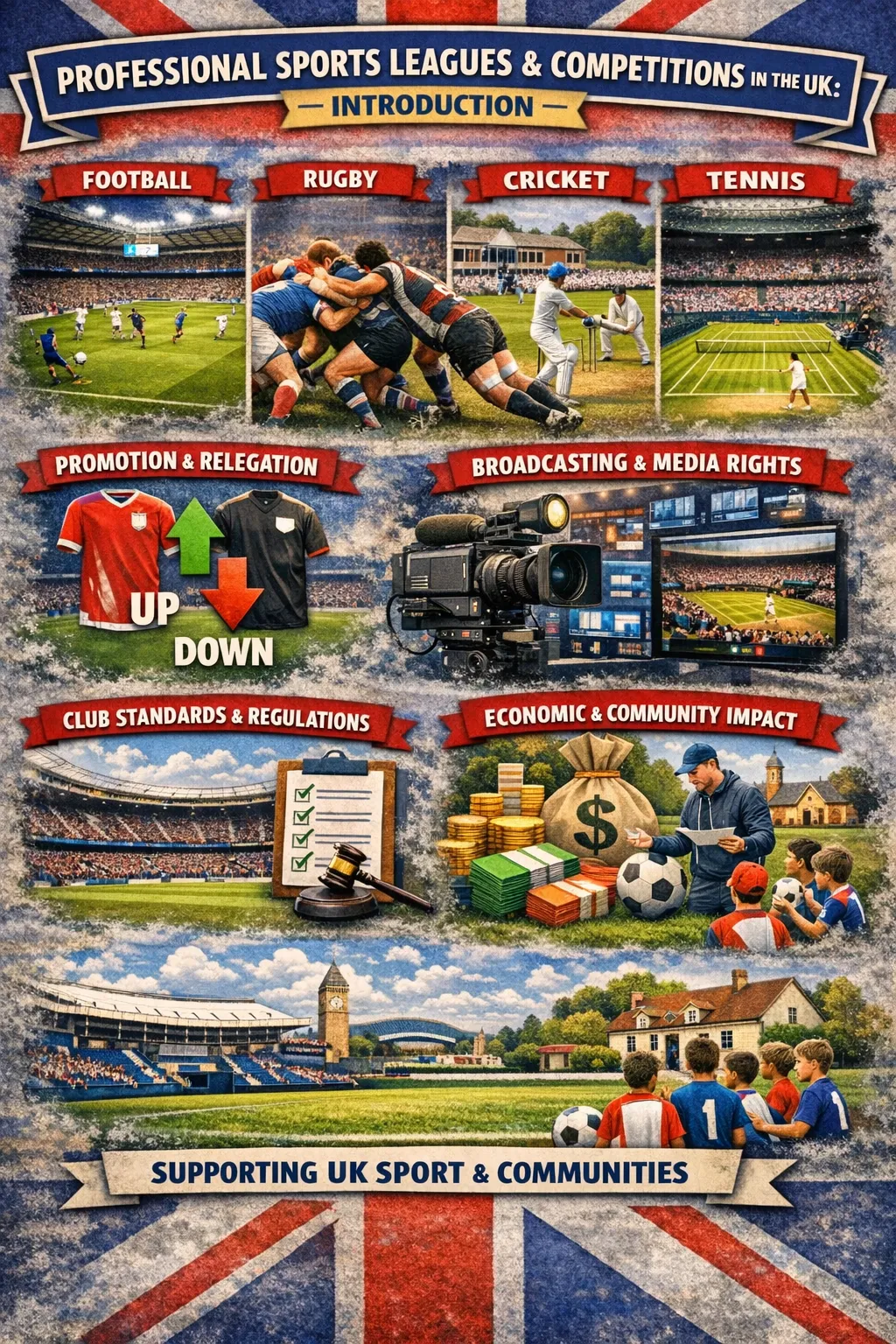
The United Kingdom is home to some of the world’s most prestigious and commercially successful professional sports leagues and competitions. From the global dominance of the Premier League to the historic traditions of cricket, rugby, tennis and horse racing, professional sport generates billions of pounds in revenue, attracts worldwide audiences and occupies a central place in British cultural life.
This guide explains the major professional sports leagues and competitions in the UK, how they are structured, how broadcasting and commercial rights work, and why professional sport matters for the economy and society.
How is professional football organised?
Football is by far the UK’s most popular and commercially significant sport. The English football pyramid is a hierarchical league system with the Premier League at its apex, followed by the English Football League (EFL) comprising the Championship, League One and League Two, and then multiple tiers of non-league football extending down to grassroots level. The Premier League is the most-watched domestic football league in the world, with matches broadcast in over 180 countries and combined domestic and international broadcasting rights worth billions of pounds per cycle.
The promotion and relegation system — in which the bottom clubs in each division are replaced by the top clubs from the division below — is a distinctive feature of English football that creates competitive drama and connects the grassroots game to the elite. Scotland operates a separate football league system, with the Scottish Premiership as its top division, managed by the Scottish Professional Football League (SPFL). Wales and Northern Ireland have their own domestic leagues, though many Welsh clubs (including the largest, such as Swansea City and Cardiff City) play in the English system.
The financial structure of football has become increasingly concentrated, with Premier League clubs generating revenues far exceeding those in lower divisions. This financial disparity, the impact of foreign ownership on club governance, the role of agents, player welfare, fan engagement and the sustainability of clubs in the lower leagues are all issues that the new independent football regulator is expected to address.
What other major professional sports operate in the UK?
Rugby union is a major professional sport, with the Gallagher Premiership as England’s top domestic league and the United Rugby Championship involving Welsh, Scottish and Irish teams alongside South African sides. The Six Nations Championship, contested annually by England, Scotland, Wales, Ireland, France and Italy, is one of the most prestigious international rugby competitions. Rugby league, predominant in the north of England, operates through Super League as its top professional competition.
Cricket is governed by the England and Wales Cricket Board (ECB) and operates a professional structure including the County Championship (the traditional four-day format), one-day competitions and The Hundred, a franchise-based 100-ball competition introduced in 2021 to attract new audiences to the sport. English cricket has faced significant scrutiny over issues of racism, diversity and governance following allegations by former players and independent reviews that found institutional racism within the sport.
Tennis, golf, horse racing, motorsport, boxing, athletics and cycling all have significant professional presences in the UK. Wimbledon is the world’s oldest and most prestigious tennis tournament. The Open Championship (golf), Royal Ascot, the Grand National, the British Grand Prix at Silverstone, and the London Marathon are all internationally recognised events. Horse racing is one of the UK’s largest sports by economic contribution, supporting a significant rural economy and regulated by the British Horseracing Authority.
How do broadcasting rights work in UK sport?
Broadcasting rights are the single most important source of revenue for most professional sports in the UK. The Premier League’s domestic and international TV deals are worth approximately £10 billion over the current cycle, distributed among the 20 clubs according to a formula that includes equal shares, performance-based payments and facility fees for televised matches. The “listed events” regime, maintained by Ofcom under the Broadcasting Act 1996, protects certain events of national significance — including the FIFA World Cup, the Olympic Games, Wimbledon, the Grand National and the FA Cup Final — for free-to-air television, ensuring that they remain accessible to the widest possible audience.
The shift of much sporting content behind pay-TV and streaming paywalls has been a significant cultural change, with concerns about the accessibility of sport to viewers who cannot afford subscription services. The growth of illegal streaming and piracy of sports broadcasts is a major commercial and legal challenge for rights holders and broadcasters.
How does professional rugby work in the UK?
Rugby union and rugby league are both significant professional sports in the UK. In rugby union, the English Premiership (Gallagher Premiership) is the top tier of club competition in England, featuring clubs such as Saracens, Leinster, Bath, Bristol Bears and Northampton Saints. The United Rugby Championship (URC) includes teams from Scotland, Wales and Ireland alongside South African sides. The Six Nations Championship, contested annually between England, Scotland, Wales, Ireland, France and Italy, is one of the most prestigious international rugby competitions in the world.
Rugby league’s top professional competition in the UK is Super League, dominated by clubs from the north of England including Wigan Warriors, St Helens, Leeds Rhinos and Hull FC. The sport’s governing body in England is the Rugby Football League (RFL). The Rugby League World Cup was hosted by England in 2022. Both rugby codes have faced financial pressures, with several Premiership rugby union clubs experiencing insolvency or severe financial difficulty in recent years, highlighting the challenges of sustaining professional sport outside football.
How do cricket, tennis and other professional sports operate?
Cricket in England and Wales is governed by the England and Wales Cricket Board (ECB). The professional domestic structure includes the County Championship (first-class cricket played over four days), the Vitality Blast (domestic T20 competition) and The Hundred (a 100-ball-per-innings format launched in 2021 to attract new audiences). England competes in international test matches, one-day internationals and T20 internationals, and the ECB has invested significantly in women’s cricket, with the women’s professional domestic structure growing rapidly.
Tennis in the UK is centred on the Wimbledon Championships, one of the four Grand Slam tournaments and the oldest tennis tournament in the world. The All England Lawn Tennis and Croquet Club organises Wimbledon, while the Lawn Tennis Association (LTA) governs the sport nationally and runs programmes to increase participation at grassroots level. Golf, motorsport (including Formula 1, with the British Grand Prix at Silverstone), horse racing, boxing, athletics and swimming all have significant professional structures and public followings in the UK.
How do athlete welfare and employment work in professional sport?
Professional athletes in the UK are generally employed under contracts with their clubs or, in individual sports, operate as self-employed contractors or are supported by funding from UK Sport or NGBs. Player welfare — including physical and mental health, career transition support, financial management and protection from exploitation — has become an increasingly important focus for sports organisations, players’ unions and regulators.
Players’ unions such as the Professional Footballers’ Association (PFA), the Rugby Players’ Association (RPA) and the Professional Cricketers’ Association (PCA) represent the interests of professional athletes in negotiations with employers, provide welfare and support services, and advocate for improvements in working conditions, safeguarding and career transition. The retirement of professional athletes — many of whom finish their playing careers in their 30s — presents particular challenges, and support for career transition, education and mental health during and after sporting careers has been identified as a priority across all professional sports.
How does the Premier League work?
The Premier League is the top tier of English football and the most-watched football league in the world, broadcast to over 200 countries and territories. It consists of 20 clubs that compete in a 38-match season from August to May. The bottom three clubs are relegated to the Championship at the end of each season, replaced by promoted clubs. The league generates over £6 billion in annual revenue, making it the wealthiest domestic football league globally.
Premier League clubs are subject to the league’s own financial regulations, including profit and sustainability rules (PSR) that limit the losses clubs can incur over a rolling three-year period. Clubs that breach these rules face sanctions including points deductions, as demonstrated by cases involving Everton and Nottingham Forest. Player transfers are conducted during two annual transfer windows (summer and January), with the total spending of Premier League clubs regularly exceeding £2 billion per year. The distribution of domestic and international broadcasting revenue, commercial partnerships and prize money provides the league’s financial foundation, though the gap between the largest and smallest clubs continues to grow.
How does the English Football League work?
Below the Premier League, the English Football League (EFL) comprises three divisions — the Championship (24 clubs), League One (24 clubs) and League Two (24 clubs) — totalling 72 professional clubs. The EFL is the oldest league competition in the world, and its clubs are deeply embedded in the communities they serve. Promotion and relegation between divisions creates sporting drama and financial incentive, though the financial gap between the Premier League and the Championship — often described as the “cliff edge” of parachute payments — creates significant risk for clubs that are relegated.
The EFL also organises the Carabao Cup (League Cup) and the EFL Trophy. Below the EFL, the National League system provides a pyramid of semi-professional and amateur leagues extending down to grassroots level, connected by promotion and relegation at each tier. The women’s game has its own professional structure — the Women’s Super League (WSL) and the Women’s Championship — which has grown rapidly in profile, attendance and investment following the success of the England women’s team (the Lionesses) at the 2022 European Championship.
How do horse racing and combat sports work?
Horse racing is one of Britain’s oldest professional sports and a significant industry in its own right, employing approximately 20,000 people directly and supporting a wider rural economy through breeding, training, racecourse operations and the betting industry. The British Horseracing Authority (BHA) governs the sport, overseeing approximately 1,500 race meetings per year across 59 racecourses. Major events include Royal Ascot, the Derby at Epsom, the Grand National at Aintree and the Cheltenham Festival. The sport is closely linked to the gambling industry, with horse racing betting generating billions of pounds in turnover annually.
Boxing in the UK is governed by the British Boxing Board of Control (BBBofC), which licenses professional boxers, referees, promoters and venues. The UK has a strong tradition in professional boxing, producing world champions across multiple weight divisions. The sport is closely regulated for safety, with mandatory medical examinations, insurance requirements and strict rules on matchmaking. Mixed martial arts (MMA) has grown significantly in popularity in the UK, with events sanctioned under rules approved by relevant commissions, though the regulatory framework for MMA is less established than for boxing.
How does the relationship between sport and gambling work?
The relationship between professional sport and gambling in the UK is extensive and commercially significant but increasingly controversial. Sports betting generates billions of pounds annually, and gambling companies are major sponsors of football clubs, stadiums, competitions and broadcasting. The Gambling Act 2005 provides the regulatory framework, with the Gambling Commission responsible for licensing and regulating all forms of gambling in Great Britain.
Concerns about the impact of gambling advertising on children, the association between sport and gambling, the risks of match-fixing and the prevalence of gambling-related harm have led to significant policy debate. The government’s gambling white paper (2023) introduced measures including a statutory levy on gambling operators to fund research, prevention and treatment of gambling harm, and the Premier League has announced that front-of-shirt gambling sponsorship will end. The integrity of sport is directly affected by the scale and accessibility of betting markets, making the regulation of the sport-gambling nexus a critical governance issue.
Why do professional sports matter?
Professional sport contributes billions of pounds to the UK economy through broadcasting, sponsorship, ticket sales, merchandise, tourism and the wider supply chain. It provides employment for thousands of athletes, coaches, officials, administrators and support staff, and generates significant tax revenue. Beyond economics, professional sport creates shared cultural experiences, inspires participation, drives tourism and enhances the UK’s international reputation.
Related guides
- How Sport Is Governed in the UK
- Funding and Grassroots Sport in the UK Explained
- Sports Integrity, Safeguarding and Anti-Doping in the UK Explained
- How the UK Economy Works
Related coverage:
Read our latest UK sports news
Prepared by: