
Funding and Grassroots Sport in the UK Explained
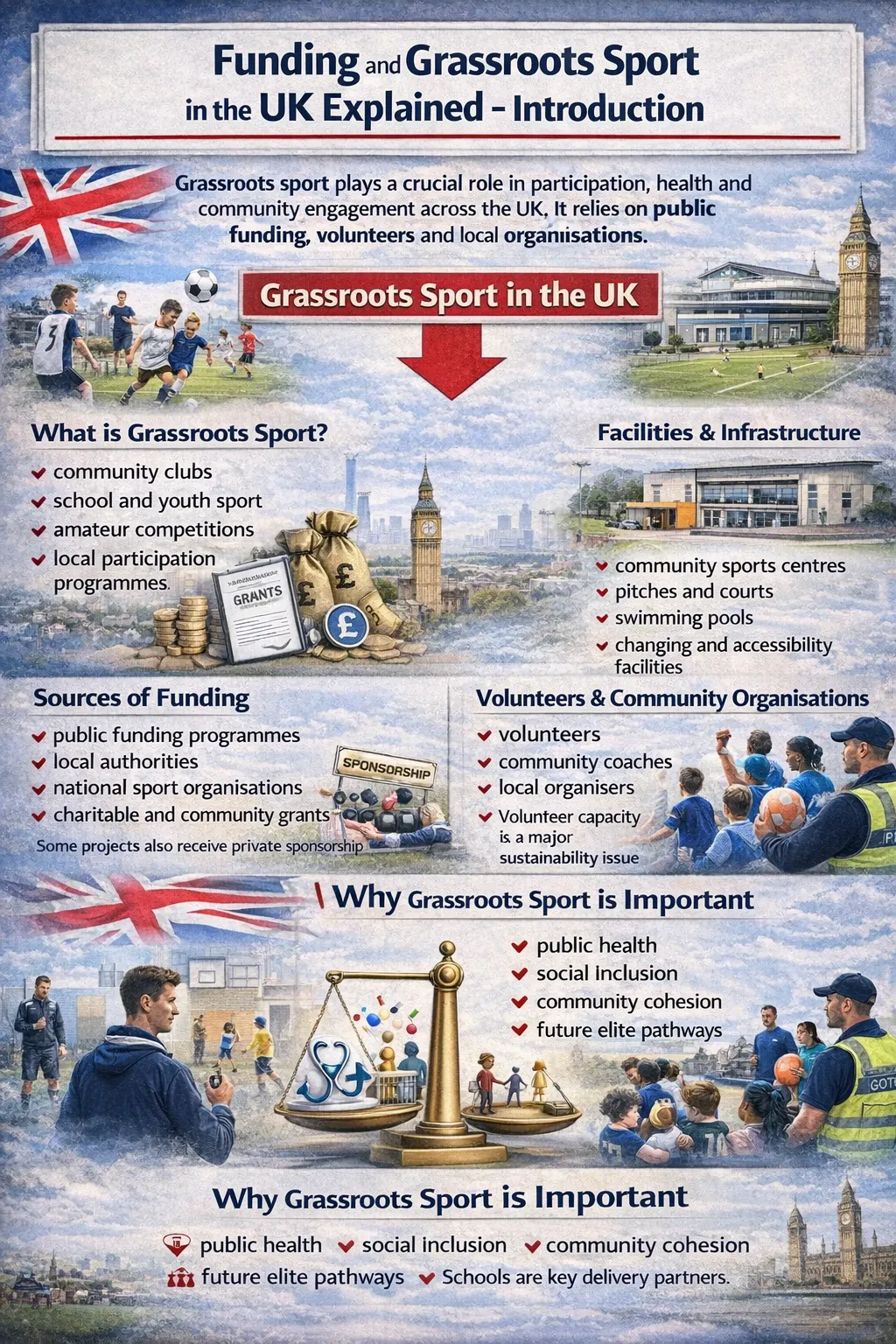
Grassroots sport — community-based participation at all ages and abilities — is the foundation of the United Kingdom’s sporting culture and the essential pipeline through which future elite athletes emerge. From children’s football clubs and park runs to community swimming sessions and disability sport programmes, grassroots activity shapes the health, wellbeing and social life of millions of people. The funding and organisation of community sport involves a complex network of government bodies, lottery distributors, national governing bodies, local authorities and thousands of voluntary clubs and organisations.
This guide explains how grassroots sport is funded, who is responsible for promoting participation, what challenges community sport faces and why investment in sport at every level matters for the nation’s health and social cohesion.
How is grassroots sport funded?
The primary public funder of grassroots sport in England is Sport England, an arm’s-length body of the Department for Culture, Media and Sport. Sport England distributes both government funding and National Lottery proceeds to promote participation in sport and physical activity across the population. Its current 10-year strategy, Uniting the Movement, focuses on tackling inequalities in access to sport, connecting communities through physical activity and investing in the people, places and organisations that make sport happen.
Sport England’s funding programmes support a wide range of activities, from capital investment in facilities (sports halls, swimming pools, artificial pitches and community centres) to revenue funding for participation programmes, coaching development, volunteering and organisational capacity building. The National Lottery contributes approximately £250-300 million per year to sport through Sport England, making it one of the most significant sources of funding for community sport in the country.
The devolved nations have their own sport funding bodies. sportscotland promotes and invests in sport across Scotland, using government and lottery funding. Sport Wales fulfils a similar role in Wales, and Sport Northern Ireland invests in grassroots and performance sport in Northern Ireland. UK Sport, a separate body, focuses on elite and Olympic/Paralympic sport rather than grassroots participation, though the two are connected through the talent pathway from community to international level.
What role do local authorities and facilities play?
Local authorities are major providers of sports facilities and services, operating or commissioning leisure centres, swimming pools, playing fields, parks, tennis courts and other facilities used by millions of people. However, local authority spending on leisure and sport has been significantly reduced since 2010, as councils have faced severe budget pressures and have been forced to prioritise statutory services such as social care, housing and children’s services over discretionary spending on sport and leisure.
Many local authority leisure services are now operated by external trusts or private companies under management contracts, which can offer cost savings and access to charitable business rates relief. The COVID-19 pandemic caused severe financial damage to the leisure sector, with prolonged closures and reduced capacity leading to revenue losses, facility closures and, in some cases, the permanent loss of swimming pools and sports centres. The National Audit Office and parliamentary committees have highlighted the deteriorating condition of the public leisure estate and the need for sustained investment.
The protection of playing fields and outdoor sports facilities from development has been a longstanding concern. Sport England acts as a statutory consultee on planning applications that affect playing fields, and its policy is to oppose any development that would result in the loss of playing field land unless equivalent or better replacement provision is made. Despite this protection, the total stock of playing fields in England has declined over time, and concerns about access to outdoor space for sport, particularly in urban areas, remain significant.
How do voluntary sports clubs operate?
The voluntary sports club is the bedrock of UK grassroots sport. There are estimated to be over 150,000 community sports clubs in the UK, run predominantly by volunteers — coaches, administrators, referees, committee members and parents — who give their time to enable others to participate. These clubs range from small, informal groups meeting in local parks to large, well-established organisations with their own facilities, junior development programmes and multiple teams competing in structured leagues.
Clubs are typically affiliated to national governing bodies (NGBs) for their sport — such as the Football Association, England Cricket Board, England Athletics, the Lawn Tennis Association and the Rugby Football Union — which provide competition structures, coaching qualifications, safeguarding frameworks, insurance and development support. The relationship between clubs and NGBs is central to the organisation of sport in the UK, with NGBs acting as the link between grassroots participation and elite performance pathways.
Challenges facing voluntary clubs include declining volunteer numbers (particularly among younger adults), rising costs for facility hire, equipment and insurance, the administrative burden of safeguarding and governance requirements, difficulty attracting and retaining participants (especially teenagers and young adults), and competition for people’s time from sedentary leisure activities. Supporting the sustainability and capacity of voluntary sports clubs is a key priority for Sport England and the NGBs.
How are participation and physical activity promoted?
Increasing physical activity levels across the population is both a sport policy and a public health priority. The UK Chief Medical Officers recommend that adults undertake at least 150 minutes of moderate-intensity physical activity per week (or 75 minutes of vigorous activity), alongside muscle-strengthening activities on at least two days per week. For children and young people, the recommendation is at least 60 minutes of moderate-to-vigorous activity every day. However, a significant proportion of the population — approximately one in four adults and one in three children — does not meet these guidelines.
Sport England’s approach has shifted from a narrow focus on organised sport towards a broader emphasis on all forms of physical activity — including walking, cycling, dancing, gardening and active travel — recognising that many people who are currently inactive are more likely to be engaged through informal, accessible activities than through traditional sports club structures. Programmes such as This Girl Can, We Are Undefeatable (targeting people with long-term health conditions) and the Together Fund (supporting community organisations in underserved areas) reflect this more inclusive approach.
How does school sport contribute to grassroots participation?
Schools are a critical entry point for children’s participation in sport and physical activity. The National Curriculum in England includes physical education (PE) as a compulsory subject at all key stages, with primary schools expected to provide at least two hours of PE per week. The PE and Sport Premium — additional government funding of approximately £320 million per year for primary schools — is designed to improve the quality of PE teaching, increase participation and develop sustainable PE programmes.
School sport competitions, coordinated through the School Games programme, provide opportunities for children to experience competitive sport in a supportive environment. Partnerships between schools and local sports clubs are encouraged through the school-club link model, in which NGBs, county sports partnerships and local clubs work together to create pathways from school sport into community-based participation. However, concerns have been raised about the quality and quantity of PE in many schools, the loss of playing fields, the decline of competitive sport in some schools and the gap between the PE provision available in state and independent schools.
Extra-curricular sport — after-school clubs, inter-school competitions and holiday programmes — plays an important role in developing children’s sporting skills, confidence and enthusiasm. The provision of extra-curricular sport varies widely between schools, with more affluent schools typically offering a broader range of sporting activities. Addressing this inequality of opportunity is a key priority for Sport England, the Youth Sport Trust and national governing bodies.
How does disability sport work at grassroots level?
Disability sport — participation by people with physical, sensory, intellectual and learning disabilities — is an important and growing area of grassroots provision. Activity Alliance (formerly the English Federation of Disability Sport) works with Sport England, NGBs and local partners to increase participation by disabled people, who remain significantly less likely to be physically active than non-disabled people. Barriers to participation include inaccessible facilities, a lack of appropriate coaching, transport difficulties, cost and attitudinal barriers.
Many sports offer adapted or inclusive formats — including wheelchair basketball, wheelchair rugby, boccia, goalball, blind cricket and para-athletics — that enable people with a wide range of disabilities to participate and compete. The success of British athletes at the Paralympic Games has raised the profile of disability sport and contributed to changing public attitudes, though the translation of elite success into grassroots participation remains a work in progress. Special Olympics Great Britain provides year-round sports training and competition for people with intellectual disabilities, and the Invictus Games have highlighted the role of sport in the recovery and rehabilitation of wounded, injured and sick military personnel and veterans.
How do community sport and physical activity programmes target inequality?
Persistent inequalities in sport and physical activity participation — by gender, age, disability, ethnicity and socioeconomic background — are a central focus of grassroots sport policy. Women and girls, older adults, people from lower socioeconomic groups, some ethnic minority communities and people with long-term health conditions are all less likely to meet physical activity guidelines than the general population. Sport England’s Uniting the Movement strategy explicitly prioritises tackling these inequalities and focuses investment on the people and communities that face the greatest barriers to being active.
Targeted programmes include This Girl Can (a national campaign to encourage women and girls to be active, regardless of ability, size or appearance), We Are Undefeatable (supporting people living with long-term health conditions), the Together Fund (providing small grants to community organisations in underserved areas) and the Tackling Inequalities Fund (created during the COVID-19 pandemic to support organisations working with communities disproportionately affected by inactivity). The shift from measuring success primarily through participation numbers to measuring the reduction of inequalities represents a significant change in approach for grassroots sport policy.
What role does the National Lottery play in funding sport?
The National Lottery has been the single most important source of funding for sport in the UK since its launch in 1994. A fixed proportion of lottery ticket sales — approximately 20 per cent — is distributed to “good causes,” including sport, arts, heritage and community projects. Sport England and UK Sport together receive approximately £300-350 million per year from the lottery, funding everything from grassroots participation programmes and community facility improvements to elite athlete support and major event preparation.
National Lottery funding has transformed sport in the UK. It funded the construction of many of the venues used at the London 2012 Olympics, supported the athlete development programmes that have produced Olympic and Paralympic medal success, and invested in thousands of community projects — from village hall renovations and multi-use games areas to coaching bursaries and disability sport programmes. However, lottery revenue has declined in real terms as the market for lottery products has faced increased competition from other forms of gambling and entertainment, raising concerns about the long-term sustainability of lottery funding for sport.
How has the COVID-19 pandemic affected grassroots sport?
The COVID-19 pandemic had a devastating impact on grassroots sport and physical activity. Prolonged closures of leisure centres, swimming pools, gyms, sports clubs and outdoor facilities during national lockdowns disrupted participation patterns, caused severe financial damage to providers and facilities, and contributed to declining physical activity levels across the population. Sport England’s Active Lives Survey found that the number of inactive adults in England increased significantly during the pandemic, with the most disadvantaged communities and those already least active disproportionately affected.
The recovery of grassroots sport since the lifting of restrictions has been uneven. Some activities — particularly outdoor and informal activities such as walking, cycling, running and outdoor swimming — have benefited from increased interest during and after the pandemic, as people discovered the mental health and wellbeing benefits of exercising outdoors. However, indoor sports, swimming and organised team sports have recovered more slowly, and some facilities that closed during the pandemic have not reopened. The government provided emergency funding through the Sport Survival Package and the National Leisure Recovery Fund, but many organisations in the grassroots sport sector continue to face financial fragility, reduced volunteer capacity and the challenge of re-engaging participants who dropped out during the pandemic.
Why does grassroots sport matter?
Grassroots sport and physical activity deliver benefits that extend far beyond fitness. Regular participation improves physical health (reducing the risk of cardiovascular disease, type 2 diabetes, certain cancers and musculoskeletal conditions), supports mental health and wellbeing, develops social skills and confidence in children and young people, builds community connections and social cohesion, and contributes to local economies through employment, volunteering and consumer spending. The governance and funding of grassroots sport is therefore not just a sporting issue but a public health, education and social policy priority.
Related guides
- How Sport Is Governed in the UK
- Professional Sports Leagues and Competitions in the UK Explained
- Sports Integrity, Safeguarding and Anti-Doping in the UK Explained
- Public Health System in the UK Explained
- UK Public Finances and Government Spending Explained
Related coverage:
Read our latest UK sport news
Prepared by:
