How Sport Is Governed in the UK
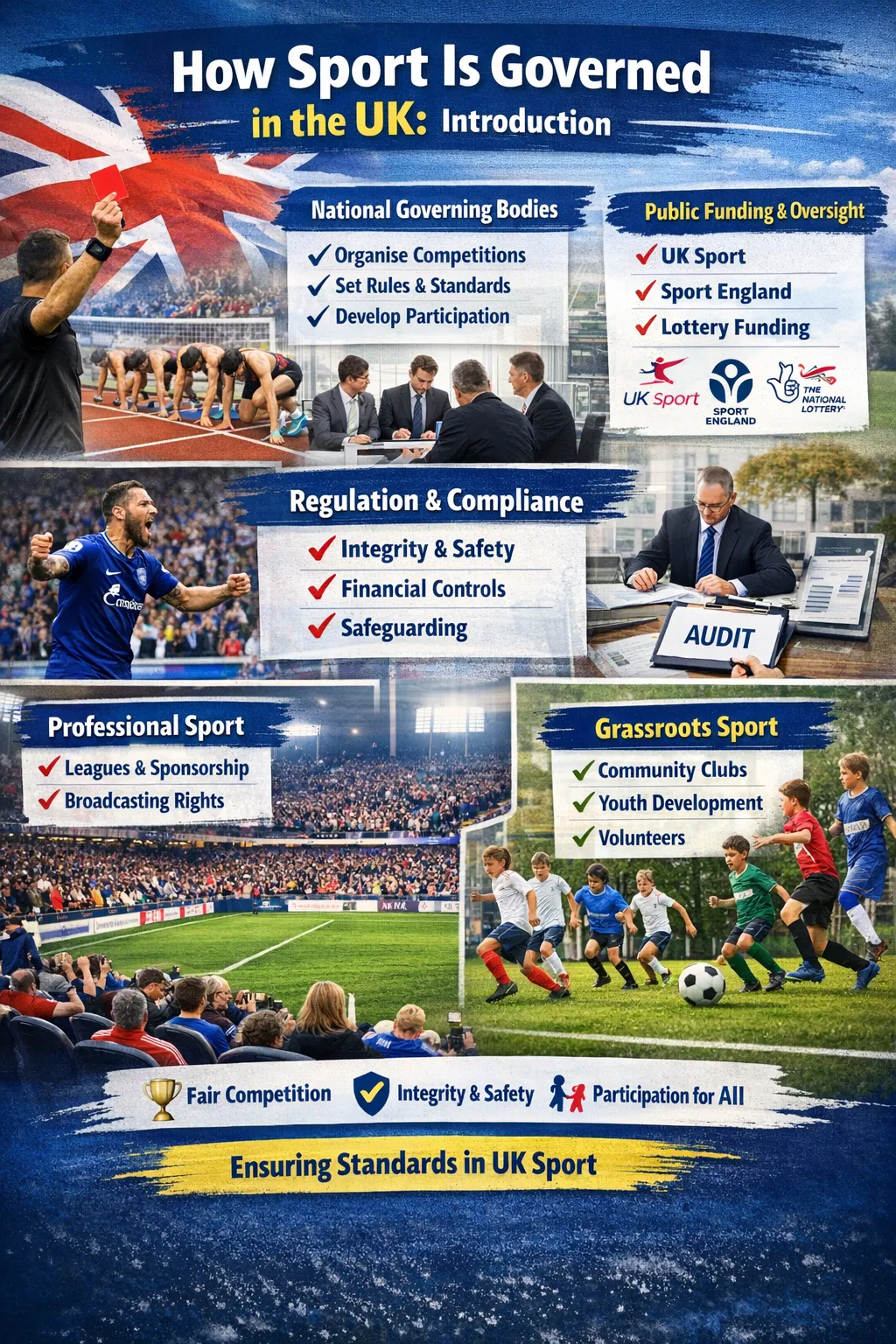
Sport plays a central role in British culture, identity and public life. From the Premier League and Wimbledon to grassroots football clubs and community swimming pools, sporting activity engages millions of people across the United Kingdom as participants, spectators and volunteers. The governance of sport — how it is organised, funded, regulated and held accountable — is a complex ecosystem involving government, national sports councils, governing bodies, commercial organisations and the voluntary sector.
This guide explains how sport is governed in the UK, who the key organisations are, how policy is set, what the main issues facing sports governance are and why it matters.
How is sport organised in the UK?
Sport in the UK operates through a layered system of government policy, arms-length public bodies, national governing bodies (NGBs) and commercial organisations. The Department for Culture, Media and Sport (DCMS) is the government department responsible for sport policy in England, including the strategic framework for sport, major events, anti-doping, integrity and the interface between sport and wider government objectives such as public health, education and community cohesion.
Sport England is the arms-length body responsible for growing and developing grassroots sport and physical activity in England. It distributes funding from the government and the National Lottery to NGBs, community organisations and local projects. UK Sport is responsible for investing in Olympic and Paralympic sport, supporting elite athletes and managing the UK’s involvement in major international sporting events including the Olympic and Paralympic Games, Commonwealth Games and World Championships.
In Scotland, sportscotland fulfils a similar role to Sport England, funded by the Scottish Government and the National Lottery. Sport Wales and Sport Northern Ireland perform equivalent functions in their respective nations. The four home nations cooperate on UK-wide matters through bodies such as the British Olympic Association (BOA), the British Paralympic Association (BPA) and UK Anti-Doping (UKAD).
National governing bodies — such as the Football Association (FA), the Rugby Football Union (RFU), the England and Wales Cricket Board (ECB), the Lawn Tennis Association (LTA), the All England Lawn Tennis Club (which organises Wimbledon), UK Athletics and British Cycling — are responsible for managing their respective sports, including setting rules, organising competitions, selecting national teams, developing coaches and officials and promoting participation. NGBs are typically independent organisations that receive public funding through Sport England or UK Sport in return for delivering agreed outcomes.
What is the role of government in sport?
The Department for Culture, Media and Sport (DCMS) is the government department responsible for sport policy in England. DCMS sets the strategic framework for sport, allocates government funding and oversees the arm’s-length bodies that deliver sport policy — principally UK Sport (which supports elite and Olympic/Paralympic sport) and Sport England (which promotes grassroots participation and community sport). In Scotland, sportscotland reports to the Scottish Government; Sport Wales to the Welsh Government; and Sport Northern Ireland to the Northern Ireland Executive.
Government involvement in sport extends beyond funding and strategy. The government sets the legislative framework for areas including safeguarding, gambling regulation (which affects sports betting), broadcasting rights (through the “listed events” regime that protects certain major sporting events for free-to-air television), anti-doping, stadium safety and equality in sport. Ministers engage regularly with national governing bodies on issues of public concern, and parliamentary select committees — particularly the DCMS Select Committee — scrutinise sport policy, governance failures and emerging issues.
How does Olympic and Paralympic sport work?
UK Sport is the agency responsible for investing in Olympic and Paralympic sport, with the goal of achieving medal success at the Games. UK Sport distributes funding — from government and the National Lottery — to national governing bodies based on their medal potential, using a “no compromise” approach that concentrates investment on sports and athletes with the best chance of winning medals. This strategy has been credited with transforming the UK’s performance at the Olympic and Paralympic Games, with Great Britain finishing in the top four of the medal table at every Summer Olympics since London 2012.
The British Olympic Association (BOA) selects and manages the Team GB delegation to the Olympic Games, while the British Paralympic Association (BPA) fulfils the same role for the Paralympic Games. These are independent bodies, separate from UK Sport, that work with national governing bodies to prepare athletes for competition. The UK’s elite sport system also includes world-class training facilities, sports science and medicine support, and athlete welfare programmes, though the balance between medal ambition and athlete wellbeing has been the subject of scrutiny following concerns about cultures of fear and overtraining in some sports.
How do national governing bodies operate?
National governing bodies (NGBs) are the organisations responsible for managing individual sports in the UK. Major NGBs include the Football Association (FA), the England and Wales Cricket Board (ECB), the Rugby Football Union (RFU), the Lawn Tennis Association (LTA), England Athletics, British Cycling, British Swimming and UK Athletics, among many others. NGBs are responsible for setting the rules of their sport, organising competitions, developing talent pathways, training coaches and officials, promoting participation and ensuring the integrity and safety of their sport.
NGBs that receive public funding from Sport England or UK Sport are required to meet the Code for Sports Governance, which sets standards for transparency, accountability, diversity and financial management. The code requires boards to include at least 30 per cent of each gender, to publish annual accounts, to implement term limits for board members and to establish independent audit and risk processes. Compliance with the code is a condition of public funding, giving the government significant leverage over sports governance standards.
What is the independent football regulator?
The Football Governance Bill, progressing through Parliament, will establish an independent regulator for English football — the first statutory regulator for any sport in the UK. The regulator is intended to address longstanding concerns about the financial sustainability of football clubs, the distribution of revenue between the Premier League and the lower divisions, the protection of clubs’ community heritage (including names, badges, home grounds and shirt colours) and the fitness and propriety of club owners and directors.
The proposal for an independent football regulator was recommended by the fan-led review of football governance, chaired by Tracey Crouch MP, which reported in 2021. The review found that the existing self-regulatory system — in which the football authorities governed themselves — had failed to prevent financial mismanagement, protect fans’ interests or ensure the fair distribution of revenues. The regulator will have licensing powers, the ability to set financial regulations and the authority to intervene in the ownership and operation of clubs.
What are the key governance issues in UK sport?
Governance standards in sport have come under increasing scrutiny. The Code for Sports Governance, published by Sport England and UK Sport, sets minimum standards that organisations must meet to receive public funding, covering areas including board composition, diversity, financial management, transparency, accountability and safeguarding. The code requires boards to have at least 30 per cent representation from each gender and to include independent non-executive directors.
Several sports have faced significant governance challenges. Football governance has been a particular focus, with the Football Governance Bill establishing an independent regulator for English football — the first statutory regulator for any sport in the UK. The regulator will oversee the financial sustainability of football clubs, protect the interests of fans, ensure appropriate ownership and governance standards, and address the distribution of revenue across the football pyramid. The creation of the regulator followed years of campaigning by fan groups and several high-profile club failures.
Safeguarding — the protection of children and vulnerable adults in sport from abuse, exploitation and harm — has become a major governance priority following revelations of historic sexual abuse in football, gymnastics, swimming and other sports. All NGBs that receive public funding are required to have robust safeguarding policies, trained welfare officers and procedures for reporting and investigating concerns. The NSPCC’s Child Protection in Sport Unit works with NGBs to raise standards and support the implementation of safeguarding measures.
How does equality and diversity in sport governance work?
Equality and diversity in sport — both in participation and in leadership — have become central governance issues. The Code for Sports Governance requires boards to include at least 30 per cent of each gender, and Sport England and UK Sport have set targets for increasing the diversity of leadership across the sector. Despite progress, women, ethnic minorities, disabled people and people from lower socioeconomic backgrounds remain significantly underrepresented in senior leadership positions in most sports.
Several high-profile cases have highlighted the challenges. The Independent Commission for Equity in Cricket (ICEC), established following allegations of racism in the sport, published a landmark report in 2023 documenting widespread discrimination and recommending fundamental reforms to the ECB’s governance, culture and approach to equality. British Cycling faced an independent investigation into claims of a dysfunctional and discriminatory culture. The Football Association has introduced requirements for interviews of diverse candidates for coaching and senior roles, following the model of the NFL’s Rooney Rule.
The inclusion of transgender athletes in competitive sport has become one of the most contentious governance issues internationally. UK sports bodies have developed policies balancing inclusion with competitive fairness, with World Athletics, World Aquatics and other international federations introducing eligibility criteria based on testosterone levels and transition timing. The debate involves complex questions about biology, identity, fairness and the purpose of sex-based categories in sport, and policies continue to evolve as scientific evidence develops.
How do major sporting events impact governance?
Hosting major international sporting events — including the Olympic and Paralympic Games, the FIFA World Cup, the Cricket World Cup, the Rugby World Cup and the Commonwealth Games — requires significant governance capacity, public investment and cross-sector coordination. The UK hosted the London 2012 Olympic and Paralympic Games, widely regarded as one of the most successful modern Games, and the Birmingham 2022 Commonwealth Games. The legacy of major events — in terms of facilities, participation, economic development and international reputation — is a key consideration in bidding decisions.
The governance of major events involves government (through DCMS and the Treasury), local authorities, organising committees, international sports federations and a wide range of delivery partners. Legacy planning — ensuring that the investment in venues, infrastructure and public engagement delivers lasting benefits — has become a central part of event governance. The Queen Elizabeth Olympic Park in east London provides a model of post-Games legacy development, with the stadium, velodrome, aquatics centre and surrounding parkland repurposed for community use, elite sport, cultural events and commercial development.
How does sports finance and commercial governance work?
The financial governance of professional sport has become increasingly complex as commercial revenues — from broadcasting, sponsorship, merchandising, matchday income and digital media — have grown dramatically. The Premier League’s broadcast rights alone are worth over £10 billion per cycle, and the total revenue of English football clubs exceeds £6 billion per year. This commercial growth has attracted investment from sovereign wealth funds, private equity firms and international business figures, raising questions about ownership transparency, financial regulation and the protection of clubs’ sporting and community interests.
Financial sustainability is a critical governance challenge across professional sport. Several football clubs have experienced financial distress, including administration, points deductions and winding-up petitions, often as a result of unsustainable spending on player wages, transfer fees and operational costs. The proposed independent football regulator will introduce financial sustainability regulations, including requirements for clubs to operate within their means and to maintain adequate financial reserves. Similar concerns about financial sustainability have affected rugby union, with multiple Premiership clubs entering administration in recent years.
Why does sports governance matter?
Good governance ensures that sport is managed in the interests of participants, fans and communities rather than solely for commercial gain. It protects the integrity of competition, safeguards vulnerable people, promotes diversity and inclusion, ensures financial sustainability and maintains public confidence in institutions that receive significant public and lottery funding. As sport becomes ever more commercialised and globalised, effective governance is essential to preserving the values that make sport a force for good in society.
Related guides
- Professional Sports Leagues and Competitions in the UK Explained
- Funding and Grassroots Sport in the UK Explained
- Sports Integrity, Safeguarding and Anti-Doping in the UK Explained
- How the UK Government Works
- How the UK Economy Works
Related coverage:
Read our latest UK sports news
Prepared by: