Sports Integrity, Safeguarding and Anti-Doping in the UK Explained
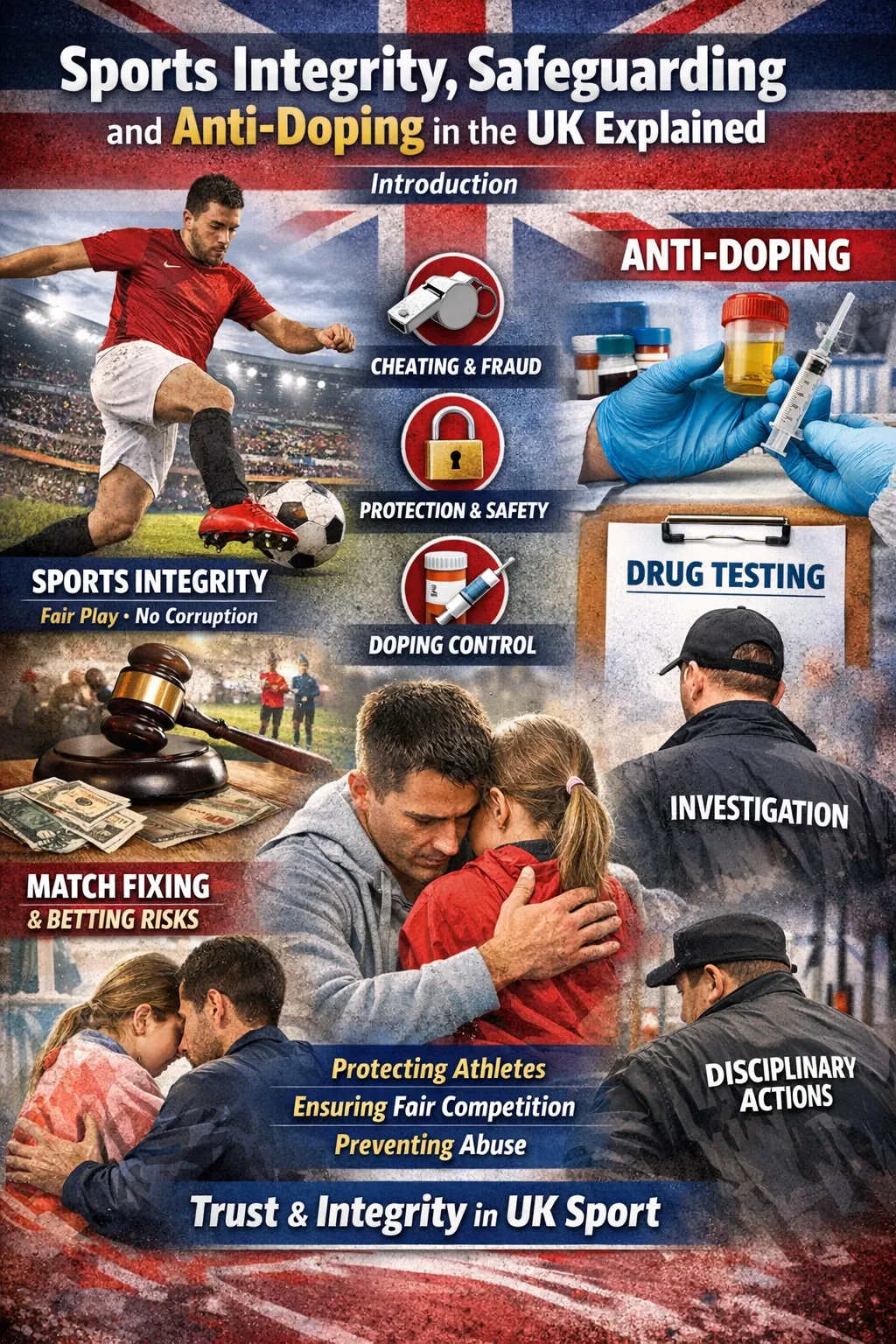
The integrity of sport — ensuring fair competition, protecting participants from abuse, and preventing corruption and cheating — is essential to maintaining public trust in sport and safeguarding the welfare of everyone involved, from elite athletes to grassroots participants. The United Kingdom has developed a comprehensive framework of organisations, laws and codes of practice to promote integrity across all sports, covering anti-doping, safeguarding, match-fixing, governance standards and disciplinary processes.
This guide explains how the UK approaches sports integrity, who is responsible for enforcement, how safeguarding and anti-doping systems work and why these issues matter.
How does anti-doping work in the UK?
UK Anti-Doping (UKAD) is the national anti-doping organisation responsible for protecting clean sport in the UK. UKAD operates in accordance with the World Anti-Doping Code, the international framework established by the World Anti-Doping Agency (WADA), and implements a comprehensive programme of testing, education, intelligence and investigations across all sports.
UKAD conducts thousands of doping tests each year, both in competition and out of competition. Athletes at the highest levels are required to provide whereabouts information — details of where they will be at specified times each day — to enable no-notice testing. Testing involves the analysis of urine and blood samples for prohibited substances and methods, including anabolic steroids, stimulants, growth hormones, erythropoietin (EPO), blood transfusions and gene doping. Samples are analysed at WADA-accredited laboratories, including the Drug Control Centre at King’s College London.
Athletes who commit anti-doping rule violations face sanctions that can include bans of up to four years (or longer for aggravating circumstances), disqualification of results, forfeiture of medals and prizes, and public disclosure. Anti-doping violations include the presence of a prohibited substance in a sample, the use or attempted use of prohibited substances or methods, refusing or evading testing, tampering with the doping control process, and trafficking or administering prohibited substances. Athletes can appeal sanctions to the National Anti-Doping Panel or, for international-level athletes, to the Court of Arbitration for Sport (CAS).
How does safeguarding work in sport?
Safeguarding in sport — protecting children, young people and adults at risk from abuse, bullying, harassment and exploitation — has become a central concern for sports organisations following a series of high-profile scandals. The independent review into child sexual abuse in football, prompted by disclosures from former players in 2016, revealed systemic failures in safeguarding within the sport and led to significant reforms across all major sports.
The Child Protection in Sport Unit (CPSU), operated by the NSPCC in partnership with Sport England, sportscotland, Sport Wales and Sport Northern Ireland, provides expert guidance, standards and support to sports organisations on safeguarding children. All funded national governing bodies are required to meet minimum safeguarding standards, including having a safeguarding policy, a designated safeguarding officer, procedures for reporting concerns, DBS (Disclosure and Barring Service) checks for staff and volunteers in regulated activity, and safeguarding training for coaches and officials.
The Ann Craft Trust provides specialist support for safeguarding adults at risk in sport. Duty of care to all participants — including protection from physical, emotional and sexual abuse, bullying, discrimination and neglect — is a fundamental obligation for all sports organisations, from national governing bodies to local clubs. The Whyte Review (2022) into gymnastics in the UK highlighted serious failures in the duty of care owed to young athletes, including abusive coaching practices, and led to significant reforms in the governance and culture of British Gymnastics.
How is match-fixing and corruption addressed?
Match-fixing — the manipulation of the outcome or specific elements of a sporting event for financial gain, typically through betting — is a serious threat to the integrity of sport. In the UK, match-fixing is a criminal offence under the Gambling Act 2005, the Fraud Act 2006 and the Bribery Act 2010. The Gambling Commission monitors betting patterns for signs of suspicious activity and works with sports governing bodies, law enforcement and international partners to investigate and prosecute cases of match-fixing.
The Sports Betting Intelligence Unit (SBIU), operated by the Gambling Commission, analyses data from bookmakers and betting exchanges to identify unusual betting patterns that may indicate manipulation. When suspicious activity is identified, information is shared with the relevant sports governing body and, where appropriate, with the police. The National Crime Agency has also been involved in investigations into organised match-fixing networks, particularly where these are linked to international criminal organisations.
Individual sports have their own integrity rules and disciplinary procedures. The Football Association, the International Cricket Council, World Athletics and other governing bodies operate integrity units that educate athletes about the risks of corruption, monitor competitions and investigate allegations. Athletes and officials who are found to have engaged in match-fixing, spot-fixing (manipulating specific elements of a match) or providing inside information to gamblers face sanctions including lifetime bans from their sport.
What governance standards apply to UK sports bodies?
Good governance is essential to maintaining the integrity and public trust of sports organisations. The UK Sport and Sport England Code for Sports Governance sets mandatory standards that all organisations receiving public funding must meet. The code requires organisations to demonstrate transparency, accountability, diversity in leadership, financial integrity and effective management. Specific requirements include having at least 30 per cent of each gender on boards, publishing annual accounts, implementing term limits for board members and establishing independent audit and risk processes.
Several sports have faced significant governance crises in recent years. The Football Association underwent major governance reforms following an independent review, the English Cricket Board faced scrutiny over its handling of racism allegations, and British Cycling was criticised for its organisational culture in an independent review. These cases have reinforced the importance of strong, independent governance and have led to greater external scrutiny of how sports bodies are run.
How does the UK address discrimination in sport?
Discrimination in sport — on the basis of race, gender, sexual orientation, disability, religion or other protected characteristics — undermines the integrity and inclusiveness of sporting competition. The Equality Act 2010 provides the legal framework prohibiting discrimination in sport, and national governing bodies have policies and disciplinary procedures for addressing discriminatory behaviour by players, coaches, officials and spectators.
Racism has been a persistent problem in UK sport, particularly in football, where Black players have been subjected to racial abuse from fans, online hate speech and systemic discrimination in coaching and management pathways. The Kick It Out campaign, established in 1993, works to challenge discrimination in football and promote equality and inclusion. Players, clubs, leagues and the FA have taken collective action, including walkoffs, social media boycotts and the introduction of stronger sanctions for discriminatory behaviour. The Football Association’s coding system for sanctions distinguishes between different forms of discriminatory conduct, with more severe penalties for racist abuse.
Homophobia in sport remains a significant challenge, with very few openly gay or bisexual male professional athletes in team sports. The Rainbow Laces campaign, run by Stonewall in partnership with sports organisations, promotes LGBTQ+ inclusion, and several sports have introduced policies to welcome and support LGBTQ+ participants, officials and fans. The culture of many sports is evolving, but the barriers to openness — particularly for men in high-profile team sports — remain substantial.
How is athlete welfare protected?
Athlete welfare encompasses the physical safety, mental health, personal development and long-term wellbeing of all participants in sport. The duty of care owed by sports organisations to athletes — particularly children and young people in performance pathways — has received increased attention following investigations into abusive practices in several sports, including gymnastics, swimming, cycling and football.
The Baroness Grey-Thompson Duty of Care in Sport Review (2017) recommended strengthening the protection of athletes at all levels, including through independent complaints mechanisms, better mental health support, education and career transition services, and a more athlete-centred culture in performance sport. UK Sport and Sport England have introduced requirements for funded sports to demonstrate compliance with welfare standards, and the creation of Sport Resolutions — an independent dispute resolution service for sport — provides a mechanism for handling complaints outside the internal processes of governing bodies.
Mental health among elite athletes has become a major focus of attention. The pressures of competition, media scrutiny, social media, injury, career uncertainty and the transition to retirement can all contribute to mental health difficulties. Many sports now provide access to psychological support, and high-profile athletes who have spoken publicly about their mental health — including cricketers, footballers, gymnasts and swimmers — have helped to reduce stigma and encourage others to seek help. UK Sport’s Mental Health Strategy for the high-performance system sets out a framework for supporting athlete mental health across all Olympic and Paralympic sports.
How does sports dispute resolution work?
Disputes in sport — between athletes and governing bodies, clubs and leagues, or between different sports organisations — are typically resolved through internal disciplinary and appeal processes, independent arbitration or, in some cases, the courts. Sport Resolutions UK provides independent arbitration, mediation and tribunal services for the sport sector, handling cases ranging from selection disputes and anti-doping appeals to safeguarding matters and governance complaints.
At the international level, the Court of Arbitration for Sport (CAS), based in Lausanne, is the supreme judicial body for sport, hearing appeals from decisions of international federations, national anti-doping organisations and other sports bodies. CAS awards are binding and enforceable, and the UK’s approach to sports dispute resolution is closely aligned with the international framework. The increasing commercialisation and legal complexity of professional sport means that sports law — encompassing contract disputes, employment law, regulatory compliance, intellectual property and disciplinary proceedings — has become a significant area of legal practice.
How does the UK approach online abuse in sport?
Online abuse directed at athletes, officials and sports figures — including racist abuse, sexist abuse, homophobic abuse, threats of violence and other forms of harassment on social media — has become a major integrity and welfare issue in UK sport. High-profile incidents, including the racist abuse directed at England footballers after the Euro 2020 final, have highlighted the scale and severity of the problem and prompted coordinated action by sports bodies, technology companies, law enforcement and the government.
Sports organisations have implemented social media boycotts, reporting mechanisms and support services for affected individuals. The Online Safety Act 2023 imposes duties on social media platforms to protect users from illegal content, including racist and threatening abuse, and Ofcom has the power to enforce compliance. The police have dedicated resources to investigating online hate crime, though the volume of abusive content and the challenges of identifying anonymous perpetrators mean that only a small proportion of cases result in prosecution.
The broader challenge of maintaining a positive and respectful culture in sport — both online and in person — encompasses abuse directed at referees and officials, touchline behaviour by parents and coaches in youth sport, discrimination against minority groups and the normalisation of aggressive or intimidating behaviour. Sports organisations, led by the FA’s Respect campaign and similar initiatives across other sports, have sought to promote positive behaviour, strengthen sanctions for abuse and create environments where all participants feel safe and welcome.
Why does sports integrity matter?
The integrity of sport depends on the confidence of participants, spectators, sponsors and broadcasters that competition is fair, that athletes are competing cleanly, that vulnerable people are protected from harm and that the organisations running sport are well-governed and accountable. When integrity fails — through doping, match-fixing, abuse or corruption — the damage extends beyond the individuals involved to affect the reputation of entire sports, the confidence of grassroots participants and the willingness of governments and sponsors to invest in sport. Maintaining high standards of integrity is therefore not just an ethical imperative but an essential condition for the long-term health and sustainability of the UK’s sporting ecosystem.
Related guides
- How Sport Is Governed in the UK
- Professional Sports Leagues and Competitions in the UK Explained
- Funding and Grassroots Sport in the UK Explained
- How the UK Criminal Justice System Works
- How the UK Government Works
Related coverage:
Read our latest UK sport news
Prepared by: