Since the arrival of the original Forza Horizon in 2012, British developer Playground Games has built a reputation for authenticity, sending design teams on location to capture thousands of photographs and hours of video before constructing a virtual copy. Yet for much of the past decade, one country remained stubbornly out of reach. “Japan has been on our shortlist for several games now,” said design director Torben Ellert. “But we just didn’t feel like we were ready to take on the challenge of building it.”
The challenge of Japan
The hesitation was not simply a matter of landscape variety, though Japan offers an extraordinary range of environments. For Playground, the deeper obstacle was expectation. Gamers around the world have been shaped by decades of stylised depictions of Japan — from the neon-drenched Kabukichō district of the Yakuza series to the fictional rural town of Inaba in Persona 4 and the iconic street-racing manga Initial D and Wangan Midnight. “With Japan there’s such an expectation [of] what gamers want — it’s a certain version of Japan that they picture,” said art director Don Arceta. Playground’s answer was to step away from those established images and instead build its own version, grounded in real-world research and cultural expertise.
Bringing in the experts
To navigate the cultural complexity, the studio hired cultural consultant Kyoko Yamashita, a former Porsche ambassador and car enthusiast, who worked with the team for three years. According to Xbox Wire, Yamashita advised on subtle details such as the traditional colours of store signs and what they symbolise. She emphasised that authenticity was treated as a “practice, not a checkbox,” and noted that the development team’s field trips to Japan demonstrated their “curiosity and observation.” One observation that shaped the game was Tokyo’s “organised chaos with surprising calm,” which influenced discussions on movement, etiquette and sound design. “Because it’s a culture we see a lot, there’s a temptation to think you know it better than you do,” said Ellert. “Which is why we tried really hard to get people to course correct us if we were drifting.”
Alongside Yamashita, Playground collaborated with Kyoto-based bodyshop Rocket Bunny and car culture photographer Larry Chen, who appears in the game as a quest-giving character and fronted a YouTube documentary series called Art of Driving that explores the game’s cars and locations. The same series also involved nine independent Japanese artists — including Dragon76 (Satoshi Fujita), Kazuhisa Uragami, Inko Ai Takita, Naoshi, Kenji Iwasaki, Okuyama Taiki, Tatsuro Kiuchi, Lady Aiko and Wakana Yamazaki — who created bespoke in-game murals inspired by different regions of Japan, translating regional identity into art that serves as a cultural anchor throughout the map.
Recreating the racing scene
On the road, Playground has sought to replicate the major elements of Japanese street-racing culture. Seminal drift and wangan cars such as the Nissan Skyline, Toyota Supra and Mazda RX-7 are included. The narrow, winding mountain roads of the illicit touge racing scene — which emerged in the 1960s and peaked in popularity in the late 1990s — are a central focus. “We knew we wanted to do a touge experience, but we also knew that if you get 50 people in a room and ask them to define a touge experience you’d get 50 different descriptions,” said Ellert. The team chose to feature super-iconic roads such as Hakone Nanamagari and Mount Haruna. While these are inspired by real locations — Mount Haruna is famously known as Akina from Initial D — the in-game versions are not exact replicas but aim to capture the feel of the experience. “Someone will go, ‘Oh, that’s not what I thought Initial D would look like in Horizon’ — and it’s like, well, yes, this is our take on that experience,” Ellert added.
The game also introduces new features grounded in Japanese car culture: “Car Meets” and “Drag Meets” offer players structured social events, while dedicated “Time Attack Circuits” allow them to set fastest lap times. The legendary Daikoku Parking Area, a real-world hub for car meets, has been recreated as a dedicated social space. Arceta described it as “basically a church — a church for cars. It’s so sacred. So us getting that right and capturing that type of car meet — it was really important.”
Building a living world
Beyond the racing, the most extensive effort has gone into authentically representing Japanese culture and landscapes. The Forza Horizon 6 map is the largest and densest in the series, a curated amalgam of scenic types. “We looked at iconic roads, landmarks, car culture, interesting biomes,” said Arceta. “There was a lot of reference photography, a lot of scans, trips out there to capture the vibe and all the nuances that make Japan so special.” For the first time, the team used 360-degree cameras for reference photography, capturing the entire environment in both 2D and 3D — “like our own version of Google Maps,” Arceta said. That technology helped generate scale and dimension, giving the developers a genuine sense of space.
Players can zoom through bamboo forests and rice fields, race close to railway tracks as a bullet train rockets past, and discover roadside temples and pristine vending machines in rural lay-bys. “It’s the car-culture-adjacent elements — the petrol stations, garages, the grassroots time attack circuits — just capturing that vibe,” said Arceta. “Those were the things that were exciting to work on.”
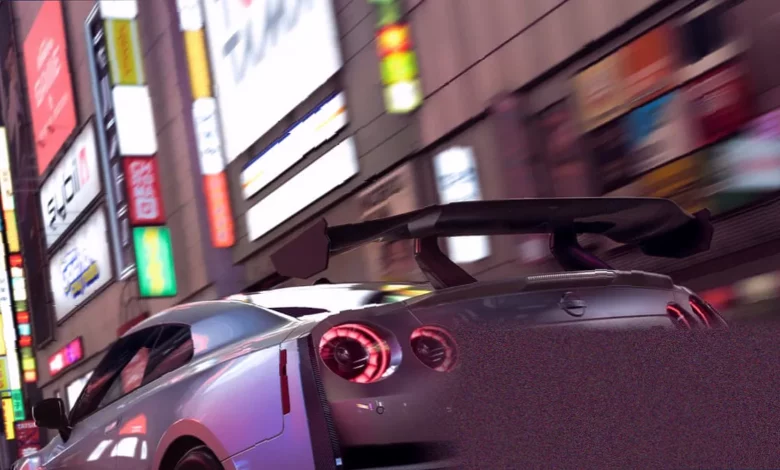
In the south of the map sits a condensed yet sprawling version of Tokyo, the largest and most intricate urban environment in the franchise’s history — five times larger than previous cities. Dedicated development teams were split, with one group focused solely on the city, which takes in the bustle of Shibuya, the densely stacked electrical stores of Akihabara, a commercial and banking district, and quaint suburban outskirts. Ellert recalled following Japanese streamers after a preview version was released: “One called out our representation of Tokyo railway station saying, ‘I worked there and this looks really good.’ Honestly, for us to make a place with all the research, consultancy and support we can get and then for someone who lives there to say, ‘I recognise this place’ — that suggests we went in the right direction.”
Cultural sensitivity has been woven into the fabric of the world. Shrines, temples and cherry blossom trees are indestructible, respecting their cultural significance. Seasonal changes are a core feature, supported by extensive field recordings captured across all four seasons to enhance the audio experience using Triton Acoustics for object-based spatial reverb. The key art for the game was influenced by traditional Japanese ink paintings (Sumi-E), with the team consulting a master artist to capture its spirit. Mount Fuji is a prominent landmark visible across the map, and further real-life routes such as the C1 Loop and Ginkgo Avenue have been faithfully incorporated.
Forza Horizon 6 was released on May 15, 2026 for Premium Edition buyers and May 19, 2026 for Standard and Deluxe Editions, with a PlayStation 5 release scheduled later in 2026. The game has been praised for its visual fidelity, detailed environments and authentic representation of Japanese car culture — a testament to the years of preparation and the determination to finally take on the challenge Japan had long presented.