Samsung holds last-minute talks to prevent major strike amid rising pressure from South Korea

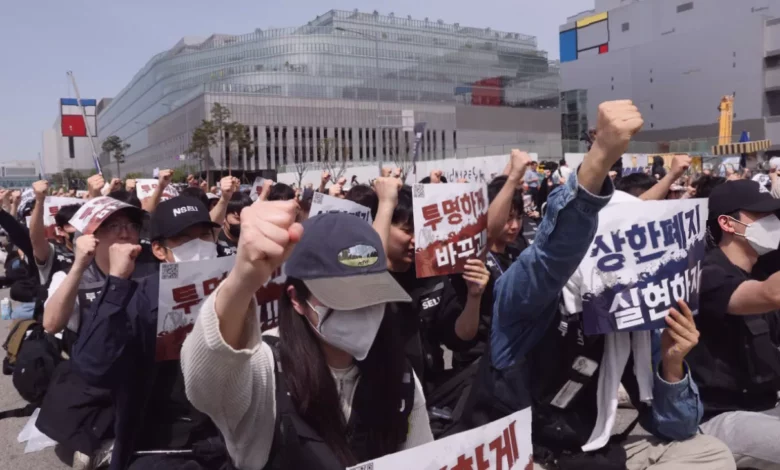
Nearly 48,000 Samsung Electronics workers may walk out for 18 days starting Thursday, as months of negotiations between the company and its largest union remain deadlocked over the formalisation of bonus payments, despite last-minute mediation efforts by South Korea’s labour authorities.
The potential stoppage, the longest and largest in Samsung’s recent history, threatens to inflict severe damage on South Korea’s economy. Samsung alone accounts for nearly a quarter of the nation’s exports, and its revenue is equivalent to approximately 12.5 per cent of South Korea’s GDP. A senior central bank official, speaking on condition of anonymity, warned that in a worst-case scenario the strike could shave 0.5 percentage points off the forecast 2.0 per cent expansion for the South Korean economy this year, potentially lowering annual growth to the 1 per cent range. The official estimated that up to 30 trillion won ($19.9 billion) of chip production could be lost, with an additional “few weeks” of disruption before production lines return to normal.
As the world’s largest memory chip maker, Samsung’s production stoppage would ripple through global supply chains. KB analyst Jeff Kim estimated that an 18-day strike could disrupt global supplies of DRAM memory by 3 to 4 per cent and NAND memory by 2 to 3 per cent, likely fuelling further price increases. The dispute also raises concerns about the impact on AI infrastructure, cloud computing, automotive technologies and advanced manufacturing, at a time when the artificial intelligence boom has already created supply shortages. The American Chamber of Commerce in Korea (Amcham) warned that a strike would disrupt global semiconductor supply chains and undermine Korea’s long-term investment competitiveness, potentially accelerating supply chain diversification by multinational firms.
The damage could extend to thousands of smaller companies that cooperate with Samsung, potentially causing production halts, employment instability and global parts supply issues. Government officials have estimated potential losses at up to 1 trillion won ($667.68 million) per day of strike, a figure that could balloon to 100 trillion won ($66.7 billion) if production disruptions lead to the disposal of semiconductor wafers.
Bonus dispute at the heart of the deadlock
The core disagreement centres not merely on the amount of money workers receive, but on how bonuses are calculated and whether their structure is enshrined in employment contracts. The union has demanded that Samsung abolish its current cap on bonuses, which stands at 50 per cent of annual salaries; allocate 15 per cent of annual operating profit to a bonus pool shared by workers; and formalise these terms in contracts, making them permanent.
Samsung has resisted institutionalising the removal of bonus caps, arguing that the cyclical semiconductor industry requires flexible financial management and the ability to invest heavily in capital expenditure. Management contends that a fixed, uncapped profit-sharing structure could undermine long-term investment capacity. The company’s current bonus system is based on Economic Value Added (EVA), a metric that union members say is less transparent than the models used by rival firms. Samsung has proposed that memory chip workers receive one-off “special” bonuses this year that would top those of SK Hynix employees, while keeping the cap in place. In addition, management has proposed a conditional special bonus of 9 to 10 per cent of operating profit for the Device Solutions division, but only if it clears 200 trillion won in operating profit, and only for three years — not as a permanent contractual change.
The dispute is exacerbated by the comparison with smaller rival SK Hynix, which took the lead in supplying high-bandwidth memory for AI chips to Nvidia. SK Hynix overhauled its pay structure last year, agreeing to allocate a fixed 10 per cent of operating profit to a bonus pool and abolishing bonus caps. Samsung’s union says SK Hynix workers last year received bonuses more than three times higher than those of Samsung workers. The gap has reportedly triggered an exodus of Samsung employees to SK Hynix and a surge in union membership at Samsung. For many investors, the biggest concern is not the strike itself but whether Samsung will agree to permanent increases in labour costs by formalising bonus changes. “The point is how they negotiate the formalising of pay increases,” said Lee Seung-yub, a portfolio manager at Seoul-based hedge fund Quad Investment Management.
Internal divisions have also emerged within the union. Some members have questioned the leadership’s focus on supporting loss-making units within the Device Solutions division at the expense of more profitable ones, as the union discusses its proposed bonus distribution formula.
Government intervention and legal action
With the strike deadline looming, South Korean authorities have stepped in. Park Su-keun, chairman of the National Labor Relations Commission (NLRC), which is facilitating talks, told reporters on Tuesday that while both sides have made concessions, they remain deadlocked on two crucial issues — which he did not elaborate on — but added, “There is some possibility that an agreement could be reached.” Talks were scheduled to conclude at 7pm (1000 GMT) on Tuesday.
Industry Minister Kim Jung-kwan told parliament on Tuesday, “The reality is that all of our citizens are worried about this, considering the ripple effects that a Samsung strike could bring.” Labour Minister Kim Young-hoon has been shuttling between the parties to facilitate talks. President Lee Jae Myung has called on both sides to reach a settlement, emphasising that workers deserve respect, as do corporate management rights.
The government has threatened to invoke emergency labour mediation measures, including emergency arbitration — a rarely used power that would immediately suspend strike action for 30 days while the NLRC mediates. Prime Minister Kim Min-seok stated the government could do so if the dispute escalates and threatens the national economy. Business groups have also urged the union not to proceed with the strike.
Meanwhile, a court on Monday partially granted Samsung’s request for an injunction, ruling that essential staffing levels must be maintained at some production facilities during any industrial action. The court cited the continuous 24-hour operational nature of semiconductor manufacturing, where even temporary shutdowns can cause significant damage and long recovery times. Samsung has notified the union that this ruling requires 7,087 workers to report for work even if the strike proceeds, covering safety protection, equipment management, wafer management and process management. The court barred the union and its leaders from occupying or locking company facilities and from obstructing workers from entering them. Breaches incur daily fines of 100 million won ($74,000) for the union and 10 million won for individual leaders. The union, however, has interpreted the ruling differently, arguing that maintaining a “weekend or holiday workforce” would mean fewer than 7,000 people working in the semiconductor sector, which they claim would not interfere with the right to dispute.
The dispute is the biggest clash between Samsung and its labour union since Samsung Electronics Chairman Jay Y. Lee pledged in 2020 to put the firm’s past union-busting activities behind him. On May 17, 2026, Lee issued a public apology to consumers and the public for the labour dispute — his first public comment on the issue. Samsung’s history of labour relations includes a one-day strike in June 2024, a three-day strike in July 2024 extended indefinitely before ending in August, and a one-day strike in April 2026 that caused an 18 per cent drop in memory fab output and a 58 per cent drop in contract foundry output on the affected night shift. Separately, the union at Samsung Biologics voted to strike in March 2026 over unfair labour practices, with a five-day strike occurring this month.
The outcome of the Samsung negotiations is being watched closely across South Korea’s major industrial conglomerates, where labour unrest has been rising. Unions at Hyundai Motor and Kakao have also made aggressive demands, and the Samsung dispute is seen as a potential watershed moment for labour-management relations across the country. The global AI boom has intensified the stakes, as workers demand a greater share of the profits generated by soaring demand for semiconductors. Shares in Samsung ended 2 per cent lower on Tuesday, paring losses after the news of narrowing differences, but the stock is down 1.3 per cent for the past week.